
EU Announces Legal Entity to Maintain Business With Iran
◢ The European Union said Monday its members would set up a payment system to allow oil companies and businesses to continue trading with Iran in a bid to evade sanctions after the US withdrew from a nuclear agreement. Iran and the European Union announced their defiance towards US President Donald Trump's administration after high-level talks at the United Nations among the remaining members of the accord.
The European Union said Monday its members would set up a payment system to allow oil companies and businesses to continue trading with Iran in a bid to evade sanctions after the US withdrew from a nuclear agreement.
Iran and the European Union announced their defiance towards US President Donald Trump's administration after high-level talks at the United Nations among the remaining members of the accord.
The countries said in a statement that they were determined "to protect the freedom of their economic operators to pursue legitimate business with Iran."
With the United States and the dollar dominating so much of global trade, the statement said the new mechanism would "facilitate payments related to Iran's exports (including oil) and imports, which will assist and reassure economic operators pursuing legitimate business with Iran."
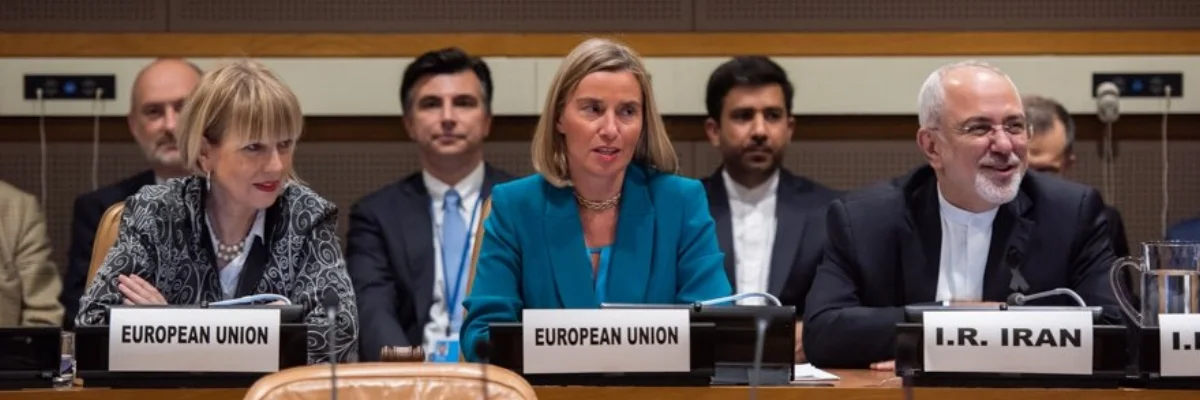
EU foreign policy chief Federica Mogherini, speaking at the United Nations
alongside Iranian Foreign Minister Mohammad Javad Zarif, said the countries
were still working out the technical details.
"In practical terms, this will mean that EU member states will set up a legal entity to facilitate legitimate financial transactions with Iran and this will allow European companies to continue to trade with Iran in accordance with European Union law and could be open to other partners in the world," she told reporters.
She said that the remaining members of the so-called Joint Comprehensive Plan of Action—Britain, China, France, Germany and Russia—would also maintain their commitments to support Iran on civilian nuclear energy.
"The participants recalled that these initiatives are aimed at preserving the JCPOA, which is in the international interest," she said.
Pressure on Iranian Economy
In line with findings of UN inspectors, Mogherini reiterated that Iran has been in compliance with the nuclear agreement—under which Tehran drastically scaled back its nuclear program in exchange for relief from sanctions.
The agreement was sealed in 2015 in a signature achievement for then US
president Barack Obama.
Trump pulled out of the agreement in May, describing it as a "disaster" and quickly moving to reimpose sanctions on Iran.
Despite the protests of the European Union, a number of business including French energy giant Total and carmakers Peugeot and Renault as well as Germany's Siemens and Daimler have already suspended operations in Iran for fear of triggering US sanctions.
With Iran's economy already feeling the pinch, US national security adviser John Bolton earlier Monday vowed to impose "maximum pressure" on Tehran, while insisting that Washington was not pushing for regime change.
US Arab allies Saudi Arabia and the United Arab Emirates as well as Israel have long sought for Washington to work to curtail non-Arab and predominantly Shiite Muslim Iran's influence in the Middle East, including in war-torn Syria.
The EU move comes a day before Trump and Iranian President Hassan Rouhani separately address the UN General Assembly, with the US leader expected to take a hard line on Iran.
Photo Credit: EEAS
Iran Sanctions Shadow Falls on Smaller German Banks
◢ Germany's biggest lenders have shied away from business with Iran after past penalties for breaching US sanctions, but smaller banks have leapt on opportunities afforded by the nuclear deal rejected by Donald Trump. Officials at Germany’s central bank believe that much has so far changed for business with Iran.
Germany's biggest lenders have shied away from business with Iran after past penalties for breaching US sanctions, but smaller banks have leapt on opportunities afforded by the nuclear deal rejected by Donald Trump.
There are just months to go until a November deadline issued by Washington after the US president abandoned a hard-fought agreement that loosened business restrictions on the Islamic Republic in exchange for Tehran giving up its pursuit of nuclear weapons.
But some firms plan to press on in their dealings with Iran despite the looming threat of penalties.
"We will continue to serve our clients," for now, said Patrizia Melfi, a director at the "international competence centre" (KCI) founded by six cooperative savings banks in the small town of Tuttlingen in southwest Germany.
The centre, which supports companies operating in sensitive markets like Iran or Sudan, has seen demand "rising sharply in the last few years, from firms listed on the Dax (Germany's index of blue-chip firms), from all over Germany and from Switzerland," she added.
German exports to Iran have grown since the nuclear deal was signed in 2015, adding 15.5 percent last year to reach almost EUR 2.6 billion (USD 3.0 billion) after 22-percent growth in 2016.
Such figures remain vanishingly small compared with Germany's 111.5 billion euros in exports to the US—its top customer.
Nevertheless, the KCI will "wait and see what the sanctions look like" before turning away from Iran, Melfi said.
Walking on Eggshells
Already, firms dealing with Tehran must take great care not to fall foul of US restrictions.
Transactions are carried out in euros, and the KCI does not deal with businesses that have American citizens or green card resident holders on their boards.
What's more, products sold to Iran cannot contain more than 10 percent of parts manufactured in the US.
One of the most important inputs for the business is "courage among our managers" given the high risks involved, Melfi said.
Germany's two biggest banks, Deutsche Bank and Commerzbank, avoid Iran completely after being slapped with harsh fines in 2015 over their dealings there, with Deutsche alone paying USD 258 million in penalties.
DZ Bank, which operates as a central bank for more than 1,000 local co-op lenders, is withdrawing completely from payment services there, a spokesman told AFP.
That left KCI to seek out the German branch of Iranian state-owned bank Melli in Hamburg.
Even that linkage could break if Iran's biggest business bank appears on a US list of barred businesses as it has before.
Meanwhile, among Germany's roughly 390 Sparkasse savings banks, business with the regime is mostly limited to producing documents linked to export contracts.
"We will be looking even more closely at those" in the future, a person familiar with the trade told AFP.
Elsewhere in the German economy, the European-Iranian Trade Bank (EIH) founded in 1971 is another conduit to Tehran.
Also based in Hamburg, it for now remains "fully available to you with our products and services", the bank assures clients on its website, although "business policy decisions by European banks may result in short term or medium term restrictions on payments".
'Effectively Protected'
Neither does the Bundesbank (German central bank) believe that much has so far changed for business with Iran.
"Only the European Union's sanctions regime will be decisive", if and when it is changed, the institution told AFP.
Any payment involving an Iranian party would have to be approved by the Bundesbank if things return to their pre-January 2016 state.
German banking lobby group Kreditwirtschaft has called on Berlin and other EU nations to clarify their stance—and to make sure banks and their clients are "effectively protected against possible American sanctions."
KCI's Melfi said time is running out for EU governments to act.
"Many firms just want to stop anything with Iran, since they can't calculate the risk of staying," she noted.
On Friday for the first time since the Iran nuclear deal came into force in 2015, China, Russia, France, Britain and Germany gathered in Vienna—at Iran's request—without the United States, to discuss how to save the agreement.
Photo Credit: DZ Bank