
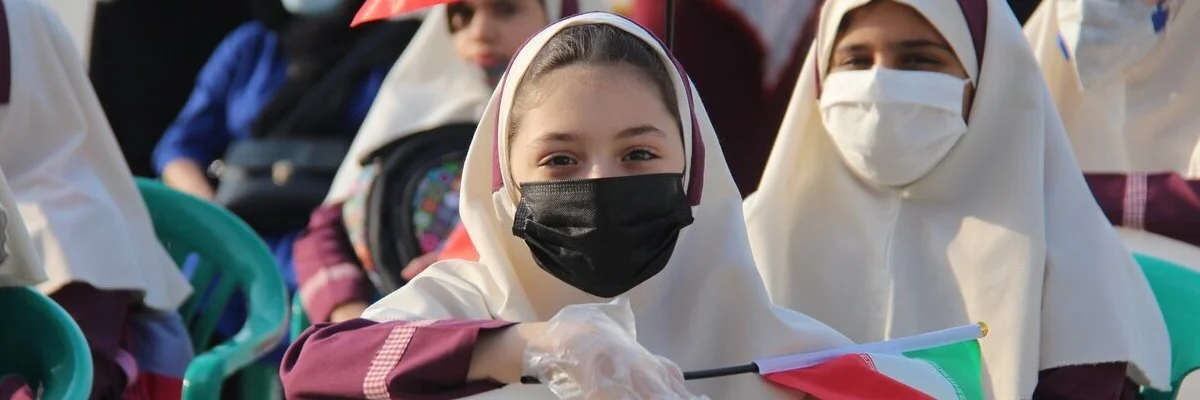
Iran To Alter Schoolbook Cover After Anger Over Girls' Removal
Iran's education ministry said Tuesday the new cover of a schoolbook which removed girls from an illustration would be modified next year, following widespread criticism on social media.
By Amir Havasi
Iran's education ministry said Tuesday the new cover of a schoolbook which removed girls from an illustration would be modified next year, following widespread criticism on social media.
After the ministry distributed textbooks for the new school year on September 5, parents saw the cover of the third-grade mathematics book had changed.
Two girls had been removed, leaving only three boys under a tree made up of numbers and mathematical signs.
A wave of criticism online prompted a rare apology from the education minister.
"A tasteless act was done in removing the image of girls, therefore we apologize for this and will correct it," Mohsen Haji-Mirzayi said Sunday, state news agency IRNA reported.
On Tuesday, the ministry told AFP the books would be changed.
"The textbooks have already been printed and distributed, so the cover will not change until the next year," its public relations office said, without giving further details.
Both public and private schools in Iran are required to use the ministry's textbooks.
The removal of the girls' images sparked uproar among Iranians on social media, with some denouncing the move as a form of gender discrimination.
Some pointed out that Iranian-born Maryam Mirzakhani was the first woman to win the coveted Fields Medal, the equivalent of the Nobel Prize for mathematics.
A professor at Stanford University in California, Mirzakhani died in 2017 in the US at the age of 40, after a battle with cancer.
"The most prestigious mathematics figure of Iran's recent decade was a woman named Maryam Mirzakhani, and then you remove girls from a mathematics textbook cover?" one person wrote on Twitter.
"Hey, Mr. IRI (an acronym for the Islamic republic), print this photo and paste it on the cover," another tweeted, attaching a photo of Mirzakhani along with the hashtag #gender_equality.
Some parents also posted pictures of covers on which their children had painted the girls back.
Illustrator Nasim Bahary, who had designed the original cover seven years ago, called the change "unbelievable".
She said Friday on Instagram that at the time she had been told to change elements such as a girl sitting on a tree branch or a boy positioned in a way "that looks like he wants to hug a girl".
Iran's Vice President for Women and Family Affairs, Masoumeh Ebtekar, said last week on Twitter that "the people's considerations are correct, girls cannot be ignored."
But she also noted that other changed covers—including a science schoolbook featuring only three girls—showed there was no intent to discriminate.
A statement by the ministerial body in charge of textbooks said the change was because the original illustration was "too crowded with too many mathematical concepts."
But the reformist Shargh daily on Saturday slammed the ministry for its overall textbook material and design.
Citing data by the ministry's previous caretaker Javad Hosseini, it said "70 percent of names and designs in schoolbooks are masculine", adding that women are significantly underrepresented in school learning materials.
Photo: IRNA
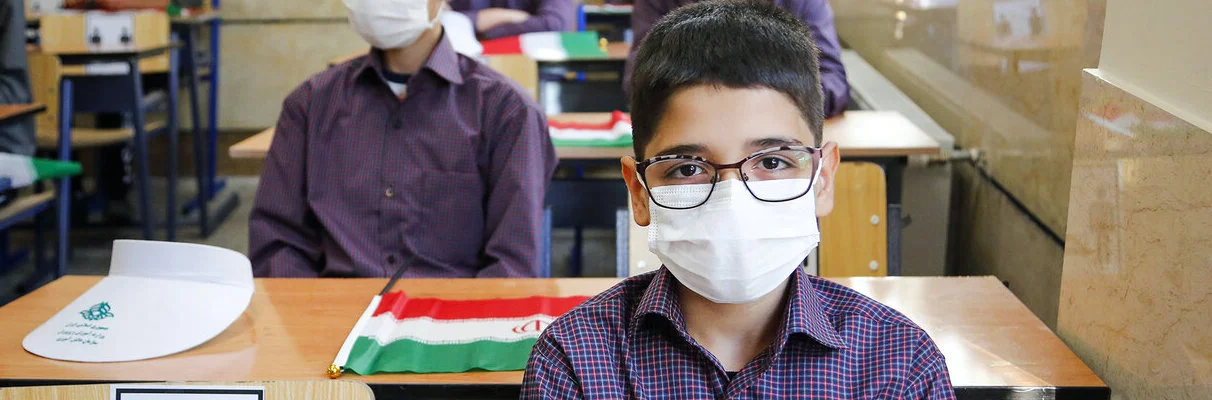
New School Year Begins in Iran Amid Concerns, Criticism
The school year in Iran began on Saturday after a near six-month shutdown due to the novel coronavirus pandemic, with parents voicing concerns despite authorities pledging to enforce health protocols.
By Amir Havasi
The school year in Iran began on Saturday after a near six-month shutdown due to the novel coronavirus pandemic, with parents voicing concerns despite authorities pledging to enforce health protocols.
Some 15 million pupils in the Islamic republic returned to class, mostly remotely, as the country continues to battle its Covid-19 outbreak, the deadliest in the Middle East with over 22,000 killed and more than 384,000 infected since the first cases were confirmed in February.
The first day of classes at Nojavanan high school in northeastern Tehran was attended by a slew of officials and journalists, as well as students.
President Hassan Rouhani appeared in a video to inaugurate the new academic year at the school -- a break with tradition that drew fire from some Iranians online who thought he should have come in person if students were required to be present.
Education Minister Mohsen Haji-Mirzaei looked to assuage parents' concerns in a speech after he rang the bell to launch the new school year.
"I hope that families trust us and rest assured that the ministry will exercise utmost vigilance" regarding health protocols, he said.
Pupils and other attendees wore masks and were required to pass through a disinfection tunnel, have their temperatures checked and sit socially distanced in the schoolyard.
Other anti-virus measures at schools include keeping classes to 35 minutes and requiring students and staff to stay one meter (three feet) apart and wear masks, according to Iran's anti-virus taskforce.
Rouhani Under Fire
During his video address, Rouhani emphasized the need to for students to observe health protocols, calling for the "utmost discipline" in respecting measures.
Rouhani's choice not to attend the opening ceremony in person drew criticism from some.
"Rouhani rang the bell (to start the school year) remotely, then he expects me to send my son in person?" reformist journalist Maziar Khosravi wrote on Twitter.
Conservative film producer Mahmoud Razavi echoed Khosravi in a tweet, saying, "how can they expect people to trust protocols when the president himself does not, and send their loved ones to school?"
Rouhani's government had come under fire before schools reopened, with the head of Iran's medical council, Mohammadreza Zafarghandi, writing an open letter in which he called proposed health protocols counterproductive, as students could spread the virus if they were infected but asymptomatic.
‘Stressful'
This concern was shared by some teachers, parents and students at Nojavanan high school.
"Controlling (Covid-19's spread) is very difficult... as is teaching kids how to follow health protocols and social distancing," school principal, Nasrin Mobini, told AFP.
"We are all concerned -- my colleagues, the parents, everyone."
Literature teacher Amiri, 60, said the return of students to school was "stressful", but that it was important that the first classes be held in person so teachers and students can get to know each other.
One parent, only giving her surname as Azaraksh, said she brought her son for the opening day with "concern", but she preferred in-person education if health protocols were "really" observed.
Many students shared their parents' worries, but were pleased to be back at school.
"We're happy that schools have reopened, but... it's still dangerous for us and others," said 14-year-old Askhan.
Most classes are expected to be held remotely, though some pupils, including those in preschool and elementary school will attend classes in person intermittently.
Ava Golkar, 33, the English department head at Soroush elementary school in northern Tehran, told AFP that only five pupils attended the opening day in person, while the rest watched via video streaming.
Photo: IRNA
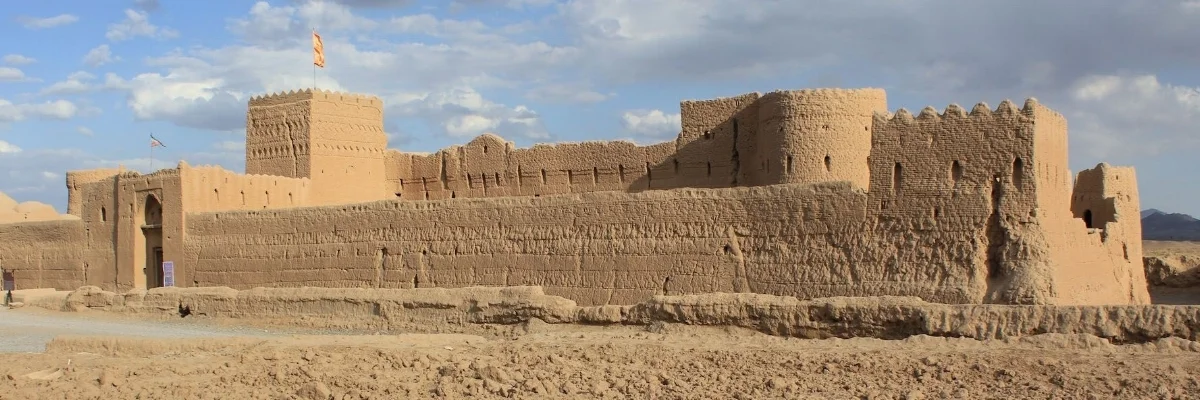
UNESCO Adds 8 Pre-Islamic Iranian Sites to Heritage List
◢ UNESCO on Saturday added eight pre-Islamic Iranian archeological sites to its World Heritage List, the UN agency announced at a meeting in the Bahraini capital. The sites collectively appear on the worldwide list as the "Sassanid Archaeological Landscape of Fars region (Islamic Republic of Iran)."
UNESCO on Saturday added eight pre-Islamic Iranian archeological sites to its World Heritage List, the UN agency announced at a meeting in the Bahraini capital.
The sites collectively appear on the worldwide list as the "Sassanid Archaeological Landscape of Fars region (Islamic Republic of Iran)."
A province in modern-day Iran's south, Fars was the cradle of the Sassanid dynasty, which appeared at the start of the third century.
After the fall of the Parthian empire, the Sassanids ruled territory that, at its peak, stretched from the west of Afghanistan to Egypt, before falling to the Arab conquest under the Umayyad caliphate in the middle of the seventh century.
"These fortified structures, palaces and city plans date back to the earliest and latest times of the Sassanian Empire," UNESCO said.
With the latest addition, Iran now has 24 sites on the heritage list of the United Nations Educational, Scientific and Cultural Organization.
Photo Credit: Wikicommons
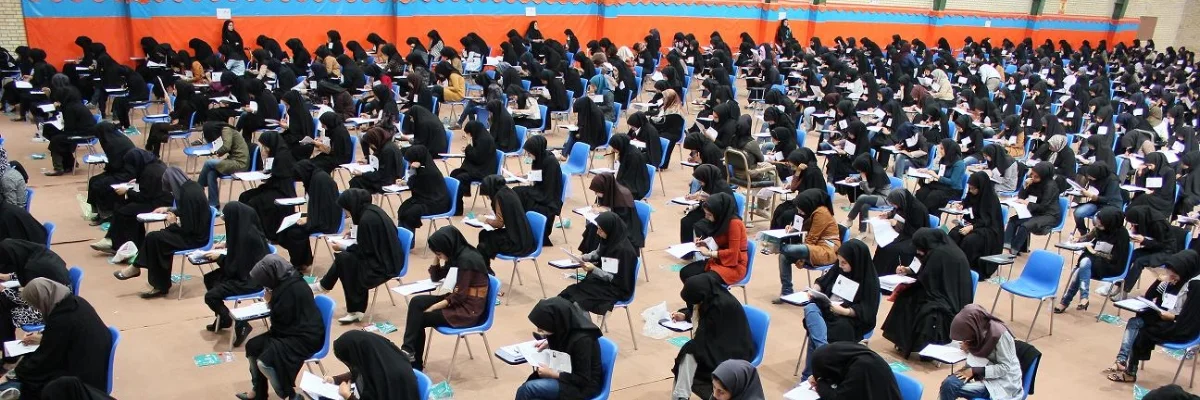
Iran Bans Foreign Social Media Networks in Schools
◢ Iran's ministry of education on Sunday banned the use of foreign social media networks in schools, the ILNA news agency reported, amid a push by Tehran to limit the influence of outside online platforms. Schools must "only use domestic social networks" for their communication, the ministry said in a statement, according to the reformist-linked news agency.
Iran's ministry of education on Sunday banned the use of foreign social media networks in schools, the ILNA news agency reported, amid a push by Tehran to limit the influence of outside online platforms.
Schools must "only use domestic social networks" for their communication, the ministry said in a statement, according to the reformist-linked news agency.
Telegram is the most popular social network in Iran. In 2017, the app claimed it had 40-million monthly users in the Islamic Republic.
Instagram is also very popular, and companies in Iran—like elsewhere—often use both platforms to communicate directly with customers.
Less used, Facebook and Twitter are blocked in Iran, but easily accessible using a virtual private network (VPN).
During a wave of protests that hit dozens of Iranian cities over at the start of the year, Iranian authorities temporarily banned Telegram, accusing the app of allowing foreign-based "counter-revolutionary" groups to fuel unrest.
Since then, authorities have sought to develop Iranian social media networks and limit the reliance on foreign-based platforms, which Tehran accuses of hosting sites deemed hostile to the Islamic Republic.
Several Iranian platforms offering services similar to Telegram have emerged in recent months, like the Soroush network, which already claims to have five million subscribers.
According to the official IRNA news agency, Telecommunication Minister Mohammad-Javad Azari Jahromi recently pledged Iranian networks would offer the same guarantees of confidentiality as foreign platforms.
"No message is read, and no (personal) information is communicated to anyone," he told parliament.
In a statement recently posted to his website, Iran's Supreme Leader Ayatollah Ali Khamenei said the government should guarantee the "security and privacy" of people on the internet.
Khamenei called intrusions into online privacy "haram", or prohibited from a religious standpoint.
Iranian media has appeared to encourage people to join the new networks by assuring viewers they will continue to operate even if Telegram is again banned.
Photo Credit: Mehr