
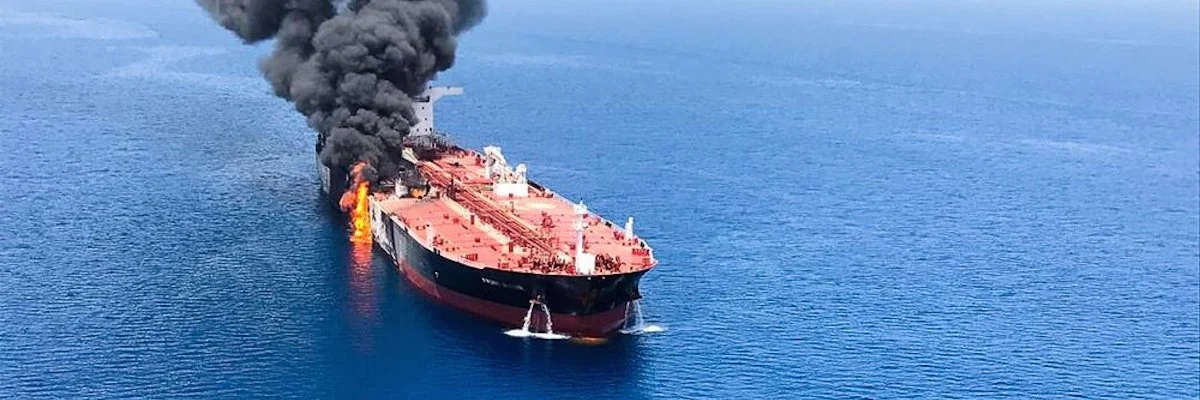
Attacks on Oil Tankers Near Hormuz Fan Fears of Conflict
◢ Two oil tankers were damaged on Thursday in a suspected attack near the entrance to the Persian Gulf, stoking fears that high-stakes diplomatic efforts won’t avert a military confrontation between the U.S. and Iran. Oil prices surged. The incidents, including an attack on a Japanese-operated vessel, were the second in a month to hit ships near the Strait of Hormuz chokepoint, through which about 40% of the world’s seaborne oil travels.
By Verity Ratcliffe, Anthony DiPaola and Bruce Stanley
Two oil tankers were damaged on Thursday in a suspected attack near the entrance to the Persian Gulf, stoking fears that high-stakes diplomatic efforts won’t avert a military confrontation between the U.S. and Iran. Oil prices surged.
The incidents, including an attack on a Japanese-operated vessel, were the second in a month to hit ships near the Strait of Hormuz chokepoint, through which about 40% of the world’s seaborne oil travels. They come as Japanese Prime Minister Shinzo Abe, a rare ally of both Donald Trump and Iranian leaders, visits Tehran in an effort to ease tensions.
“Even in the absence of ironclad evidence, the U.S. and its allies will point the finger at Iran,” said Fawaz A. Gerges, professor of Middle Eastern politics at the London School of Economics. “These incidents are a bad omen because they point to a calculated escalation that tells us both sides are hunkering down.”
The prospects of a conflict have spiked since the Trump administration tightened its sanctions on Iranian oil exports in early May. Trump abandoned a year ago the 2015 deal that was meant to prevent Iran from developing a nuclear bomb and reimposed sanctions in a bid to force the Islamic Republic to rein in its military program and proxy militias.
Facing economic catastrophe, Iran has threatened to retreat from the accord itself unless European parties throw it an lifeline. Its supreme leader, Ali Khamenei, told Abe on Thursday that his country would not repeat the “bitter experience” of talks with the U.S.
High-Stakes Diplomacy
The Bahrain-based Fifth Fleet said it received two separate distress signals at 6:12 a.m. and about 7:00 a.m. local time. “U.S. Navy ships are in the area and are rendering assistance,” Commander Josh Frey, a spokesman, said. He couldn’t confirm reports that one of the vessels was struck by a torpedo. Iran said it has rescued 44 sailors.
The manager of one tanker, the Norwegian-owned Front Altair, said it was sailing in international waters when it was damaged by an explosion, whose cause “is as yet unknown.” The Norway Maritime Authority said there were three detonations on board. The ship had loaded a cargo of naphtha in Abu Dhabi and was bound for Taiwan, a company official said.
A distress call over VHF radio from the Front Altair said the ship was “under attack and on fire," said Donald MacLeod, a navigation officer on a vessel about 45 miles away on the Oman Sea. "They had to abandon ship."
Kokuka Sangyo, the Japanese operator of the other ship, said it was attacked twice, three hours apart, forcing the crew to evacuate. The tanker was carrying 25,000 tons of methanol from Saudi Arabia to Asia.
Brent oil crude soared as much as 4.5% and was trading at $62.07 a barrel at 10:42 a.m. in London. Stocks in Saudi Arabia and Dubai were down more than 1%.
The incidents come a day after Iran-backed rebels in Yemen fired a missile at a Saudi airport, wounding 26 people. The projectile crashed into the arrivals hall, damaging ceilings and windows and causing a fire, though the airport was able to keep functioning with only two flights cancelled. Houthi rebels last month hit oil infrastructure hundreds of kilometers inside Saudi Arabia, forcing it to temporarily close an oil pipeline.
Iran distanced itself from any attack.
“Iran is concerned by the suspicious events around commercial tankers related to Japan,” Foreign Ministry spokesman Abbas Mousavi, was quoted as saying on Fars news agency. “We see this as going against efforts from within the region and beyond to reduce tensions.”
Oil tankers last became a target in the Persian Gulf and Arabian Sea during the so-called "Tanker War" in the 1980s—a sideshow of the Iran-Iraq conflict. Between 1981 and 1988, a total of 451 ships suffered some sort of attack in the region from Iraqi or Iranian forces, according to a report from the U.S. Naval Institute.
Photo: ISNA

Iran Vows Revenge on 'Mercenaries' Behind Suicide Attack
◢ President Hassan Rouhani vowed revenge Thursday against the "mercenary group" behind a suicide bombing which killed 27 people in southeastern Iran and accused the US and Israel of supporting "terrorism.” Rouhani was speaking at Tehran's Mehrabad Airport before leaving for the Russian resort of Sochi for a summit with his Russian and Turkish counterparts Vladimir Putin and Recep Tayyip Erdogan on the future of war-battered Syria.
President Hassan Rouhani vowed revenge Thursday against the "mercenary group" behind a suicide bombing which killed 27 people in southeastern Iran and accused the US and Israel of supporting "terrorism.”
"We will certainly make this mercenary group pay for the blood of our martyrs," the official IRNA news agency quoted the Iranian president as saying in response to Wednesday's attack.
"The main root of terrorism in the region is America and Zionists, and some oil-producing countries in the region also financially support the terrorists," he added.
Rouhani was speaking at Tehran's Mehrabad Airport before leaving for the Russian resort of Sochi for a summit with his Russian and Turkish counterparts Vladimir Putin and Recep Tayyip Erdogan on the future of war-battered Syria.
Wednesday's attack, which targeted a busload of Revolutionary Guards in the volatile southeastern province of Sistan-Baluchistan, was one of the deadliest on Iranian security forces in years.
The bomber struck as the troops were returning from a patrol mission on the border with Pakistan, where Baluchi separatist and jihadist groups have rear bases, the Guards said.
Sistan-Baluchistan is home to a large ethnic Baluchi community, who straddle the border and who, unlike most Iranians, who are Shiite Muslims, are mainly Sunni.
Warning to Neighbors
Rouhani called on Iran's neighbors to assume their "legal responsibilities" and not allow "terrorists" to use their soil to prepare attacks.
"If this continues and they cannot stop the terrorists, it is clear—based on international law—that we have certain rights and will act upon them in due time," he said, without elaborating.
The attack came on the same day as the United States gathered some 60 countries in Poland for a conference on the Middle East and Iran which they hoped would increase pressure on Tehran.
Iran quickly linked the attack to the Warsaw conference, where supporters of the formerly armed opposition People's Mujahedeen plan a second day of protests on Thursday.
Dubbing the meeting the "WarsawCircus", Foreign Minister Mohammad Javad Zarif said it was "no coincidence that Iran is hit by terror on the very day" that the talks began in the Polish capital.
"Especially when cohorts of same terrorists cheer it from Warsaw streets & support it with twitter bots? US seems to always make the same wrong choices, but expect different results," Zarif wrote on Twitter.
Wednesday's bombing was claimed by the jihadist Jaish al-Adl (Army of Justice), which is blacklisted as a terrorist group by Iran, the SITE Intelligence Group reported.
The group was formed in 2012 as a successor to Sunni extremist group Jundallah (Soldiers of God), which waged a deadly insurgency against Iranian targets over the previous decade.
Sistan-Baluchistan has been hit by previous deadly attacks in recent months.
On January 29, three members of an Iranian bomb squad sent to the scene of an explosion in provincial capital Zahedan were wounded when a second device blew up as they were trying to defuse it.
And in early December, two people were killed and around 40 wounded in an attack in the strategic port city of Chabahar, on the province's Arabian Sea coast, which Zarif blamed on "foreign-backed terrorists".
In October, Jaish al-Adl claimed responsibility for abducting 12 Iranian security personnel near the border, five of whom were later released and flown home after Pakistani intervention.
Zarif visited Islamabad twice in a month for briefings on the progress of the efforts to secure the captured unit's release.
Photo Credit: IRNA
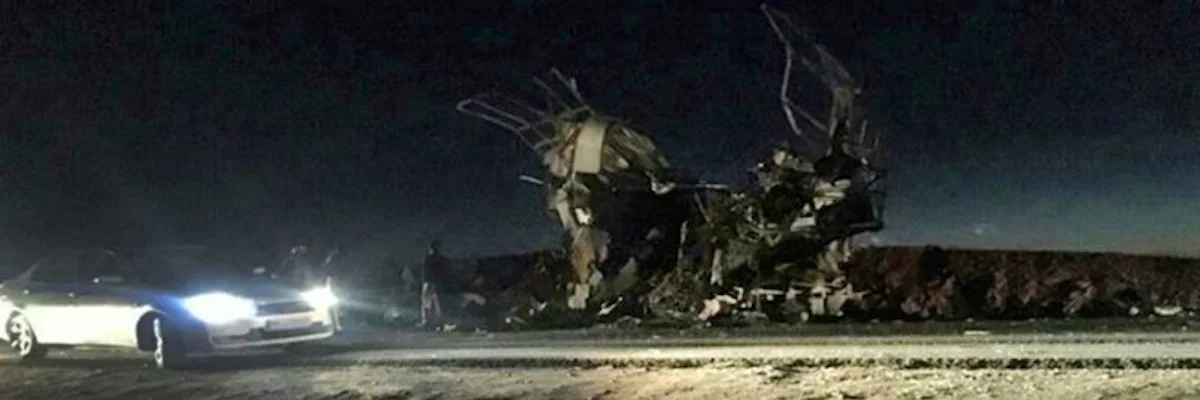
Suicide Attack on Bus Kills 27 Iran Revolutionary Guards
◢ A suicide car bombing on a Revolutionary Guards bus in southeastern Iran killed 27 troops on Wednesday, in one of the deadliest attacks on the elite forces in years. The assault came as the troops were returning from a border patrol mission, the Guards said in a statement.
A suicide car bombing on a Revolutionary Guards bus in southeastern Iran killed 27 troops on Wednesday, in one of the deadliest attacks on the elite forces in years.
The assault came as the troops were returning from a border patrol mission, the Guards said in a statement.
"In this terrorist attack 27 of Islam's brave warriors were killed and 13 were wounded," the statement read, accusing "world domination and Zionist intelligence agencies" of supporting the attackers.
Earlier the official IRNA news agency said "the suicide attack on an Islamic Revolutionary Guards Corps personnel bus happened on the Khash-Zahedan road."
A picture released by the semi-official Fars news agency showed a hulk of twisted metal lying by the side of a road, unrecognizable as a bus.
The attack happened when "a car filled with explosives blew up besides a bus," the Guards said.
"Mercenaries of intelligence agencies of world arrogance and domination," carried out the attack to counteract "the victory of the 40th anniversary of the Islamic revolution," they added.
Iran has been celebrating the 40th anniversary of the return to Tehran of Ayatollah Ruhollah Khomeini in 1979 after more than 14 years in exile and the overthrow of the pro-Western shah. His arrival triggered the start of the Islamic Revolution and led to the creation of the Islamic Republic.
Wednesday's attack took place in the volatile southeastern province of Sistan-Baluchistan which has a large, mainly Sunni Muslim ethnic Baluchi community straddling the border with Pakistan.
The SITE Intelligence Group reported that the attack was claimed by Jaish al-Adl, a jihadist group formed in 2012 as a successor to the Sunni extremist group Jundallah (Soldiers of God), which waged a deadly insurgency against Iranian targets over the past decade
The Jaish al-Adl—blacklisted as a "terrorist group" in Iran—"announced its responsibility in a brief Persian message on February 13, 2019," SITE reported.
The attack came on the same day as the United States gathered some 60 countries in Poland for a conference on the Middle East and Iran which they hoped would increase pressure on Tehran.
'US Obsession
Dubbing the meeting in Poland the "WarsawCircus", Iranian Foreign Minister Mohammad Javad Zarif said it was "no coincidence that Iran is hit by terror on the very day" that the talks began in the Polish capital.
"Especially when cohorts of same terrorists cheer it from Warsaw streets & support it with twitter bots? US seems to always make the same wrong choices, but expect different results," Zarif wrote on Twitter
He earlier blasted the two-day conference as "dead on arrival.”
"It is another attempt by the United States to pursue an obsession with Iran that is not well-founded," Zarif told a Tehran news conference.
Sistan-Baluchistan has been the scene of other attacks.
On January 29 three members of an Iranian bomb squad sent to the scene of an explosion in its capital Zahedan were wounded when a second device blew up as they were trying to defuse it, police said at the time
And in early December last year two people were killed and around 40 others wounded in the port city of Chabahar, also in Sistan-Baluchistan, in an attack which Zarif at the time blamed on "foreign-backed terrorists"—a reference to Sunni Muslim extremists.
Another of the bloodiest attacks in recent times to have hit Iran happened in September when assailants killed 24 people at a military parade in the southwestern city of Ahvaz.
In October, Jaish al-Adl claimed responsibility for abducting 12 Iranian security personnel near the border with Pakistan
And in July at least 10 members of the Revolutionary Guards were killed when insurgents attacked one of their bases along the border with Iraq.
Photo Credit: Fars News Agency
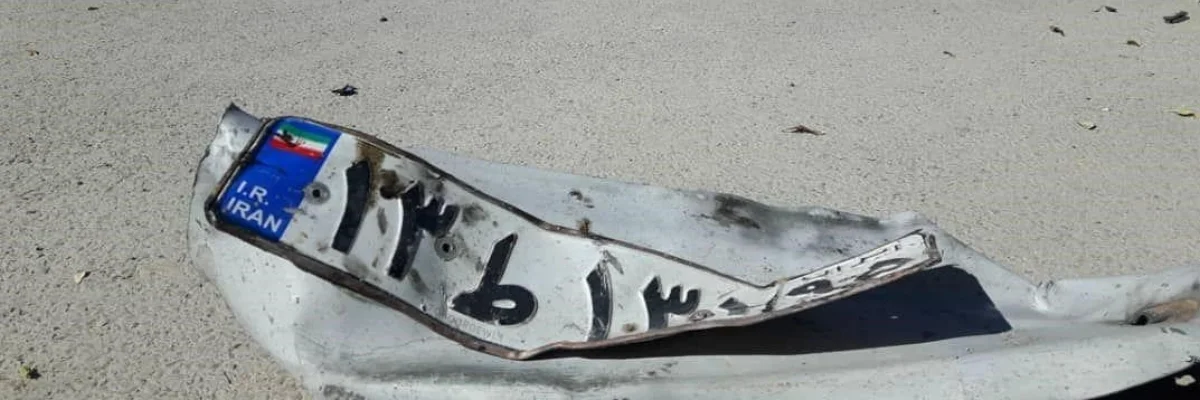
Suicide Bomber Kills Two in Southeast Iran
◢ A suicide bomber killed at least two people and wounded many more outside police headquarters in the port city of Chabahar in restive southeastern Iran on Thursday, according to a revised official toll. Chabahar lies in Sistan-Baluchistan province which has long been a flashpoint, with Pakistan-based Baluchi separatists and Sunni Muslim extremists carrying out cross-border attacks targeting the Shiite authorities.
A suicide bomber killed at least two people and wounded many more outside police headquarters in the port city of Chabahar in restive southeastern Iran on Thursday, according to a revised official toll.
Chabahar lies in Sistan-Baluchistan province which has long been a flashpoint, with Pakistan-based Baluchi separatists and Sunni Muslim extremists carrying out cross-border attacks targeting the Shiite authorities.
"This terrorist act led to the martyrdom of two members of the police force," the province's deputy governor in charge of security, Mohammad Hadi Marashi, told state television.
Chabahar city governor Rahmdel Bameri said earlier that four people were
killed and many more wounded when the bomber blew up a car, but later revised
the death toll to two.
"The explosion was very strong and broke the glass of many buildings close by," Bameri told state television.
Many nearby shop owners and civilian passers-by, including women and children, were severely wounded, he added.
Chabahar lies some 100 kilometres (60 miles) west of the Pakistan border and is home to a large, mainly Sunni Muslim ethnic Baluchi community which straddles the two countries.
The number of assailants was not immediately clear.
"The terrorists tried to enter Chabahar police headquarters but they were prevented by the guards and they detonated the car bomb," Marashi said without elaborating on how many assailants took part.
Chabahar has a deep-water port on the Gulf of Oman and with Indian assistance Iran has been developing it as a major energy and freight hub between Central Asia and India, bypassing Pakistan.
Photo Credit: Tasnim

Iran Denies French Accusations Over Alleged Bomb Plot
◢ French security services believe the Iranian intelligence ministry was behind a foiled bomb plot that aimed to target an opposition group in Paris in June, a diplomatic source told AFP. "The head of operations at the intelligence ministry ordered it," the source said on condition of anonymity, referring to an alleged plot to bomb a meeting of the People's Mujahedeen of Iran (MEK) in a Paris suburb.
Iran on Tuesday denied French accusations that one of its diplomats was involved in an alleged bomb plot targeting an exiled opposition group near Paris in June.
"We deny the accusations and forcefully condemn the Iranian diplomat's arrest and call for his immediate release," the foreign affairs ministry said in a statement.
It described the allegations as a conspiracy to "sabotage Iran's ancient and long-standing relations with France and other significant European countries."
The statement was released minutes before a French diplomatic source told AFP that security services believed the Iranian intelligence ministry was behind the foiled plot.
In retaliation, France announced it had frozen assets belonging to two suspected Iranian intelligence operatives as well as Iran's ministry of security and intelligence.
"This extremely serious act envisaged on our territory could not go without a response," France's interior, foreign and economy ministers said in a rare joint statement.
The opposition meeting allegedly targeted was also attended by leading US figures, including close allies of President Donald Trump.
Six people were arrested afterwards in coordinated raids by European police forces, including an Iranian diplomat identified as Assadollah Asadi, who is set to be extradited from Germany to Belgium for prosecution.
Asadi was targeted by France for the six-month asset freeze along with another man named as Saeid Hashemi Moghadam.
Iran has accused the opposition group, the People's Mujahedeen of Iran (MEK), which Tehran considers a "terrorist" group, of orchestrating the plot to discredit President Hassan Rouhani as he embarked on a tour of Europe.
Photo Credit: Wikicommons
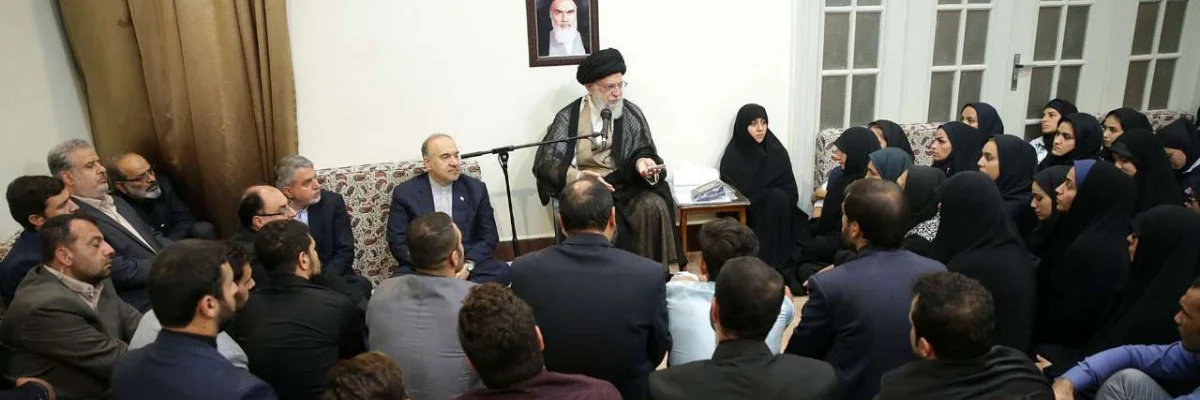
Iran Supreme Leader Says Saudi, UAE 'Funded' Ahvaz Attackers
◢ Iran's supreme leader on Monday said the attackers who killed 24 people at a weekend military parade in the southwestern city of Ahvaz were funded by Saudi Arabia and the United Arab Emirates. "Based on reports, this cowardly act was the work of those very individuals who are rescued by the Americans whenever they are in trouble and who are funded by the Saudis and the (United) Arab Emirates," Ayatollah Ali Khamenei said, in remarks posted on his official website.
Iran's supreme leader on Monday said the attackers who killed 24 people at a weekend military parade in the southwestern city of Ahvaz were funded by Saudi Arabia and the United Arab Emirates.
"Based on reports, this cowardly act was the work of those very individuals who are rescued by the Americans whenever they are in trouble and who are funded by the Saudis and the (United) Arab Emirates," Ayatollah Ali Khamenei said, in remarks posted on his official website.
He did not give any further details on the identity of those behind what he called a "terrorist attack.”
In the immediate aftermath of the attack on Saturday, Iranian authorities said they suspected Arab separatist groups were behind the attack, none of whom is known to have a presence in Syria.
Khamenei, who was speaking to a group of Iranian athletes, said the attack "once again shows the Iranian nation faces many enemies on its proud path of progress and development".
"We will most certainly rigorously punish the perpetrators of this attack," he added.
Photo Credit: IRNA
Thousands Attend Funeral for Iran Attack Dead
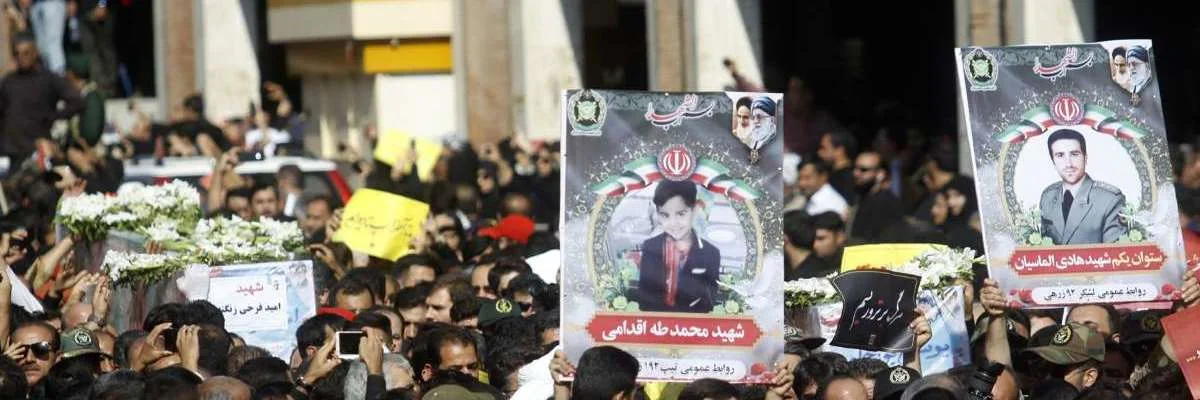
◢ Tens of thousands of mourners attended a funeral on Monday in the southwestern Iranian city of Ahvaz for soldiers and civilians killed in an attack on a military parade. Four militants attacked the Saturday parade marking the start of the 1980-1988 Iran-Iraq war, spraying the crowd with gunfire and killing 24 people.
Tens of thousands of mourners attended a funeral on Monday in the southwestern Iranian city of Ahvaz for soldiers and civilians killed in an attack on a military parade.
Four militants attacked the Saturday parade marking the start of the 1980-1988 Iran-Iraq war, spraying the crowd with gunfire and killing 24 people.
Iranian officials blamed Arab separatists, backed by Gulf Arab allies of the US, for the operation.
AFP reporters on Monday saw members of the public and the military carrying coffins draped in the Iranian flag, some bearing pictures of the deceased.
The mourners, mostly wearing black, carried pictures of the dead along with banners reading "we will stand to the end" and "no to terrorism.”
Under blazing sun, crowds streamed in from all four main streets leading into the city-centre square where the funeral was held, three of them dedicated to men and the fourth to women.
In the square itself, also segregated, a woman dressed in the traditional Arab-style chador wailed loudly and held a picture of her son, Reza Shoaibi, a conscript who was among the dead.
As the funeral progressed, her wailing and expressions of sorrow steadily grew louder until she fainted.
The heat became so intolerable that trucks sprayed water onto the crowd as temperatures hit 40 degrees Celsius (105 fahrenheit).
Mourners waved red, green and black flags with revolutionary messages, as well as the flags of Arab tribes from the surrounding Khuzestan region.
Iranian authorities have blamed Arab separatists and accused the United States, Israel and Gulf Arab monarchies of backing Saturday's "terrorist" attack.
The Islamic State group also claimed responsibility.
Khuzestan, which has a large ethnic Sunni Arab community, was a major battleground of the 1980s war with Iraq and it saw unrest in 2005 and 2011.
Kurdish rebels frequently attack military patrols on the border further north, but attacks on government targets in major cities are rare.
'Devastating' Revenge
Monday's ceremony began in front of the square's Sarallah Mosque with speeches by generals and security officials.
Intelligence Minister Mahmoud Alavi said that arrests had already been made.
"The terrorists themselves have perished, our agents will identify their remnants and supporters to the last man. A major part of them have already been arrested," he told the crowd.
Brigadier General Hossein Salami, the deputy head of the Islamic Revolutionary Guards Corps, vowed to exact vengeance.
“We promise that our reaction will be devastating, we warn everyone that we will take revenge," he told mourners.
After the speeches ended, a famous wartime religious chanter sang songs of lamentation as thousands of mourners beat their chests in unison, a traditional mourning practice of Shiite Muslims.
Later, the coffins were transported to the city cemetery and laid to rest.
The dead ranged from a preschool boy to a wheelchair-bound war veteran.
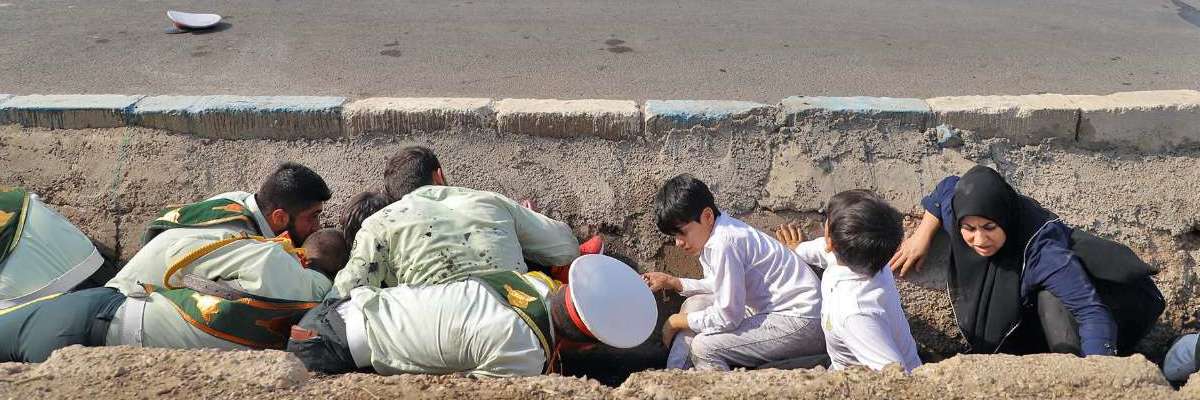
Pictures of women and children scrambling to find cover evoked an emotional response from Iranians.
Abdolzahra Savari, an ethnic Arab who had attended the funeral, called the attackers infidels.
"These are ruthless people with no shred of humanity in them," he said.
Sabah Abiad, a middle-aged bank employee who attended the funeral, said the unity among the region's different groups was self-evident.
"As you can see now, all of the people, whether they're Lor, Arab, Shushtari or Dezfuli, are all here today and all say death to the terrorists," he told AFP.
Iran holds regular military parades to mark national anniversaries and show off its latest military hardware, notably missiles.
This year's parades had special significance as tensions with the United States have peaked since the US withdrew from the 2015 nuclear deal in May and began to re-impose unilateral economic sanctions on Tehran.
Iran's presence in Syria has also triggered rising tensions with Israel.
Photo Credit: IRNA
Iran Vows 'Crushing Response' After Gunmen Kill 29 at Army Parade
◢ Iranian President Hassan Rouhani vowed a "crushing" response after assailants sprayed a crowd with gunfire, shooting dead at least 29 people including women and children Saturday at a military parade near the Iraqi border. The Islamic State (IS) group claimed responsibility for the rare assault in the southwestern city of Ahvaz, while Iranian officials blamed "a foreign regime" backed by the United States.
Iranian President Hassan Rouhani vowed a "crushing" response after assailants sprayed a crowd with gunfire, shooting dead at least 29 people including women and children Saturday at a military parade near the Iraqi border.
The Islamic State (IS) group claimed responsibility for the rare assault in the southwestern city of Ahvaz, while Iranian officials blamed "a foreign regime" backed by the United States.
A local journalist who witnessed the attack said shots rang out for 10 to 15 minutes and that at least one of the assailants, armed with a Kalashnikov assault rifle, wore the uniform of Iran's Revolutionary Guards.
"We realised it was a terrorist attack as bodyguards (of officials) started shooting," Behrad Ghasemi told AFP. "Everything went haywire and soldiers started running."
"The terrorists had no particular target and didn't really seem to care as they shot anyone they could with rapid gunfire."
Ahvaz lies in Khuzestan, a province bordering Iraq that has a large ethnic Arab community and has seen separatist violence in the past that Iran has blamed on its regional rivals.
Iran summoned diplomats from Denmark, the Netherlands and Britain over their "hosting of some members of the terrorist group" which carried out the attack, state media said Sunday.
"It is not acceptable that the European Union does not blacklist members of these terrorist groups as long as they do not perpetrate a crime on... European soil," official news agency IRNA quoted foreign ministry spokesman Bahram Qasemi as saying.
After addressing a similar parade in Tehran to commemorate the start of the 1980-1988 war with Iraq, Rouhani warned that "the response of the Islamic Republic of Iran to the smallest threat will be crushing.”
Foreign Minister Mohammad Javad Zarif said the attack was carried out by "terrorists recruited, trained, armed & paid by a foreign regime".
"Iran holds regional terror sponsors and their US masters accountable for such attacks," he wrote on Twitter.
'Bloody Crime'
IS claimed the attack via its propaganda mouthpiece Amaq and, according to intelligence monitor SITE, said the attack was in response to Iranian involvement in conflicts across the region.
State television gave a toll of 29 dead and 57 wounded, while IRNA said those killed included women and children who were spectators at the parade.
Three attackers were killed at the scene and the fourth died later of his injuries, said armed forces spokesman Brigadier General Abolfazl Shekarchi.
The Revolutionary Guards accused Shiite-dominated Iran's Sunni arch-rival Saudi Arabia of funding the attackers, while Iran's supreme leader Ayatollah Ali Khamenei also blamed Iran's pro-US rivals.
Tehran-backed Lebanese Shiite movement Hezbollah condemned the "terrorist" attack, saying that "repulsive Satanic hands" were behind it.
"This operation was a continuation of the other forms of war the United States and its allies are waging, directly or indirectly," it said.
In a message to Russia's close regional ally, President Vladimir Putin said he was "appalled by this bloody crime", while Syria, another ally, neighboring Turkey and France also expressed condolences.
Khuzestan was a major battleground of the 1980s war with Iraq and the province saw unrest in 2005 and 2011, but has since been largely quiet.
Kurdish rebels frequently attack military patrols on the border further north, but attacks on regime targets in major cities are rare.
On June 7, 2017 in Tehran, 17 people were killed and dozens wounded in simultaneous attacks on the parliament and on the tomb of revolutionary leader Ayatollah Ruhollah Khomeini—the first inside Iran claimed by IS.
In April, 26 alleged members of the Sunni extremist group went on trial in connection with the attacks.
Rouhani Defiant
The attack in Ahvaz came as Rouhani and other dignitaries attended the main anniversary parade in Tehran.
In a keynote speech, he vowed to boost Iran's ballistic missile capabilities, despite Western concerns that were cited by his US counterpart Donald Trump in May when he abandoned a landmark nuclear deal with Tehran.
"We will never decrease our defensive capabilities... we will increase them day by day," Rouhani said.
"The fact that the missiles anger (the West) shows they are our most effective weapons."
The United States reimposed crippling sanctions on Iran last month, and another round of even harsher sanctions targeting Iran's vital oil sector is set to go back into effect on November 5.
Washington has said it is ready to open talks on a new agreement to replace the July 2015 accord, but Tehran has repeatedly said it cannot negotiate under pressure from sanctions.
Rouhani leaves Sunday for New York to attend next week's United Nations General Assembly along with Trump, but Iran has repeatedly ruled out any meeting.
Photo Credit: IRNA