
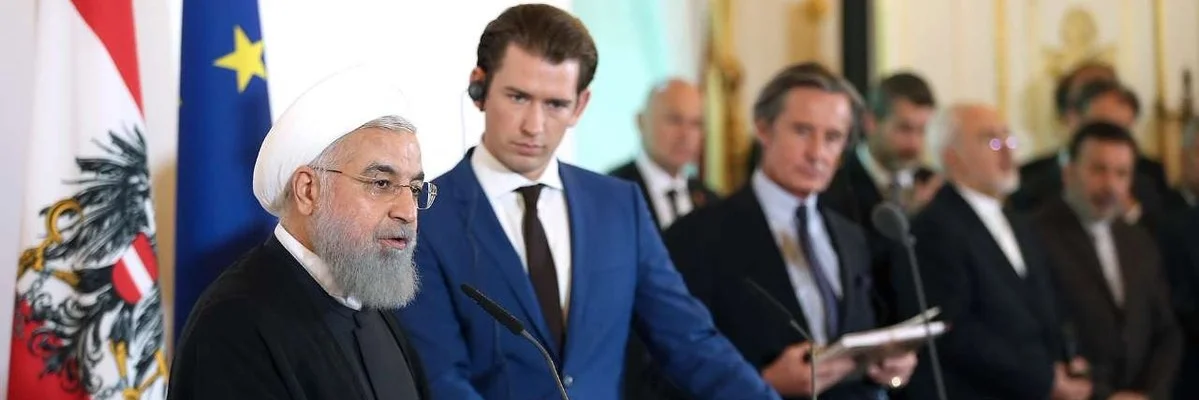
Iran's Rouhani in Vienna to Shore Up Nuclear Deal, Dogged By Diplomat's Arrest
◢ Iranian President Hassan Rouhani on Wednesday was on the second leg of his European tour seeking assurances over the 2015 nuclear deal, a trip clouded by the arrest of a Tehran diplomat over an alleged bomb plot against opposition exiles in Paris. Hoping to boost economic cooperation to help offset the return of US sanctions following Washington's pullout from the historic deal, Rouhani arrived late Tuesday in Vienna—the city where it was signed.
Iranian President Hassan Rouhani on Wednesday was on the second leg of his European tour seeking assurances over the 2015 nuclear deal, a trip clouded by the arrest of a Tehran diplomat over an alleged bomb plot against opposition exiles in Paris.
Hoping to boost economic cooperation to help offset the return of US sanctions following Washington's pullout from the historic deal, Rouhani arrived late Tuesday in Vienna—the city where it was signed.
"Insofar as it is possible for Iran, we shall remain party to the accord, we shall not quit the JCPOA (the Joint Comprehensive Plan of Action) on condition that we can also benefit from it," Rouhani said.
"If the other signatories, apart from the United States, can guarantee Iran's interests then Iran will stay in the JCPOA", he insisted.
US President Donald Trump unilaterally pulled out of the agreement nearly two months ago, to the ire of the other signatories—China, France, Germany, Britain and Russia—which along with the European Union have continued to back the accord.
"We need a balance between our duties and the hypothesis of restrictions.... We hope for decisive actions regarding trade and the economy," added Rouhani in comments sending a message to the other deal signatories, whose foreign ministers are due to meet in Vienna on Friday for the first time since Trump's decision to dump the deal.
Austria just took up the European Union's six-month rotating presidency, while Vienna is the home of the UN nuclear watchdog, the IAEA, which monitors Iran's compliance with the accord.
Rouhani's European trip will be of "prime importance" as it could "provide a more precise picture of cooperation between Iran and Europe," the Iranian foreign ministry spokesman said at the weekend.
The Iranian government has itself warned that it will not continue to abide by the nuclear agreement if doing so goes against its economic interests.
Rouhani, a moderate conservative re-elected in 2017, began meeting President Alexander Van der Bellen on Wednesday, and met Chancellor Sebastian Kurz later in the day.
'False Flag Ploy'
The nuclear deal has been the cornerstone of Rouhani's policy of greater openness with the West, and the US departure has seen him severely criticized by ultra-conservatives at home.
Iran's supreme leader, Ali Khamenei, has demanded Europe provide a number of economic guarantees in order for Tehran to continue its commitment.
Increasing the pressure on Iran's European partners, he ordered preparations be made to quickly restart nuclear activities in case talks collapse.
Rouhani's visit follows reports of the Iranian diplomat's arrest along with five others over a purported foiled attack on a rally of thousands of Iranian opposition supporters in Paris.
Rouhani has not changed his programme over what his foreign minister dismissed as a "false flag ploy" designed as a distraction.
"How convenient: Just as we embark on a presidential visit to Europe, an alleged Iranian operation and its 'plotters' arrested," Mohammad Javad Zarif tweeted.
Just hours before welcoming Rouhani to Austria, Vienna summoned Iran's ambassador and announced that the unnamed diplomat's status would be withdrawn.
The diplomat attached to the Iranian embassy in Austria, who was detained in Germany, was believed to be a contact of a couple at the centre of the alleged plot.
He may soon be extradited to Belgium, which is spearheading a probe into the alleged bomb plot, prosecutors told the German news agency DPA.
"We are waiting for full clarification" on the case, Kurz said at a press conference alongside Rouhani.
Zarif, who is accompanying Rouhani, will on Friday meet top envoys from the five powers for the first time since Washington's withdrawal.
Kurz had said he would speak plainly with Rouhani about Iran's role in the Middle East, as Tehran continues to deny accusations it is destabilizing the region.
The Austrian Chancellor said he considered it "absolutely unacceptable" to question the right of Israel to exist or call for the state's destruction.'
Photo Credit: IRNA
OPEC Braces for Tough Vienna Talks on Hiking Oil Output
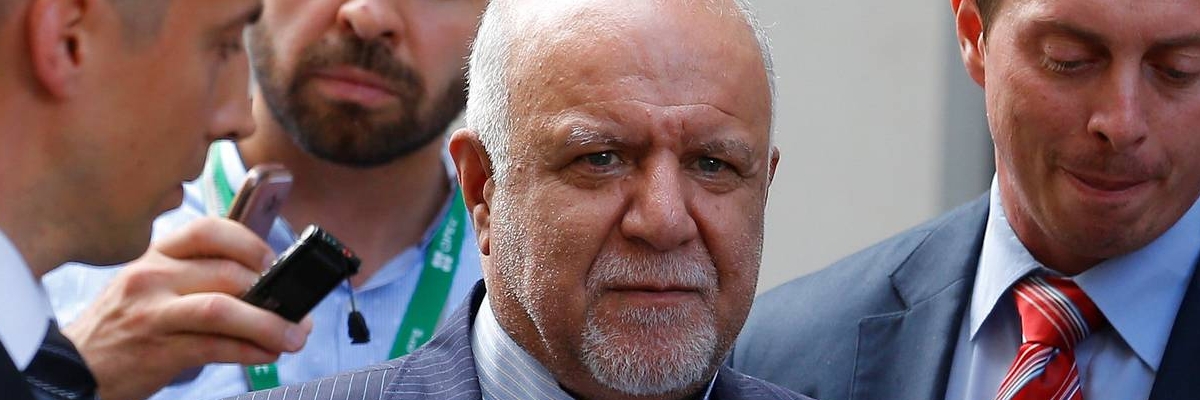
◢ Iran's oil minister on Tuesday said his country would resist unwinding a landmark OPEC agreement to cap oil production, and blamed US President Donald Trump for pushing up crude prices. "I don't believe in this meeting we can reach agreement," Bijan Namdar Zanganeh told reporters in Vienna ahead of the crucial talks.
OPEC ministers arrived in Vienna Tuesday for crunch talks on whether to reverse a landmark pact curbing oil output, with Iran pushing back against Saudi and Russian calls to ramp up production again.
The upcoming June 22-23 meetings of OPEC and non-OPEC energy ministers are set to be the most contentious in a while, with several countries bristling at the thought of reversing a deal that has been in place for 18 months and helped lift oil prices to multi-year highs.
Resistance is being led by Iran, deeply wary of any move by regional rival Saudi Arabia that could push down oil prices at a time when Tehran faces renewed sanctions following US President Donald Trump's decision to quit its international nuclear deal, which is likely to impact the country's oil exports.
However Riyadh, which cheered Washington's exit from the nuclear deal, is under pressure from its US ally to boost output as Trump hopes to keep pump prices low ahead of November's mid-term elections.
"You're dealing with a very political situation," analyst Amrita Sen of Energy Aspects told AFP.
Upon arriving at his Vienna hotel, Iran's oil minister said his country wouldn't back down, and lashed out at Trump for trying to politicize OPEC.
"I don't believe in this meeting we can reach agreement," Bijan Namdar Zanganeh told reporters.
He said Trump was partly to blame for the higher oil prices, saying the US leader had "created difficulty for the oil market" by imposing sanctions on Venezuela and Iran.
"And now he expects OPEC to change something for better prices," Zanganeh said. "This is not fair... OPEC is not part of the Department of Energy of the United States."
Geopolitical Tensions
The 14-nation OPEC cartel and its 10 non-member partner nations, including Russia, together account for more than 50 percent of the world's oil supply, giving them huge sway over the global market.
The so-called OPEC+ group agreed a milestone deal to trim production from January 2017 by 1.8 million barrels a day to clear a global oil glut and shore up low prices.
The strategy paid off, with prices jumping from below $30 a barrel in early 2016 to more than $70 in the second quarter of 2018. The pact was meant to run until the end of this year.
But a collapse in oil production in crisis-hit Venezuela and the prospect of fresh Iranian sanctions have raised fears of a supply crunch that could send prices spiking.
As recently as April however, Saudi Energy Minister Khaled al-Faleh had voiced support for the oil cut deal, saying the market had the capacity to absorb higher prices. But Trump made it clear he disagrees.
"Oil prices are too high, OPEC is at it again. Not good!" he tweeted last week. Observers believe Trump is dialling up the pressure on Riyadh because he wants to offset the expected drop in Iranian production.
In Russia meanwhile, private oil companies are finding it increasingly difficult to justify the cutbacks to shareholders eager to cash in on the higher prices.
For technical reasons, any decision to ramp up output also has to be timed not to coincide with Russia's harsh winter, meaning the next OPEC meeting in November would come too late.
Russia's Energy Minister Alexander Novak pleaded in favor of unwinding the supply-cut pact on Tuesday, citing growing global demand in the months ahead.
"In the third quarter the demand for oil is the highest, so one can expect a shortage in the market if measures are not taken," Novak told Russian news agencies before leaving for Vienna.
To Raise or Not to Raise
Iran is not alone in its battle against output hikes, with Iraq and Venezuela also objecting.
"They stand to lose if production is increased," said SEB bank analyst Bjarne Schieldrop.
According to the International Energy Agency, only a handful of countries in the OPEC+ alliance are realistically able to boost production in the short term.
That includes top supplier Saudi Arabia, its Gulf allies Kuwait and the United Arab Emirates, and Russia.
For most of the others it would make more sense to stick to the restrictions and sell their limited supply at a higher price.
Since OPEC operates on the principle of unanimity, analysts expect some sort of compromise agreement to be thrashed out by Saturday.
"War is war, business is business," said Sen, noting that OPEC ministers have proved before that they are able to set aside geopolitical differences.
Photo Credit: IRNA
Iran Expects Measures to Save Nuclear Deal by End of May
◢ European countries have until the end of May to propose ways to mitigate the effects of the US withdrawal from a landmark nuclear deal between world powers and Tehran, a senior Iranian official said Friday. Tehran has threatened to restart its uranium enrichment program at an "industrial level" if the 2015 pact falls apart.
European countries have until the end of May to propose ways to mitigate the effects of the US withdrawal from a landmark nuclear deal between world powers and Tehran, a senior Iranian official said Friday.
Tehran has threatened to restart its uranium enrichment program at an "industrial level" if the 2015 pact falls apart.
The comments came ahead of the first "joint commission" meeting in Vienna between the other signatories of the deal—China, Russia, France, Britain, Germany and Iran—since Washington's dramatic announcement on May 8 that it was pulling out from the Joint Comprehensive Plan of Action (JCPOA) and would re-impose sanctions on Iran.
The move has put the deal in "intensive care", the senior Iranian official said, speaking on condition of anonymity.
US President Donald Trump has long trashed the deal—concluded under his predecessor Barack Obama -- saying it did not do enough to curtail Tehran's nuclear ambitions.
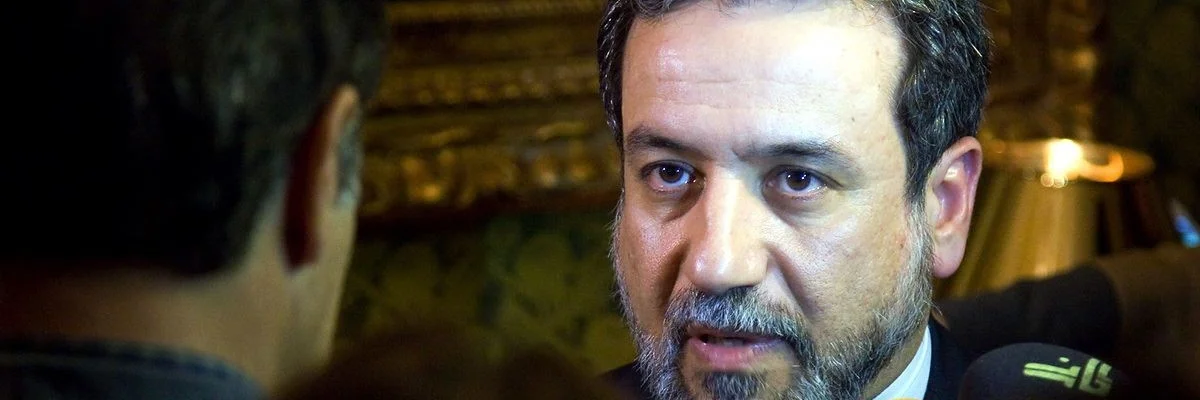
After Friday's meeting, Iranian Deputy Foreign Minister Abbas Araghchi said negotiations were ongoing with the remaining signatories "to see if they can provide us with a package which can give Iran the benefits of sanctions lifting."
He added that "practical solutions" were required to address Iran's concerns over its oil exports, banking flows and foreign investments in the country.
"The next step is to find guarantees for that package," he said.
Araghchi said that talks would continue over the next few weeks "particularly at an expert level", after which Iran would decide whether or not to stay in the accord.
"We got the sense that Europeans, Russia and China... are serious and they recognize that JCPOA's survival depends on the interests of Iran being respected," Araghchi added.
A senior EU official said after the meeting that the bloc could not "give guarantees but we can create the necessary conditions for the Iranians to keep benefiting from the sanctions lifting under the JCPOA and to protect our interests and continue to develop legitimate business with Iran."
"We are working on a variety of measures to mitigate consequences of the US withdrawal," the official, who did not want to be named, said while cautioning that "there are things that will take more time."
Russian delegate Mikhail Ulyanov struck an upbeat note, saying: "We have
all chances to succeed, provided that we have the political will.
"I must tell you that the JCPOA is a major international asset. It does not belong to the United States, it belongs to the whole international community."
He added that the possibility of referring the matter back to the UN "was not discussed during this meeting".
'Dying' Deal
Unusually for a meeting of the joint commission, the head of the UN's nuclear watchdog Yukiya Amano was invited to brief the participants on his organization's work in Iran.
According to a report seen by AFP on Thursday, the International Atomic Energy Agency (IAEA) believes Iran is still abiding by the deal's key restrictions on its nuclear facilities in return for relief from damaging economic sanctions.
The IAEA, however, is "encouraging (Iran) to go above and beyond the requirements" of the deal in order to boost confidence, said a senior diplomat in Vienna, where the nuclear watchdog is based.
As well as criticizing the deal for not adequately restricting Iran's nuclear activities, Trump also said it did not go far enough in limiting Iran's ballistic missile program, or its intervention in regional conflicts from Yemen to Iraq and Syria.
The unnamed senior Iranian official rejected any attempt to link the JCPOA to other such issues.
The official said such an attempt would mean "we lose JCPOA and we (would) make the other issues even more complicated to resolve," adding it was pointless for the Europeans to try to "appease" Trump.
"We have now a deal which is in the intensive care unit, it's dying," the official said.
The five signatories still committed to the agreement have said they want Iran to stay in the deal, with the European countries saying they would not rule out further talks with the Islamic Republic on an expanded text.
However, Iranian officials have warned that there was no question of broadening the discussions.
Photo Credit: YJC
Iran Nuclear Deal 'In Intensive Care' as Signatories Meet in Vienna
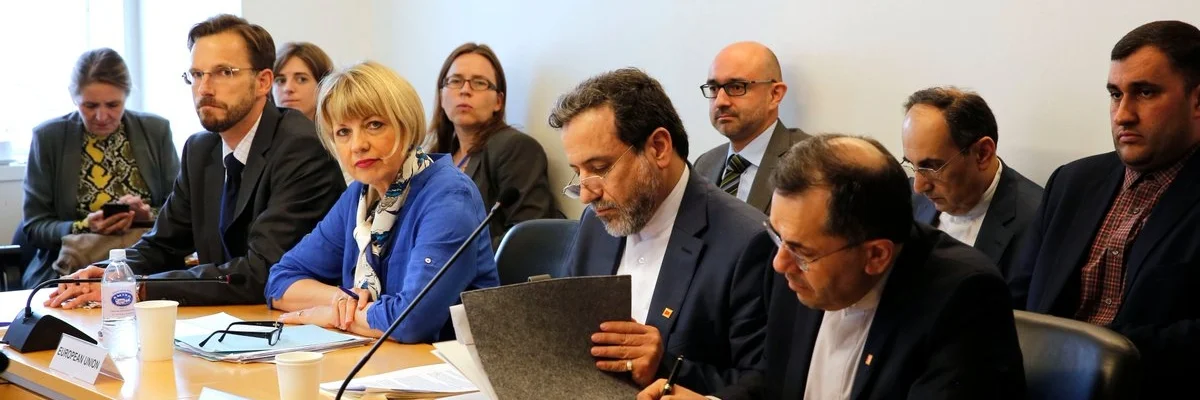
◢ Signatories of the Iran nuclear deal are meeting in Vienna on Friday in a bid to save the agreement, as Iran warned the deal had been put "in intensive care" by Washington's dramatic withdrawal earlier this month. For the first time since the accord came into force in 2015, China, Russia, France, Britain and Germany will gather—at Iran's request—without the United States, which pulled out on May 8.
Signatories of the Iran nuclear deal are meeting in Vienna on Friday in a bid to save the agreement, as Iran warned the deal had been put "in intensive care" by Washington's dramatic withdrawal earlier this month.
For the first time since the accord came into force in 2015, China, Russia, France, Britain and Germany will gather—at Iran's request—without the United States, which pulled out on May 8.
US President Donald Trump has long trashed the deal with Iran—concluded under his predecessor Barack Obama -- saying it did not do enough to curtail Tehran's nuclear ambitions.
He also said it did not go far enough in restricting Iran's ballistic missile program, or its intervention in regional conflicts from Yemen to Iraq and Syria.
A senior Iranian official rejected any attempt to link the deal, known as Joint Comprehensive Plan of Action (JCPOA) to other such issues, saying it would mean "we lose JCPOA and we (would) make the other issues even more complicated to resolve", adding that it was pointless for the Europeans to try to "appease" Trump.
"We have now a deal which is in the intensive care unit, it's dying," he said.
He added that the Europeans had promised Iran an "economic package" to maintain the benefits of the JCPOA for Iran despite the reintroduction of US sanctions.
Iran expected this package by the end of May, he said, adding that Iran had only "a few weeks" before having to decide whether to keep participating in the deal or not.
Since the US pull out, the other signatories have embarked on a diplomatic marathon to try to keep the agreement afloat.
According to a report seen by AFP Thursday, an International Atomic Energy Agency believes Iran is still abiding by the deal's key restrictions on its nuclear facilities in return for relief from damaging economic sanctions.
The IAEA, however, is "encouraging (Iran) to go above and beyond the requirements" of the deal in order to boost confidence, said a senior diplomat in Vienna, where the IAEA is based.
Iran has threatened to restart its uranium enrichment program at an "industrial level" if the deal falls apart.
The five signatories still committed to the agreement have said they want Iran to stay in the deal, with the European countries saying they would not rule out further talks with the Islamic Republic on an expanded text.
However, several Iranian officials warned that the Vienna meeting would be devoted to the existing agreement only, implying that there was no question of broadening the discussions.
Photo Credit: EEAS Twitter