

Japan Funds Development of Tuna Fisheries, Environmental Projects in Iran
Japan will fund UN initiatives to support fisheries in Chabahar, on Iran’s southeastern coast, and help foster sustainable livelihoods for locals who live near Lake Urmia in the country’s northwest.
Last month the Embassy of Japan in Tehran hosted a ceremony where two memorandums of understanding were signed new grants to support projects carried out by the United Nations Industrial Development Organization (UNIDO) and the United Nations Development Programme (UNDP) in Iran. The UN initiatives will support fisheries in Chabahar, on Iran’s southeastern coast, and help foster sustainable livelihoods for locals who live near Lake Urmia in the country’s northwest.
Attending the event were Kazutoshi Aikawa, the Ambassador of Japan; Maryam Javan Shahraki, UNIDO Representative in Iran; Claudio Providas, the UNDP Resident Representative in the Islamic Republic; Nabiollah Khoun-Mirzaei, Head of Iran Fisheries Organization; Ahmadreza Lahijanzadeh, Deputy for Marine and Wetlands at the Department of Environment; and representatives from Iran’s ministries of Agriculture and Foreign Affairs.
In his opening speech, the Japanese ambassador affirmed his country’s willingness to continue the expansion of its friendly relations with Iran.
“The government of Japan has decided to grant ¥676 million (about $6 million) to the Islamic Republic of Iran for the implementation of the two important projects,” Aikawa said.
The MoU signed with UNIDO will begin the third phase of the “Project for Promoting Inclusive and Sustainable Development of the Yellowfin Tuna Value Chain in Chabahar,” which started in 2017.
Javan Shahraki said that UNIDO and Japan have enjoyed a strong connection for decades and that their partnership encompasses all aspects of industrial development, from reducing poverty and promoting security in crisis-affected areas to trade, technology promotion and facilitating investment.
“Today we celebrate the signing ceremony of a Grant Aid ‘Project for Promoting Inclusive and Sustainable Development of the Yellowfin Tuna Value Chain’ in the strategic port of Chabahar in Sistan and Baluchestan Province,” Javan Shahraki said. “Building on earlier interventions to build the capacity of the tuna value chain in Chabahar, the new project will support the ability of local fishermen to access new markets while at the same time enhancing the sustainability of the fishery industry in Iran.”
Adding high-quality tuna to Iran’s list of regional and global exports is one of the main achievements of the UNIDO project in Chabahar, Javan Shahraki said. The project is also upgrading Chabahar Veterinary Laboratory and Iran Veterinary Lab with diagnostic kits and equipment; establishing sustainable links between private-sector companies in Iran and Japan; organizing study tours in Japan for Iranian fishermen, policymakers and laboratory experts; conducting workshops in Iran and Japan on marine cage culture, stock enhancement and after-catch management processes, on-site fishing and info-sharing for Iranian fishermen in Japan.
Javan Shahraki told Bourse & Bazaar that UNIDO has prioritised development activities in Iran, including strengthening the value chain of local and indigenous products.
“We are happy to have received Japan’s $3.5 million financial assistance for the project at hand,” Javan Shahraki said. “Chabahar’s yellowfin tuna has a competitive edge to it in the international markets compared with other tuna fish. Today marks the beginning of the third phase of our cooperation with Japan in this project. During the first phase, we studied the region’s ecology to see which species need to be focused on. Based on the research carried out by UNIDO as well as Japanese experts, Iran’s tuna fish was deemed one of extraordinary size, which in turn can generate a high value added. Yet, if harvest methods and ways of environment preservation are not improved, the fish could either fall prey to the danger of extinction or shrink in size. Right now, our tuna fish in Chabahar is three times as big as that of Japan.”
Using the government’s grant aid, UNIDO has trained local fishermen on best practices for harvesting and preserving yield quality during post-harvest procedures, and Chabahar’s quality control laboratories now have the equipment required for quality preservation.
Khoun-Mirzaei told Bourse and Bazaar that Iran has a huge capacity to produce tuna, but harvest and after-catch preservation methods are up to speed with the latest techniques used elsewhere in the world.
“This is why the collaboration between the UNIDO office in Tehran and the Japanese government is so significant, since it will upgrade our harvest knowledge, fishing equipment, quality-control methods and ecosystem preservation, and help our high-quality tuna find its way into international markets while enjoying higher value added,” Khoun-Mirzaei said.
Isa Golshahi, General Director of Iran Fisheries Organization’s Seafood Quality Improvement, Processing and Marketing Promotion Department, told Bourse and Bazaar that this project will ensure that generating higher values from the yellowfin tuna is more easily attainable.
“The fish indigenous to our waters has a high quality,” Golshahi said. “Through the cooperation with UNIDO and Japan, we can turn the tuna currently sold at prices lower than $2 per kilogram into products worth over $8 or in some cases $20 per kilogram.”
Japan Funds UNDP’s Lake Urmia Project
The second document signed during Wednesday’s ceremony marked the start of a new phase of collaboration between UNDP and the Japanese government on the “Project for Promoting Environmental Management and Sustainable Livelihoods in Lake Urmia and Other Wetlands.” Japan has provided a grant aid worth approximately US$3 million to continue work on Lake Urmia.
“The project has an environmental component but also has a focus on livelihoods,” Providas told Bourse & Bazaar. “To preserve the environment, you need to look at livelihoods as well. The important component is economic diversification and creating jobs. Can we improve water usage for farming but reduce the reliance of farming activities of around 250 villages around Lake Urmia on this endangered water body? This is what we are working on.”
Lahijanzadeh said that the Iranian government has so far spent around $1 billion on saving Lake Urmia and has been granted funds and technical assistance from Japan over several years.
“We hope to be able to transfer the knowledge and experience we have had with Japanese experts and UNDP assistance to Parishan Lake in Fars Province and Shadegan Wetlands in the southern Khuzestan Province as well,” Lahijanzadeh said.
In his speech, the Japanese ambassador said that in line with efforts to revive Lake Urmia and prevent it from drying up, the government of Japan has supported UNDP’s project for the lake’s restoration through sustainable agricultural practices and biodiversity conservation since 2014.
“In this new project, the knowledge and experiences gathered through all these years will be transferred to the remaining spots of the Lake Urmia basin, and it will also be disseminated to two other wetlands in Iran, which are facing similar problems,” Aikawa said.
Photo: IRNA
Iran Sees 'Revival' of Imperilled Lake Urmia
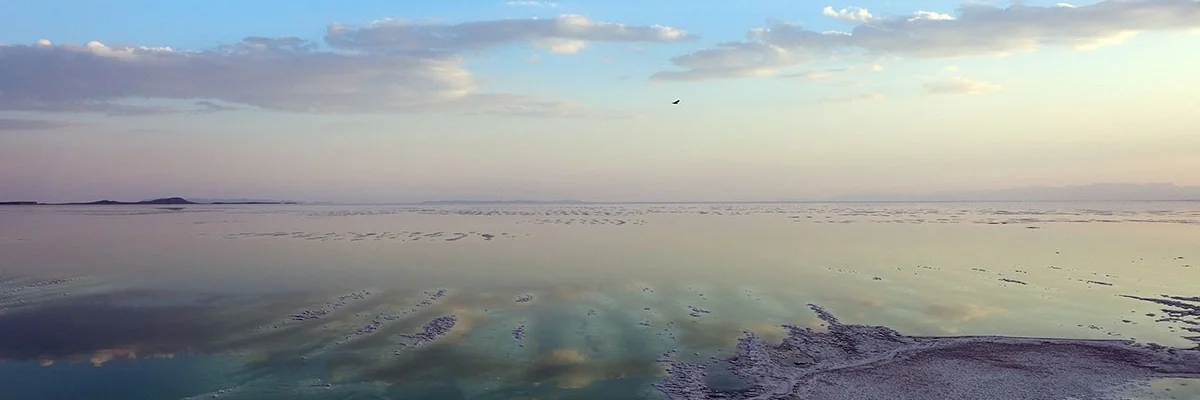
◢ It is one of the worst ecological disasters of recent decades, but the shrinking of Iran's great Lake Urmia finally appears to be stabilizing and officials see the start of a revival. A rusty cargo ship and a row of colorful pedal boats lying untouched on the bone-dry basin are a sign of the devastating loss of water in what was once the largest lake in the Middle East.
It is one of the worst ecological disasters of recent decades, but the shrinking of Iran's great Lake Urmia finally appears to be stabilizing and officials see the start of a revival.
A rusty cargo ship and a row of colorful pedal boats lying untouched on the bone-dry basin are a sign of the devastating loss of water in what was once the largest lake in the Middle East.
Situated in the mountains of northwest Iran, Lake Urmia is fed by 13 rivers and designated as a site of international importance under the UN Convention on Wetlands that was signed in the Iranian city of Ramsar in 1971.
The lake has been shrinking since 1995, according to the UN Environment Program, due to a combination of prolonged drought, over-farming and dams.
By August 2011 the lake's surface was 2,366 square kilometres (914 square miles) and shrank drastically to just 700 km2 in 2013, according to the United Nations.
The catastrophe has threatened the habitat of shrimp, flamingos, deers and wild sheep and caused salt storms that pollute nearby cities and farms.
That finally triggered a coordinated effort to save the lake in 2013—with a joint program between Iran and the UN Development Program funded by the Japanese government.
The project became a priority for the incoming administration of President Hassan Rouhani.
"One of my promises was to revive Urmia lake, and I am still committed to that promise," Rouhani said during a recent visit to the region.
Some positive results are finally emerging and the lake's surface area reached 2,300 km2 last year, according to UN Development Program figures.
"This is the beginning of the lake's revival," said Abolfazl Abesht, who heads the wetlands unit of Iran's environment department.
He warned it would take "decades" to return to the 5,000 km2 it once covered, but at least "now the trend has stopped".
Sustainable Farming
Rising temperatures and reduced rainfall have been a major factor in the lake's decline, experts say.
So, too, was the construction of a causeway in 2008 to shorten driving times between Urmia and the nearby city of Tabriz that cut the lake in two.
But people were also a major part of the problem due to a rapid rise in the population and farming around the lake, which provides a livelihood to some six million people.
The rejuvenation effort therefore focused on redirecting rivers to irrigate farmland, thus avoiding use of water from the lake, and the promotion of more sustainable farming methods.
“Almost 85 percent of the water is used for agriculture, and we are trying to help farmers reduce usage through cheap and effective techniques," said Abesht.
Measures such as using natural instead of chemical fertilizers, or leveling the land to avoid run-off, have shown major improvements for local farmer Afshin Medadi.
The 47-year-old had to invest in new equipment, but says "things are more cost-effective now", with his farm using a tenth of the water.
There has also been a noticeable reduction in the salt and dust pollution whipped up from the desiccated lake floor during storms, he added.
Others have launched their own green initiatives.
One group of 20 women set up a collective to raise awareness among lakeside communities about water waste, and encourage the production of handicrafts to boost sustainable employment.
One of the organisers, 39-year-old Kobra Asghari from the village of Gharehgozlou, hopes industries such as carpet and doll-making can gradually overtake traditional farming.
They are also encouraging women to plant less thirsty crops such as saffron and olives.
“We gradually managed to encourage the men to do the same," she said.
"People are paying more attention to their environment and the dying ecosystem."
Photo Credit: IRNA