
US Seeking 'Supplemental' Iran Deal With European Powers
◢ The US and European powers have had "very good" discussions towards agreeing a "supplemental" accord beyond the Iran nuclear deal by May 12, a senior US official said Friday. This would cover Iran's ballistic missile program, its regional activities, the expiration of parts of the nuclear deal in the mid-2020s and tighter UN inspections.
The US and European powers have had "very good" discussions towards agreeing a "supplemental" accord beyond the Iran nuclear deal by May 12, a senior US official said Friday.
President Donald Trump said in January that the 2015 deal between Iran and major powers must be "fixed" by May 12 or the United States will walk away. Senior State Department official Brian Hook said on Friday after talks in Berlin and Vienna that Trump wants to reach a "supplemental" deal with the European signatories to the agreement by then. This would cover Iran's ballistic missile program, its regional activities, the expiration of parts of the nuclear deal in the mid-2020s and tighter UN inspections, Hook said.
"We are taking things one week at a time, we are having very good discussions in London, Paris and Berlin," Hook, recently ousted Secretary of State Rex Tillerson's chief of strategy, told reporters.
"There is a lot we agree on and where we disagree we are working to bridge our differences," Hook said.
He declined to indicate what would happen if and when such an agreement is reached, saying: "We are not under instructions from the president to go beyond seeking an agreement with our European allies."
The 2015 accord between Iran and the US, Russia, China, France, Britain and Germany curtailed Iran's nuclear activities in exchange for sanctions relief.
Iran, which according to the UN atomic watchdog has been abiding by the deal since it came into force in January 2016, has ruled out any changes to the agreement.
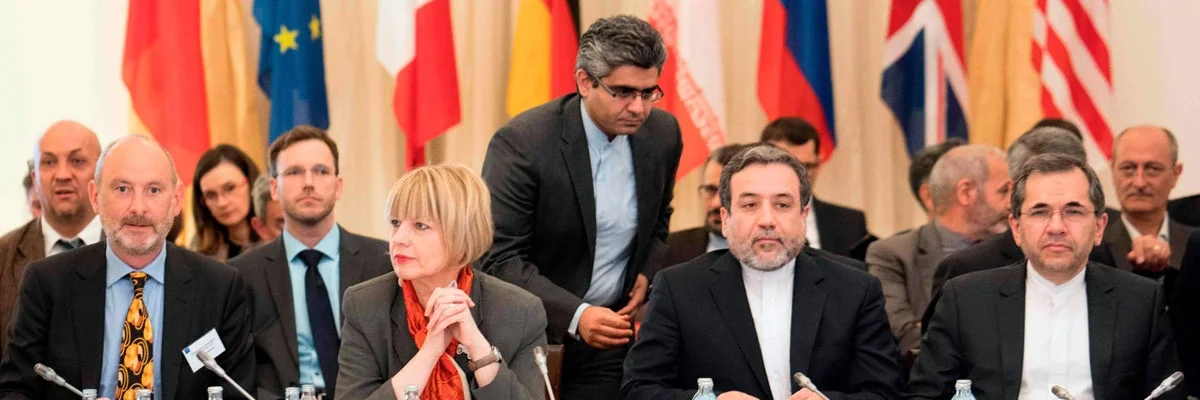
The talks in Vienna on Friday, a regular review of the accord, involved Iran and the six other signatories. Trump's decision this week to replace Tillerson with Mike Pompeo as secretary of state has been widely seen as another bad omen for the agreement.
Tillerson and his erstwhile cabinet ally Defence Secretary Jim Mattis had urged Trump to listen to the Europeans to preserve the agreement. Pompeo, head of the Central Intelligence Agency, is seen as taking a harder line on Iran.
Photo Credit: Wikicommons
Iran Says Tillerson Firing Shows US 'Determined' to Quit Nuclear Deal
◢ US Secretary of State Rex Tillerson's sacking shows that Washington is set on quitting the nuclear deal between Tehran and world powers, Iran's deputy foreign minister said Wednesday. A US exit could kill the pact between Iran, Germany and the five permanent members of the United Nations Security Council.
US Secretary of State Rex Tillerson's sacking shows that Washington is set on quitting the nuclear deal between Tehran and world powers, Iran's deputy foreign minister said Wednesday.
"The United States is determined to leave the nuclear deal, and changes at the State Department were made with that goal in mind—or at least it was one of the reasons," Abbas Araghchi said in comments carried by state new agency ISNA.
US President Donald Trump announced Tillerson's departure in a tweet on Tuesday, saying he would be replaced by Central Intelligence Agency chief Mike Pompeo, who takes a much harder line on Iran than his predecessor.
Trump has repeatedly slammed the 2015 nuclear deal, under which Iran agreed to freeze its nuclear programme in return for the lifting of crippling international sanctions.
Despite Tillerson's determination to stick with the deal, Trump has threatened to scrap what he has dubbed a "terrible" agreement unless tough new restrictions were placed on Iran by May 12.
A US exit could kill the pact between Iran, Germany and the five permanent members of the United Nations Security Council.
The deal's backers have presented it as a victory for diplomacy and nuclear non-proliferation efforts. Tehran has repeatedly ruled out changing a single comma of the text. The UN's nuclear energy agency, the IAEA, confirmed in February that Tehran had met its obligations under the agreement.
"If the US quits the nuclear deal, we will also quit it," Araghchi said Wednesday. "We have told the Europeans that if they can't keep the US in the deal, Iran will also leave it."
His comments contrast with those of Iranian officials including President Hassan Rouhani, who has said Iran will stick with the agreement as long as it is beneficial for the country—even if the United States leaves.
While Iran has reaped massive economic benefits from the accord, notably by being able to resume oil exports, it is still constrained by US sanctions in other areas.
Photo Credit: Wikicommons
Tillerson Sacking Could Spell Doom for Iran Nuclear Deal
◢ President Donald Trump's sacking of Secretary of State Rex Tillerson could sound the death knell for the Iran nuclear deal and further strain US ties with key European allies. In explaining his decision to fire Tillerson, Trump said they had disagreed on many topics, but he specifically singled out one dispute: Whether or not to stay in the Iran pact.
President Donald Trump's sacking of Secretary of State Rex Tillerson could sound the death knell for the Iran nuclear deal and further strain US ties with key European allies.
In explaining his decision to fire Tillerson, Trump said they had disagreed on many topics, but he specifically singled out one dispute: Whether or not to stay in the Iran pact.
"When you look at the Iran deal. I thought it was terrible. He thought it was OK," Trump said. "I wanted to either break it or do something, he felt a little differently. So we were not really thinking the same."
On May 12, in exactly two months, the US leader is to pronounce on the fate of the Iran deal. If sacking Tillerson is any indicator of Trump's decision on the issue, it suggests the accord is in trouble.
If, as now appears likely, Trump indeed decides to drop out of the Joint Comprehensive Plan of Action (JCPOA), then the deal—and the hopes of a generation of European and US diplomats—will be dead.
"We're also working with allies and partners to block Iran's path to a nuclear weapon and confront its sponsorship of terror and bloodshed all around the world," Trump said later in a speech at Miramar Air Base in California.
"Everywhere we go in the Middle East it's Iran, Iran, Iran. Every problem is Iran. Well, we're dealing with it in a very serious fashion. One of the worst deals I've ever seen, was the Iran deal."
Under the JCPOA, adopted in October 18, Iran surrendered much of its nuclear infrastructure and opened the rest to international inspection in exchange for international sanctions relief.
The deal was signed between Tehran and six world powers: Britain, China, France, Germany, Russia and the United States.
First Instinct
The other signatories still regard the accord as a landmark victory in the battle to stop the spread of nuclear weapons. Iran denies it has sought such arms, but warns it could restart fuel enrichment quickly.
For his part, Trump campaigned condemning the accord as the "worst deal ever" and in office he has given ear to hawkish advisors who say it does not do enough to halt Iran's alleged quest for the bomb.
Tillerson and his cabinet ally Defense Secretary Jim Mattis have urged Trump to listen to his European allies and to preserve the deal intact, while seeking new measures to pressure Iran.
With Tillerson out of the picture -- and replaced by CIA director and Iran hawk Mike Pompeo -- Trump is all the more likely to follow his first instinct and blow up the entire accord.
For Thomas Countryman, who was assistant secretary of state for international security and nonproliferation from 2011 to 2017, the reshuffle could have catastrophic consequences for US national security.
Countryman argues that Tillerson "served as a Cabinet-level check on some of President Trump's worst impulses, such as wanting to 'break' the Iran nuclear agreement."
"Mr. Pompeo instead favors an aggressive Middle East policy that would undo
the diplomatic progress we made on nonproliferation and potentially embroil us
in a new conflict in that region."
Mark Dubowitz of the hawkish Foundation Foundation for Defense of
Democracies rarely agrees with Obama-era diplomats—but he does agree that
Pompeo's arrival is bad news for the deal.
"For those Europeans (and Americans) who think Trump is not serious about walking away on May 12th if there's no agreement to fix the Iran nuke deal, I give you Exhibit A: his soon-to-be Secretary of State Mike Pompeo," he tweeted.
For the moment, US diplomacy is carrying on as before.
Berlin Talks
State Department officials told AFP that Tillerson's chief of strategy Brian Hook will be in Berlin on Thursday to meet British, French and German officials about efforts to reform the deal.
This "fix" would expand the agreement to include restrictions on Iran's ballistic missile program and end the "sunset clauses" that allow Tehran to resume some enrichment within 10 years.
European leaders have expressed some sympathy for these ideas, if they would help bind Trump's America into a deal they regard as vital for their own national security and Middle East peace.
But they are looking at a possible "supplement" arrangement that would leave the core deal intact—and perhaps preserve Iranian support for it—while adding a separate annex to address Trump's concerns.
This in itself may not be possible, but even if it were, it might not go far enough for Trump and his new chief diplomat, Pompeo. At the weekend, respected Israeli journalist Barak Ravid of Channel 10 news reported that, last week, Trump promised Israeli Prime Minister Benjamin
Netanyahu that he would not accept a supplemental deal.
Israeli officials told Ravid that Trump opposes Europe's "cosmetic changes" and wants a "significant" rewriting of the Iran deal itself. This would almost certainly destroy the agreement.
Photo Credit: Wikicommons
Trump Says 'Disagreed on Things' With Tillerson
◢ US President Donald Trump spoke of his disagreements Tuesday with ousted secretary of state Rex Tillerson, including over the Iran nuclear deal, as he explained his decision to replace him with Mike Pompeo.
US President Donald Trump spoke of his disagreements Tuesday with ousted secretary of state Rex Tillerson, including over the Iran nuclear deal, as he explained his decision to replace him with Mike Pompeo.
"We got along actually quite well but we disagreed on things," Trump told reporters.
"When you look at the Iran deal, I thought it was terrible, he thought it was okay. I wanted to either break it or do something, he felt a little differently. So we were not really thinking the same."
Photo Credit: Wikicommons