
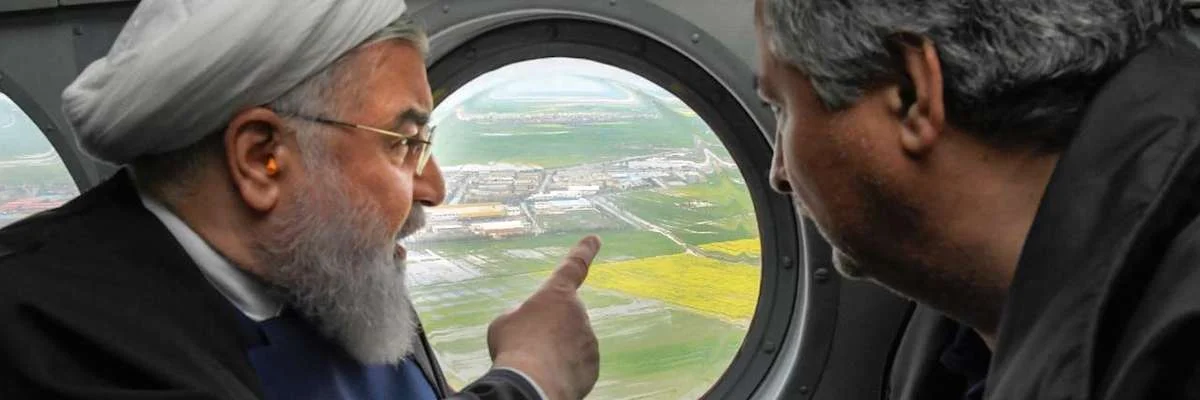
Iran President Visits Flood-Hit Zones as Death Toll Hits 43
◢ President Hassan Rouhani travelled to flood-hit zones of Iran for the first time Wednesday after nine days of heavy rains that have inundated most of the country and killed 43 people. The authorities have been struggling to cope with flooding after extreme rainfall which at times has been equivalent to half of the average annual levels within 24 hours.
President Hassan Rouhani travelled to flood-hit zones of Iran for the first time Wednesday after nine days of heavy rains that have inundated most of the country and killed 43 people.
The authorities have been struggling to cope with flooding after extreme rainfall which at times has been equivalent to half of the average annual levels within 24 hours.
The disaster, which one government minister blamed on climate change, struck in the middle of Iranian New Year break, with many relief workers on leave and millions of holiday-makers on the roads.
"When suddenly 25 out of 31, and on some days all provinces are struck (by flooding), this may be an unprecedented phenomenon," Rouhani said in Tehran, quoted by the government's website.
Rouhani then flew to the northeastern province of Golestan, one of the areas where the floods first struck on March 19 and have since killed at least 10 people, according to the latest official figures.
Speaking at a crisis meeting in Golestan aired live on state television, Rouhani responded to criticism he was slow to visit the disaster-hit zone.
"I had planned to come in the first days, but ultimately due to considerations it was decided the first vice-president would travel here," he said.
The deluge spread rapidly from the north to the west and south of the country on March 25 before hitting the centre of Iran as the weather front moved eastwards.
"In some regions, rainfall within 24 hours equalled that of the prior 10 months," said Mahmoodreza Peiravi, secretary general of Iran's Red Crescent Society.
"If you take the number and ferocity of the floods into account, the death toll was thankfully not that high," he said, while warning it could rise in coming days.
"The floods struck during the holidays and many vacationers on road trips were affected by it," Peiravi told AFP.
"It is possible that some vacationers might have been carried off by the floods and no one is yet aware of it," he warned.
Day of Mourning
A day of mourning has been declared for Thursday in the southern city of Shiraz, the worst-hit area where the flooding claimed the lives of 19 people and injured more than 100.
The latest toll included six people who drowned when a boat full of rescuers and victims overturned in the northeastern Gomishan region in Golestan province.
"Another body has been found but we have not yet recovered it," the area's emergency services head Alireza Kamalgharibi said, adding that search and rescue operations would continue as it was unclear how many people had been on board the boat.
Another four people were killed in the western provinces of Kogiluyeh-Va-Boyerahmad and Lorestan, said Morteza Salimi, head of the Iranian Red Crescent's search and rescue organization.
One death was also reported in each of Khuzestan, Kermanshah and Semnan provinces.
“More than 43,000 people were rescued and nearly 27,000 were provided with emergency accommodation," Salimi said, quoted by Tasnim news agency, adding rescue operations had been carried out in 30 provinces.
Officials estimate the flooding caused hundreds of millions of dollars in damage to homes, farms and infrastructure.
The skies have mostly cleared up for now but Iran's meteorological service has warned of more heavy showers from Saturday.
Such a widespread flood threat is unprecedented in arid Iran, which until 2018 was dealing with decades of drought.
"Climate change is forcing itself on our country," Energy Minister Reza Ardekanian, who is in charge of dams and water supply, said on Monday.
"These unprecedented floods in our country are because of climate change worldwide," he added.
Photo Credit: IRNA

23 Dead as Iran Battles Heavy Rain and Floods
◢ The death toll from major floods swamping much of Iran has risen to 23, emergency services said Tuesday, as authorities sent safety warnings to mobile telephones across the country. Supreme leader Ayatollah Ali Khamenei issued a message of condolence urging officials to speed up relief efforts and compensation for victims of the floods, which the authorities described as unprecedented.
Iran battled torrential rain and floods across most of the country on Tuesday, warning citizens to stay vigilant after unprecedented flash flooding killed 23 people.
The authorities also announced for the first time that seven people were killed a week ago in separate floods that swept the northeastern provinces of Golestan and Mazandaran.
The latest deluge claimed the lives of 19 people and injured 98 in the worst-hit southern city of Shiraz, the rescue services said.
There was also one death in each of the western provinces of Kermanshah, Lorestan and Kogiluyeh-Va-Boyerahmad, and another in the southwestern province of Khuzestand.
The disaster, which the energy minister blamed on climate change, struck in the middle of Iranian New Year holidays, with many relief workers on vacation and millions of Iranians on the roads.
On Tuesday the authorities sent out emergency warnings to the public on mobile phones as state television aired safety tips, including on how to leave cars stuck in floods.
Supreme leader Ayatollah Ali Khamenei issued a message of condolence and urged officials to speed up relief efforts and compensation for victims of the floods, which the authorities described as unprecedented.
Overall, at least 110 people were injured in this week's flooding, the health ministry said.
More than 25,000 had to be put up in emergency accommodation, according to the Iranian Red Crescent Society.
With at least 20 of Iran's 31 provinces experiencing floods or facing an imminent threat and more than 250 cities and villages needing emergency assistance, the country's National Crisis Management Committee was put on its highest alert level.
Iran's meteorological service has warned of more heavy showers through to Wednesday, and flood warnings have gone out for central provinces including Isfahan and Tehran.
Sandbagging in Tehran
In the capital sandbags were laid at the entrances to underground stations as police made emergency plans to divert traffic from freeways already impeded by runoff from the downpour.
In top tourist attraction Isfahan, residents and travelers were evacuated from the banks of the Zayandeh Rood river over fears they would burst.
The river had been completely dry until recently due low rainfall.
As the weather front moves to the east of Iran, more and more regions of the country that had been facing chronic water shortages a few months ago have been inundated with water.
The downpour has triggered scores of landslides that have blocked roads, especially in mountainous regions.
One buried an entire village in Kogiluyeh-Va-Boyerahmad province shortly after residents were evacuated, the semi-official Fars News agency quoted its governor as saying.
Hundreds of villages in western Iran have been cut off with many also losing electricity and normal water supplies, forcing authorities to deploy military helicopters to try to save and supply those left stranded.
Overnight the crisis management committee sent out multiple text messages to all mobile telephones in Iran urging people to be cautious and await instructions from official sources.
"Remain calm when facing possible dangers... do not honk your car horns in mountainous regions as it might cause avalanches," one of the messages read.
"Do not set up tents near rivers or mountainous areas... and most importantly do not cross bridges when floods are running underneath," read another one.
The floods followed extreme rainfall which at times was equivalent to half of the average annual levels within 24 hours.
Such a widespread flood threat is unprecedented in arid Iran, which until 2018 was dealing with decades of drought.
"Climate change is forcing itself on our country," said Energy Minister Reza Ardekanian, who is in charge of dams and water supply.
"These unprecedented floods in our country are because of climate change worldwide," he said on Monday, quoted by the Tasnim news agency.
Photo Credit: IRNA