
Iran Could Reverse Nuclear Breaches if Europe Acts: Zarif
◢ Iran would be willing to move back towards the 2015 nuclear deal if Europe provides "meaningful" economic benefits, the country's foreign minister said last Friday. "We have said that we are prepared to slow down or reverse these measures commensurate with what Europe does," Mr Zarif told reporters at the Munich Security Conference.
Iran would be willing to move back towards the 2015 nuclear deal if Europe provides "meaningful" economic benefits, the country's foreign minister said last Friday .
The European parties to the Iran nuclear deal—Britain, France and Germany—have been battling to save it since US President Donald Trump withdrew from it and reimposed tough sanctions on Tehran.
Iran has responded to the US pullout with a series of steps back from its own commitments under the deal, including by increasing uranium enrichment.
But Foreign Minister Mohammad Javad Zarif said the Islamic republic could be willing to move back towards compliance—under certain circumstances.
"We have said that we are prepared to slow down or reverse these measures commensurate with what Europe does," Mr Zarif told reporters at the Munich Security Conference. "We will decide whether what Europe does is sufficient to slow down or to reverse some steps - we have not even ruled out reversing some of the steps that we have taken."
Europe has set up a special trading mechanism called Instex to try to enable legitimate humanitarian trade with Iran to offset some of the effects of US sanctions.
But it has yet to complete any transactions and the Iranian side does not think it is sufficient.
"We're not talking about charity. We're talking about Iranian rights and the rights of the Iranian people to receive the economic benefits," Mr Zarif said. "We have received irreversible harm or irreparable harm because of US sanctions, but nevertheless we will reverse the steps that we have taken provided that Europe takes steps that are meaningful."
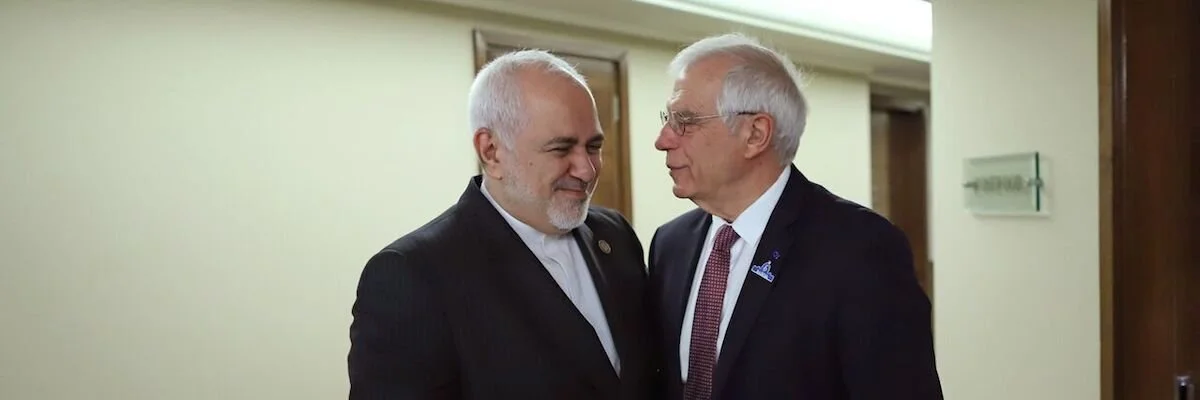
The EU's top diplomat Josep Borrell met Zarif in Teheran earlier this month to try to lower tensions after Britain, France and Germany triggered a complaint mechanism under the deal to try to press Teheran to return to full implementation.
Washington accuses Tehran of seeking a nuclear weapon, which Iran has always denied.
The renewed US sanctions have almost entirely isolated Iran from the international financial system, driven away oil buyers and plunged the country into a severe recession.
Mr Borrell has also been in consultation with the other countries still in the deal—Russia and China—who like their European counterparts want to save the accord.
A meeting of the joint commission that oversees the deal is due to be held this month to consider the dispute mechanism.
Photo: IRNA
Iran Takes Aim at 'Hateful' Pence Comments
◢ Iran's foreign minister on Sunday launched a blistering attack on US Vice President Mike Pence, saying his allegations that Tehran was plotting a "new Holocaust" were "hateful" and "ignorant.” Mohammad Javad Zarif told the Munich Security Conference that Pence's demands for the EU to follow the US in abandoning the 2015 Iran nuclear deal amounted to asking Europe to undermine its own security.
Iran's foreign minister on Sunday launched a blistering attack on US Vice President Mike Pence, saying his allegations that Tehran was plotting a "new Holocaust" were "hateful" and "ignorant.”
Mohammad Javad Zarif told the Munich Security Conference that Pence's demands for the EU to follow the US in abandoning the 2015 Iran nuclear deal amounted to asking Europe to undermine its own security.
And Zarif piled fresh pressure on the EU, telling Brussels that a trade mechanism to bypass US sanctions on Iran was inadequate and it needed to do more if it wanted to save the accord.
US President Donald Trump tore up the nuclear deal last year, branding it a failure, and Washington has slapped strict sanctions back on Tehran.
Pence used a diplomatic tour of Europe this week to demand repeatedly that EU countries stop trying to preserve the deal, which curbed Tehran's nuclear ambitions in return for sanctions relief.
Zarif slammed the vice president, saying he had "arrogantly demanded that Europe must join the US in undermining its own security and breaking its obligations" to the treaty under international law.
"His hateful accusations against Iran including his ignorant allegations of anti-semitism (...) are both ridiculous but at the same time very very dangerous," Zarif said.
Away from the fiery rhetoric, Zarif's criticism of INSTEX—the payment mechanism created by European countries to try to continue trade with Iran—will cause concern in Brussels.
The creation of INSTEX by Britain, France and Germany—the so-called E3 European signatories to the nuclear deal—was a complex, drawn-out process that has infuriated the Trump administration, exacerbating transatlantic tensions.
But while Zarif welcomed the EU's political support, he said it was not enough, and demanded Europe "walk the walk".
"INSTEX falls short of the commitments by the E3 to save the nuclear deal," he said.
"Europe needs to be willing to get wet if it wants to swim against the dangerous tide of US unilateralism."
He warned that the future of the nuclear deal was "on the brink", saying that while polls showed 51 percent of Iranians still supported staying in, there were many who thought Tehran had got a bad deal.
Photo Credit: Wikicommons