

Iran Nuclear Deal Parties Stand by Troubled Accord Amid US Pressure
The signatories to the Iran nuclear deal said Tuesday that they stood by the faltering accord, opposing US efforts to restore international sanctions on the Iran.
By Julia Zappei
The signatories to the Iran nuclear deal said Tuesday that they stood by the faltering accord, opposing US efforts to restore international sanctions on the Iran.
Britain, France, Germany, China and Russia are struggling to save the landmark 2015 accord with Iran, which has been progressively stepping up its nuclear activities since the United States pulled out of the deal in 2018.
Tehran insists it is entitled to do so under the terms of the accord—which swapped sanctions relief for Iran's agreement to scale back its nuclear program—following Washington's withdrawal and reimposition of sanctions.
EU senior official Helga Schmid, who chaired the talks in Vienna on Tuesday, wrote on Twitter that the meeting's participants were "united in resolve to preserve the #IranDeal and find a way to ensure full implementation of the agreement despite current challenges". In a later statement, she added that all parties reiterated that "the US cannot initiate the process of reinstating UN sanctions" by drawing on a United Nations resolution enshrining the nuclear accord, which they have left.
Representatives from Britain, China, France, Germany, Iran and Russia all attended the talks—part of a regular series of gatherings to discuss the accord, which have been increasingly tense since the US pullout began unravelling the agreement.
'Mockery'
China's representative, senior Foreign Ministry official Fu Cong, told reporters after the meeting that Iran needed to come back to full compliance, but at the same time "the economic benefit that is due to Iran needs to be provided.”
He slammed the US for "making a mockery of international law" in its "attempt to sabotage and to kill the JCPOA", referring to the abbreviation of the deal's formal name, the Joint Comprehensive Plan of Action.
Russia's deputy foreign minister Sergei Ryabkov was also quoted by Russian news agency RIA Novosti as saying participants were united in their "general, unanimous lack of recognition" of Washington's move.
The United Nations last week blocked the US bid to reimpose international sanctions on Iran, while Washington also failed to rally enough support to extend an arms embargo on Iran that is scheduled to start being rolled back from October.
In a boost to Tuesday's talks, the Iranian atomic energy agency last week also agreed to allow inspectors of the UN nuclear watchdog to visit two sites suspected of having hosted undeclared activity in the early 2000s.
Schmid said meeting participants "welcomed" the agreement reached during International Atomic Energy Agency head Rafael Grossi's first trip to Iran after months of calling for access.
US 'Isolated'
Mark Fitzpatrick, an associate fellow of the International Institute for Strategic Studies (IISS), told AFP ahead of the talks that the agreement on access kept "Iran generally in line with the rest of the world, against an isolated United States.”
But Fitzpatrick pointed out that "Iran's nuclear activities remain of deep concern to those states that are dedicated to non-proliferation".
Iran reportedly recently transferred advanced centrifuges used to enrich uranium from a pilot facility into a new hall at its main Natanz nuclear fuel plant, which was hit by sabotage in July. When asked about this by AFP, Iran's representative at the talks, deputy foreign minister Abbas Araghchi, said details regarding this had been given to the IAEA, declining to comment further.
"We are completely transparent in our nuclear program. The agency has been always informed and is informed now about every detail of our program, every movement in our equipment," he said.
An IAEA assessment published in June said Iran's stockpile of enriched uranium was almost eight times the limit fixed in the accord.
The level of enrichment is still far below what would be needed for a nuclear weapon, and Iran has insisted it can reverse the steps it has taken since last year—if it can again benefit economically again under the deal.
The IAEA, which regular updates its members on Iran's nuclear activities, is expected to issue a fresh report ahead of a meeting of member states to discuss the dossier later this month.
Photo: Wikicommons
Trump Administration Unveils Security Council Resolution Extending Iran Arms Embargo
A long-awaited U.N. Security Council draft resolution extending an arms embargo on Iran has little support among major powers at the U.N., reflecting Washington’s isolation on its Iran policy.
By Colum Lynch and Robbie Gramer
The administration of U.S. President Donald Trump introduced a long-awaited U.N. Security Council (UNSC) draft resolution extending an arms embargo on Iran that is due to expire in October, setting the stage for a great-power clash and likely veto in the U.N.’s principal security body, according to a copy of the draft obtained by Foreign Policy.
The U.S. draft resolution would oblige nations, including the United States, to take active measures to prevent Iran from supplying, selling, or transferring arms to other countries, unless the Security Council committee overseeing U.N. sanctions approves such transfers. The measure would also require all U.N. member states to inspect cargo transiting through their territory to check for illicit arms imports or exports from Iran, and grant them authority to seize and destroy such weapons.
It would also impose an asset freeze and travel ban on individuals responsible for violating the arms embargo, and authorize states to “seize, inspect, freeze (impound), confiscate, and dispose of any vessel in their ports.” In an effort to ratchet up pressure on Iran, the resolution would request that U.N. Secretary General António Guterres report any attacks by armed groups that threaten regional stability or interference in the freedom of navigation in the region. The resolution would also establish a special council committee to monitor compliance with the sanctions and appoint a panel of eight experts to investigate and compile information on potential violations of the embargo.
If passed, the resolution would fall under Chapter VII of the U.N. charter, making it legally binding and enforceable. But the U.S. measure, according to several U.N. Security Council diplomats, stands little chance of being adopted by the 15-nation council. One council diplomat said that the U.S. initiative might not even receive the minimum threshold of nine votes it needs in the council that would force a veto from one of the permanent Security Council members. “This is not something that they are trying to get through the council,” said the diplomat.
Some council diplomats and other nonproliferation experts see the U.S. move as a way to score political points at home, not to do anything about Iran’s destabilizing activities in the region.
“The skeptic in me says that the objective of this exercise is to go through the arms embargo resolution, and when it fails, to use that as an excuse to get a snapback of the embargo, and if and when that fails too, to use as a political talking point in the election campaign,” said Mark Fitzpatrick, a former State Department nonproliferation official now at the International Institute for Strategic Studies. Since China and Russia are almost certain to ignore any U.N. arms embargo forced by U.S. maneuvers, the practical impact on Iran’s ability to cause mischief will be minimal, he said.
“It’s not actually about stopping any arms from China and Russia, it’s about winning a political argument,” he said.
The draft also condemns a string of alleged armed attacks by Iran against the United States, Iraq, and Saudi Arabia, including the September 2019 drone and missile attack against two Saudi oil installations and a Dec. 27 strike allegedly by an Iranian-backed militia against an Iraqi military base in Kirkuk province, Iraq, which resulted in the death of a U.S. citizen and injured several U.S. and Iraqi personnel.
The 2015 Joint Comprehensive Plan of Action (JCPOA) envisioned the expiration of a sweeping U.N. arms embargo on Iran after five years if Tehran complied with its obligation to scale back its nuclear activities and subject its program to expanded international monitoring by the International Atomic Energy Agency. Iran had largely complied with its obligations until Trump withdrew the United States from the agreement in May 2018 and reintroduced a series of U.S. sanctions against the country.
Since then, Tehran has violated key tenets of the JCPOA, including enriching uranium to purity levels higher than what is allowed in the deal and increasing the stockpiles of enriched uranium, according to assessments from the International Atomic Energy Agency.
China and Russia, which wield veto power over Security Council decisions, have signaled their unwillingness to approve the resolution. Other signatories of the Iran deal—Britain, France, and Germany—have all supported retaining arms embargoes on Iran, but they also came out against the Trump administration’s threat to reimpose sanctions, highlighting the sharp disagreements between Washington and its closest European allies over Iran.
“We firmly believe that any unilateral attempt to trigger UN sanctions snapback would have serious adverse consequences in the UNSC,” the foreign ministers of Britain, France, and Germany said in a statement on June 19. “We would not support such a decision which would be incompatible with our current efforts to preserve the JCPoA.”
The foreign ministers also cautioned that lifting the U.N. conventional arms embargo “would have major implications for regional security and stability” but stressed that even without a U.N. arms embargo, the European Union has its own ban on sending conventional weapons and missile technology to Iran through 2023. Senior U.S. officials have said that Russia and China would be poised to sell conventional arms to Iran if the U.N. embargo expires.
A State Department spokesperson told Foreign Policy that “failing to extend the arms embargo will risk even greater violence in the Middle East.”
The spokesperson added that the U.S. is “hopeful” that the draft resolution will be supported by the Security Council, stating that China and Russia have upheld similar restrictions in the past. “Given that Iran’s activity continues to pose a threat to international peace and security, we do not see any reason why [the] Security Council consensus on this issue should have changed,” the spokesperson said.
The Trump administration’s push to reimpose sanctions opened a unique legal debate over the United States’ current standing with the JCPOA. The Trump administration has argued that it is still legally a party to the deal the president disavowed, allowing it to trigger the snapback of sanctions. This argument has angered top diplomats from other countries that were signatories to the deal, who said the United States couldn’t have it both ways.
Brian Hook, the Trump administration’s top Iran envoy, said in an interview with Foreign Policy last month that the president remains open to “sitting down” with Tehran for talks on a new deal. He said that the United States would still maintain its expanding sanctions regime on Iran in the meantime.
“We’re in no hurry. We have a good policy in place. The regime needs to decide when it wants to come to the table,” he said.
Photo: State Department
Pompeo to Urge Iranians Abroad to 'Support' Anti-Regime Protests
◢ US Secretary of State Mike Pompeo plans on Sunday to urge members of the Iranian diaspora to "support" protesters in Iran, as the Trump administration hints at a desire for regime change in Tehran after turning its back on the Iranian nuclear accord. President Donald Trump—who has made the Islamic republic a favorite target since his unexpected rapprochement with North Korea—decided on May 8 to restore all the sanctions that had been lifted as part of the multi-nation agreement aimed at preventing Iran from developing nuclear weapons.
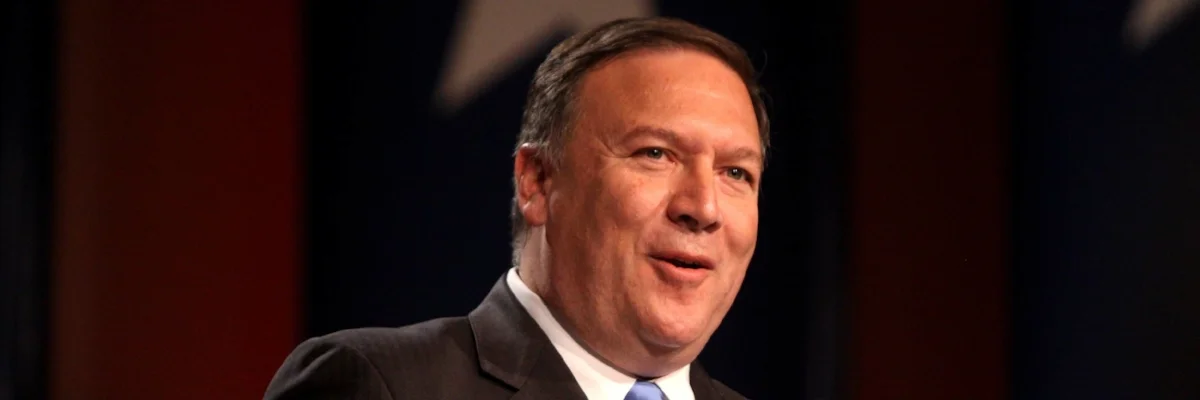
US Secretary of State Mike Pompeo plans on Sunday to urge members of the Iranian diaspora to "support" protesters in Iran, as the Trump administration hints at a desire for regime change in Tehran after turning its back on the Iranian nuclear accord.
President Donald Trump—who has made the Islamic republic a favorite target since his unexpected rapprochement with North Korea—decided on May 8 to restore all the sanctions that had been lifted as part of the multi-nation agreement aimed at preventing Iran from developing nuclear weapons.
Following the US withdrawal that stunned even Washington's closest European allies, Pompeo on May 21 unveiled a "new strategy" intended to force Iran to yield to a dozen stringent demands or else face the "strongest sanctions in history."
The next US step is due at 6:00 pm Sunday (0100 GMT Monday) in the Ronald Reagan presidential library in Simi Valley, California, when the secretary of state delivers a speech entitled "Supporting Iranian Voices."
With the 40th anniversary of the Islamic Revolution of 1979 a year away, Pompeo plans to retrace "40 years of stealing from the Iranian people, the terrorism they have committed around the region, the brutal repression at home" as well as the "religious persecution" there, a senior State Department official told reporters ahead of the speech.
The venue for Pompeo's address is significant, the official noted: some 250,000 Iranian-Americans live in Southern California.
"He will be exposing some of the corruption" of a "kleptocratic regime," the diplomat told reporters. "The regime has prioritized its ideological agenda over the welfare of the Iranian people."
'Demands For a Better Life'
Pompeo launched his campaign against Iran on Twitter last month, saying the government in Tehran and the Revolutionary Guards—the regime's elite armed
corps—had "plundered the country's wealth" in proxy wars "while Iranian families struggle."
The Trump administration's strategy appears simple: to exploit the already growing tensions within Iranian society that are being exacerbated by renewed US sanctions that have forced some foreign firms to leave.
There have been a series of anti-government protests in Iran in recent months, prompted by an array of different issues and concerns.
The State Department briefer said Pompeo plans to support "the legitimate demands of the Iranian people, especially their economic demands for a better life."
But how far will he and the administration go?
"That's the key question," Behnam Ben Taleblu of the conservative pressure group Foundation for Defense of Democracies (FDD), told AFP. "Pompeo and the administration can do more than just rhetorical support to the Iranian protester."
How far will the US go?
Several Iranian dissidents have written to Pompeo to urge him to re-establish punitive measures against the state-owned Islamic Republic of Iran Broadcasting network, which they accuse of abetting human rights violations.
Word of Pompeo's planned speech has fanned speculation on Washington's precise intentions.
The State Department insists that the US seeks merely a "change in behavior" by the regime.
But some senior members of the Trump administration.—notably national security advisor John Bolton.—have made it clear in the past that they would like to see the Tehran regime topple, and Pompeo himself said in May that "the Iranian people get to choose for themselves the kind of leadership they want."
To Behnam Ben Taleblu, "genuine regime change can only come from inside."
With an upsurge of "Iranians of all different social classes protesting," he said, the Trump administration will have to decide whether it wants to "support elements that actually want to change the regime."
Diplomats and experts in Washington are divided as to whether the protests and social tensions within Iran pose a true threat to the Islamic republic.
Nor is there agreement on what it would actually mean should the Iranian regime fall—but some find that uncertainty deeply worrying.
"The more likely result of regime collapse would be a military coup in the name of restoring order, led by the man Washington's Iran hawks fear the most: Gen. Qasem Suleimani," the commander of the Revolutionary Guards, according to Mark Fitzpatrick of the International Institute for Strategic Studies.
"Exerting maximum pressure on Iran could bring about America's worst nightmare," he added on Twitter.
Photo Credit: Wikicommons