
Iran Diplomat Calls Talks With UK Minister 'Repetitive'
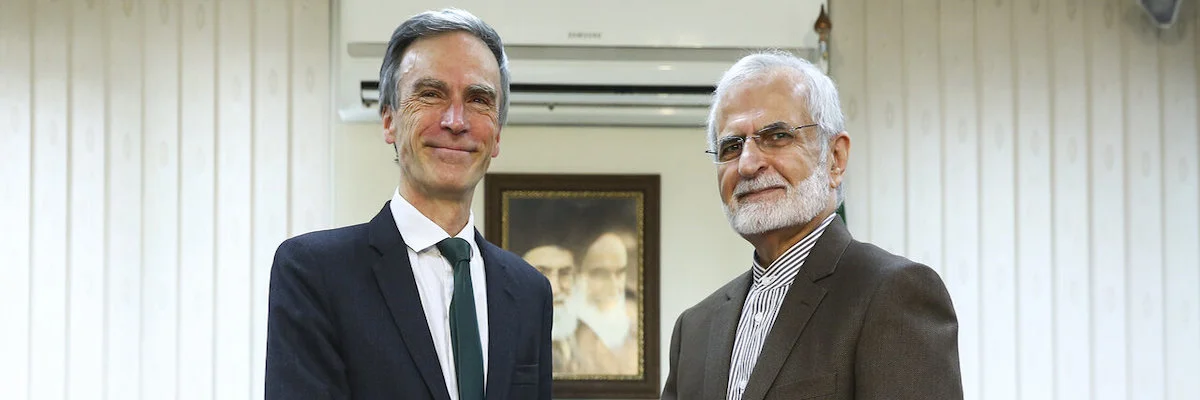
◢ A top Iranian diplomat expressed disappointment on Sunday after meeting a British Foreign Office minister amid escalating regional tensions, saying their talks were "repetitive", state news agency IRNA reported. Minister of State for the Middle East Andrew Murrison had the "usual talking points", said Kamal Kharazi, the head of the Strategic Council of Foreign Relations at Iran's foreign ministry.
A top Iranian diplomat expressed disappointment on Sunday after meeting a British Foreign Office minister amid escalating regional tensions, saying their talks were "repetitive", state news agency IRNA reported.
Minister of State for the Middle East Andrew Murrison had the "usual talking points", said Kamal Kharazi, the head of the Strategic Council of Foreign Relations at Iran's foreign ministry.
These included talking up a European payment mechanism to help Iran with US sanctions and saying "that Britain has always supported the JCPOA (nuclear deal) and has its own problems with America," Kharazi added.
"Such talks that have always been repetitive."
The JCPOA is the Joint Comprehensive Plan of Action, a multilateral 2015 nuclear deal that the US unilaterally withdrew from in May last year.
Washington has since re-imposed biting sanctions against the Islamic republic, despite Britain, China, France, Germany and Russia remaining committed to the deal.
Murrison said that in Tehran he had been "clear about the UK's long-held concerns over Iran's activities in the region," according to a Foreign Office statement.
"I reiterated the UK's assessment that Iran almost certainly bears responsibility for recent attacks on tankers in the Gulf of Oman."
The minister said he also repeated that Britain was determined "to maintain the nuclear deal which is in our shared security interests.”
"I was clear that Iran must continue to meet its commitments under the deal in full—including the limits imposed on its low-enriched uranium stockpile," he was quoted as saying.
Murrison also had meetings with Vice President Masoumeh Ebtekar, Deputy Foreign Minister Abbas Araghchi, and the deputy head of Iran's atomic agency, Behrouz Kamalvandi.
Tensions between Washington and Tehran have flared further after Iran on Thursday shot down a US surveillance drone.
Iran said the drone violated its airspace—a claim the US denies—near the strategic Strait of Hormuz.
In response, the US was ready to carry out a military strike against Iran but US President Donald Trump said he had called it off at the last minute.
The downing of the drone came after Iran-US tensions spiked following a series of attacks on commercial vessels that the US has blamed on Iran—accusations vehemently denied by the Islamic republic.
Britain is a signatory to the 2015 nuclear deal which saw Iran scale back its nuclear program in exchange for sanctions relief.
European powers have tried to respond to the US withdrawal by setting up a special trade mechanism called INSTEX that would allow legitimate trade with
Iran to continue without falling foul of US sanctions.
But the mechanism has been dismissed by Iran's supreme leader Ayatollah Ali
Khamenei as a "bitter joke.”
On May 8, Iran said it would reduce some of its nuclear commitments unless the remaining partners helped it circumvent US sanctions and sell its oil.
Iran's atomic energy agency said on Monday it would soon pass the amount of low-enriched uranium allowed under the nuclear deal.
The deal set a limit on the number of uranium-enriching centrifuges, and restricted Iran's right to enrich uranium to no higher than 3.67 percent, well below weapons-grade levels of around 90 percent.
Kharazi warned Sunday that European powers must realise Iran is "serious" about its decision and that "in two weeks it will take new steps" to scale down nuclear commitments.
Photo: IRNA
Iran Tells Trump: Don't Wait for Us to Pick Up the Phone
◢ Iranian officials rebuffed President Donald Trump’s suggestion that they call him to try to defuse frictions as the U.S. ratcheted up its actions against Tehran. Several top Iranian aides and lawmakers predicted Sunday that the current tensions wouldn’t lead to war, calling the U.S. deployment of an aircraft carrier, warship, bomber jets and missile defenses to the Middle East a propaganda stunt.
By Golnar Motevalli in Tehran
Iranian officials rebuffed President Donald Trump’s suggestion that they call him to try to defuse frictions as the U.S. ratcheted up its actions against Tehran.
Several top Iranian aides and lawmakers predicted Sunday that the current tensions wouldn’t lead to war, calling the U.S. deployment of an aircraft carrier, warship, bomber jets and missile defenses to the Middle East a propaganda stunt. Antagonism between the countries, already high, has worsened this month since Trump eliminated exceptions to U.S. sanctions on Iranian oil. The Islamic Republic responded by threatening to scale back its obligations under the 2015 nuclear deal.
“Trump has not only shown that he has no respect for the signature of the previous U.S. government but that he’s willing to violate UN Security Council resolutions and other international agreements,” said Kamal Kharazi, the head of a council that advises Supreme Leader Ayatollah Ali Khamenei, according to the Islamic Students’ News Agency.
Hours earlier, U.S. Secretary of State Mike Pompeo repeated Trump’s offer to chat to try to sort out differences. The U.S. has claimed, with no details, that Iran has been mobilizing proxies in Iraq and Syria to attack its forces, and its new deployments have stirred talk of war.
“The Americans know that no other war will bring about their defeat to such an extent and that’s why there won’t be a war, because war is not part of the U.S. strategy,” Heshmatollah Falahatpisheh, the head of Iran’s parliamentary commission for national security and foreign affairs, said in a speech before lawmakers, according to ISNA.
“Nobody is going to call Trump, and eventually the Americans will be forced to raise the issue of negotiations with Iran in a serious way,” he added.
Trump has made confronting Iran the linchpin of his Middle East policy, and his withdrawal from the nuclear deal and reimposition of sanctions meant to choke off Iranian oil exports and access to international banks has pounded the Islamic Republic’s economy. Tehran responded to the U.S. removal of sanctions waivers and the new military deployments by threatening to stop abiding by the nuclear deal’s limitations on uranium enrichment if Europe doesn’t remove obstacles to foreign investment into Iran and ease the flow of Iranian oil within 60 days.
While Iran has always denied its nuclear program had a military component, its uranium enrichment activities had been controversial because Western powers said it could potentially be used in bombmaking, so the threat to abandon limits drew another round of U.S. sanctions, this time on Iranian metals.
Kharazi said Europe could show its willingness to keep the nuclear accord alive by making a trade channel for Iran operational. But the economic sanctions Trump imposed last year have made it tough, if not impossible, for European companies and banks to risk defying the U.S. and getting caught in its sanctions net.
Photo: IRNA