
Saudi, UAE Send Relief Aid to Flood-Stricken Iran
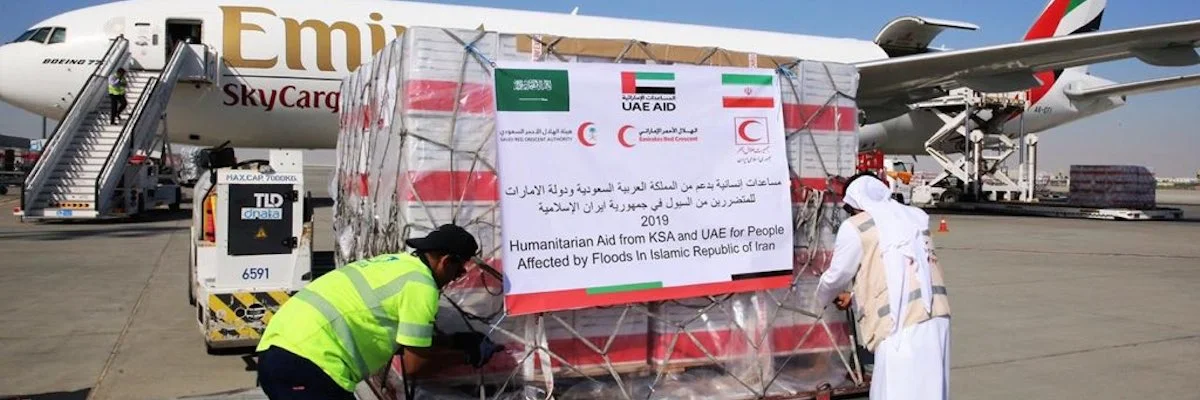
◢ Saudi Arabia and the UAE have sent 95 tons of humanitarian aid to their rival Iran as it reels from deadly floods, officials said Thursday, after Tehran complained US sanctions were obstructing relief. The aid, which includes food and shelter material, was authorized by Saudi Arabia's king and crown prince, it added.
Saudi Arabia and the UAE have sent 95 tons of humanitarian aid to their rival Iran as it reels from deadly floods, officials said Thursday, after Tehran complained US sanctions were obstructing relief.
"The Saudi Red Crescent, as part of a joint Saudi-UAE initiative to alleviate the suffering of Iranian citizens, has dispatched a relief plane to Tehran with 95 tons of humanitarian aid to support those affected by floods," the official Saudi Press Agency said.
The aid, which includes food and shelter material, was authorized by Saudi Arabia's king and crown prince, it added.
The Emirates Red Crescent was also involved in the relief operation, the UAE's official WAM news agency said.
At least 76 people have died in Iran after torrential rainfall, which has also caused billions of dollars worth of damage since March 19.
Iran's Red Crescent has repeatedly complained that US banking sanctions re-imposed last year make it impossible to receive donations from outside the country.
US President Donald Trump last year withdrew Washington from a multilateral agreement on Iran'snuclear program, later re-imposing sanctions focusing on oil exports and financial transactions.
Sunni powerhouse Saudi Arabia and Shiite-dominated Iran have a longstanding rivalry based as much on geostrategic interests as religious differences.
Facing off across the Gulf, the two major oil producers have taken opposing sides for decades in conflicts across the Middle East.
Riyadh broke off diplomatic relations with Tehran in 2016 in protest at the torching of its diplomatic missions by Iranian protesters angry over its execution of a leading Shiite cleric.
Photo: Saudi Red Crescent
Iran Orders More Than 60,000 to Evacuate Food-Hit Oil City
◢ Authorities ordered tens of thousands of residents of the southwestern Iranian city of Ahvaz to evacuate immediately on Wednesday as floodwaters entered the capital of oil-rich Khuzestan province, state television reported. The province's governor, Gholamreza Shariati, said he ordered the evacuation of five districts as a "precautionary and preventive move to avert any danger.”
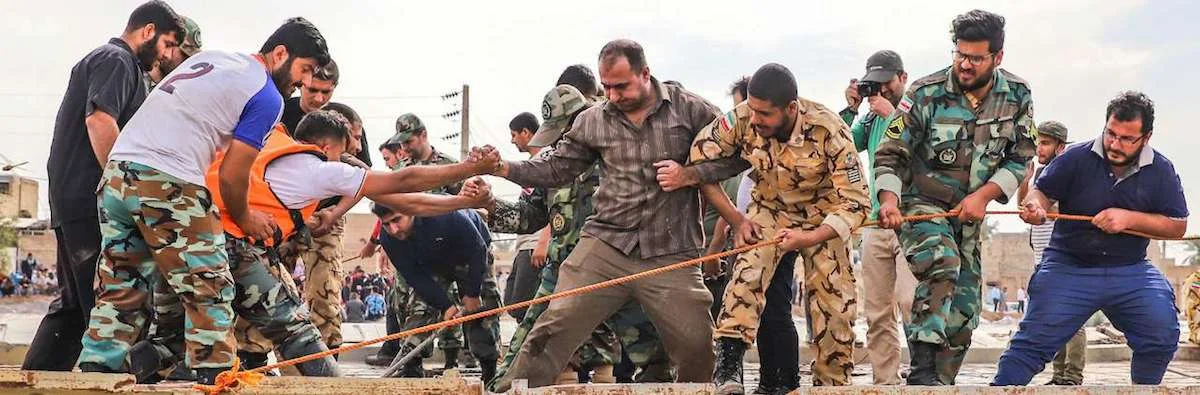
Authorities ordered tens of thousands of residents of the southwestern Iranian city of Ahvaz to evacuate immediately on Wednesday as floodwaters entered the capital of oil-rich Khuzestan province, state television reported.
The province's governor, Gholamreza Shariati, said he ordered the evacuation of five districts as a "precautionary and preventive move to avert any danger", Iran's Tasnim news agency reported.
The districts have an estimated population of between 60,000 and 70,000.
Shariati asked young men to "help us in building dykes and to assist in the evacuation of women, children and the elderly."
"The Dez and Karkheh rivers have for the first time joined each other near Ahvaz and are now flowing towards the city," Shariati told state TV, adding this was unprecedented.
"These two rivers are far away from each other, but the huge volume of floodwater caused them to join up.”
Shariati said a sixth district was also put on standby for possible evacuation.
Khuzestan province has been struggling with major floods due to heavy rains as well as floodwater coming from the north.
It is the latest in a series of unprecedented floods that have hit the normally arid country since March 19, killing at least 70 people in 20 of Iran's 31 provinces.
The country's northeast was first swamped on March 19 before the west and southwest of the country were hit on March 25.
Food is Priority
On April 1 the west and southwest were again swamped by floods when heavy rains returned.
The huge inflow of water forced authorities to release large volumes of water from the province's largest dams, which is now threatening some of the cities downstream including the Ahvaz region, home to 1.3 million.
Authorities ordered the evacuation of six new cities along the Karkheh river on Saturday as the situation neared "critical" status.
"We've been trying to manage the water ... most of it has been diverted toward other channels," Ahvaz Mayor Mansour Katanbaf told ISNA on Sunday.
But on Monday a hospital in danger of being flooded was evacuated in Ahvaz as officials battled to contain the rising waters.
Emergency services have been left scrambling to prevent further loss of life and to provide relief to flood-stricken residents.
"Delivering food and hygienic goods to (shelter) camps is our primary priority and we have provided emergency accommodations for about 44,000 people," Iran Red Crescent's head of Relief and Rescue Organization Morteza Salimi told AFP on Tuesday.
In the city of Susangerd, swamped by floodwaters, an AFP team dispatched to the region saw residents living in tents setup on the roofs of their homes as what had previously been roads had become canals marked by the palm trees lining the streets.
Red Crescent choppers were providing food and basic goods to regions cutoff by floods, with villagers rushing to receive the help as they approached.
The flooding across Iran has caused damage worth IRR 150 trillion—more than USD 1 billion at the free market rate—according to an official estimate given by lawmaker Mehrdad Lahooti.
Photo Credit: IRNA
Iran Orders Evacuation of Flood-Hit Western Cities
◢ Iranian authorities on Monday ordered the immediate evacuation of flood-stricken cities in a western province as rivers burst their banks, dams overflowed and vast areas were cut off from communication. The highest level of alert was declared in Lorestan province with four or five cities "completely critical", state television news network IRINN reported from Khorramabad, the region's capital.
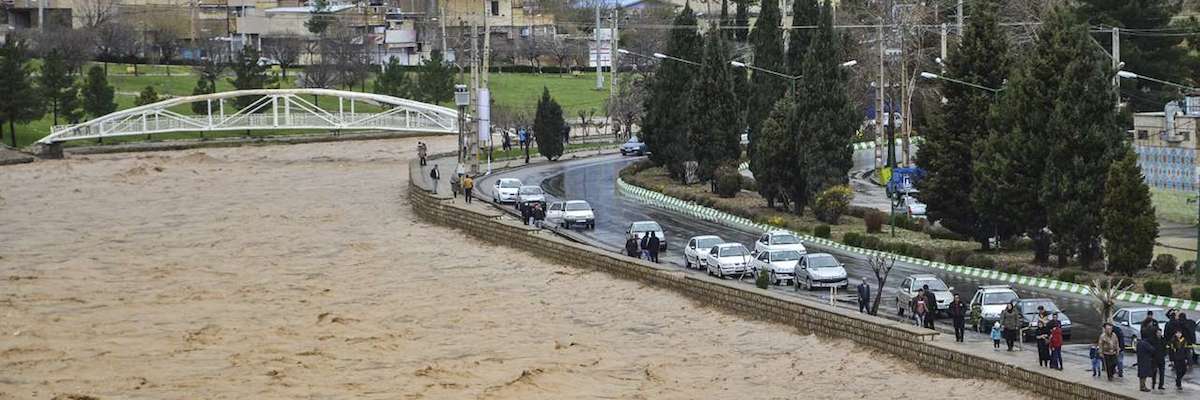
Iranian authorities on Monday ordered the immediate evacuation of flood-stricken cities in a western province as rivers burst their banks, dams overflowed and vast areas were cut off from communication.
The highest level of alert was declared in Lorestan province with four or five cities "completely critical", state television news network IRINN reported from Khorramabad, the region's capital.
"In Khorramabad the water has risen by as much as three metres (nearly 10 feet) in parts... and reports are coming in of regions... completely submerged with residents stranded on their rooftops," it added.
The Red Crescent's provincial director, Sarem Rezaee, said his organization had lost contact with much of the region.
"Telephones are not working, our radio communications are down... at this moment we have no news of other cities and villages," he told IRINN, adding roads were flooded and helicopters were unable to take off due to the bad weather.
"We have requested emergency help from neighbouring provinces but at the present no one can do anything."
The airport in the western city of Khorramabad was flooded, with images showing water submerging the runway and cutting the province's main air link to the rest of the country.
Authorities in Lorestan ordered evacuations in many regions, bringing in the armed forces to forcibly remove those who do not comply, local media reported.
The authorities said Pol-e-Dokhtar and Mamulan cities were already half submerged, with one fatality reported in Mamulan.
Images on local media show water gushing through streets in Pol-e-Dokhtar where the water level had reached 1.5 metres (five feet).
Every village in the vicinity of the two cities had been surrounded by flood waters while all five dams in Lorestan had reached capacity and four of them were overflowing.
Numerous rivers had burst their banks and landslides blocked many roads, said the reports.
Media outlets showed images of collapsed bridges and oil and gas pipelines destroyed by the flood.
The main railway line linking Tehran to the south of the country had also been blocked by the flood.
This is the third major flood to hit Iran in the past two weeks with unprecedented rainfalls in the mostly arid country that had endured a decades long drought until this year.
The first occurred in the northeast of the country on March 19 and the second struck the west and southwest of Iran on March 25 with a combined toll of 45 people killed.
The present flood has again struck in the west and southwest following heavy rain that is set to continue into Tuesday.
Apart from Lorestan half a dozen other provinces are also facing critical circumstances, with the emergency services reporting 23 out of Iran's 31 provinces have been affected and could face floods.
With the consecutive floods the reservoirs of many dams have reached full capacity forcing emergency discharge, as much as 1,800 cubic meters per second in some cases, to prevent them from breaking.
Photo Credit: IRNA

Iran President Visits Flood-Hit Zones as Death Toll Hits 43
◢ President Hassan Rouhani travelled to flood-hit zones of Iran for the first time Wednesday after nine days of heavy rains that have inundated most of the country and killed 43 people. The authorities have been struggling to cope with flooding after extreme rainfall which at times has been equivalent to half of the average annual levels within 24 hours.
President Hassan Rouhani travelled to flood-hit zones of Iran for the first time Wednesday after nine days of heavy rains that have inundated most of the country and killed 43 people.
The authorities have been struggling to cope with flooding after extreme rainfall which at times has been equivalent to half of the average annual levels within 24 hours.
The disaster, which one government minister blamed on climate change, struck in the middle of Iranian New Year break, with many relief workers on leave and millions of holiday-makers on the roads.
"When suddenly 25 out of 31, and on some days all provinces are struck (by flooding), this may be an unprecedented phenomenon," Rouhani said in Tehran, quoted by the government's website.
Rouhani then flew to the northeastern province of Golestan, one of the areas where the floods first struck on March 19 and have since killed at least 10 people, according to the latest official figures.
Speaking at a crisis meeting in Golestan aired live on state television, Rouhani responded to criticism he was slow to visit the disaster-hit zone.
"I had planned to come in the first days, but ultimately due to considerations it was decided the first vice-president would travel here," he said.
The deluge spread rapidly from the north to the west and south of the country on March 25 before hitting the centre of Iran as the weather front moved eastwards.
"In some regions, rainfall within 24 hours equalled that of the prior 10 months," said Mahmoodreza Peiravi, secretary general of Iran's Red Crescent Society.
"If you take the number and ferocity of the floods into account, the death toll was thankfully not that high," he said, while warning it could rise in coming days.
"The floods struck during the holidays and many vacationers on road trips were affected by it," Peiravi told AFP.
"It is possible that some vacationers might have been carried off by the floods and no one is yet aware of it," he warned.
Day of Mourning
A day of mourning has been declared for Thursday in the southern city of Shiraz, the worst-hit area where the flooding claimed the lives of 19 people and injured more than 100.
The latest toll included six people who drowned when a boat full of rescuers and victims overturned in the northeastern Gomishan region in Golestan province.
"Another body has been found but we have not yet recovered it," the area's emergency services head Alireza Kamalgharibi said, adding that search and rescue operations would continue as it was unclear how many people had been on board the boat.
Another four people were killed in the western provinces of Kogiluyeh-Va-Boyerahmad and Lorestan, said Morteza Salimi, head of the Iranian Red Crescent's search and rescue organization.
One death was also reported in each of Khuzestan, Kermanshah and Semnan provinces.
“More than 43,000 people were rescued and nearly 27,000 were provided with emergency accommodation," Salimi said, quoted by Tasnim news agency, adding rescue operations had been carried out in 30 provinces.
Officials estimate the flooding caused hundreds of millions of dollars in damage to homes, farms and infrastructure.
The skies have mostly cleared up for now but Iran's meteorological service has warned of more heavy showers from Saturday.
Such a widespread flood threat is unprecedented in arid Iran, which until 2018 was dealing with decades of drought.
"Climate change is forcing itself on our country," Energy Minister Reza Ardekanian, who is in charge of dams and water supply, said on Monday.
"These unprecedented floods in our country are because of climate change worldwide," he added.
Photo Credit: IRNA