
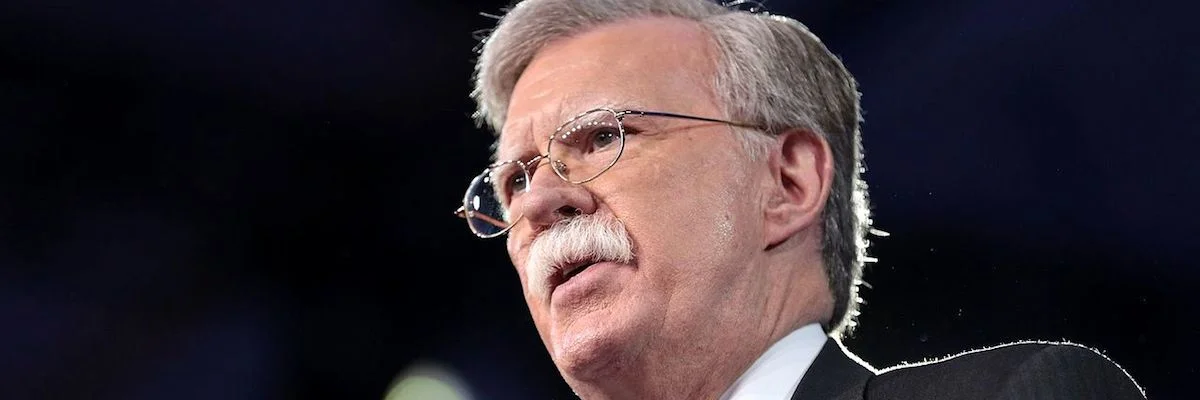
Bolton to Press Britain's Johnson on Iran
◢ US National Security Advisor John Bolton was Monday to sound out British Prime Minister Boris Johnson on global disputes that include an escalating Gulf standoff with Iran. The hawkish White House aide is the most senior US official to meet Johnson since he succeeded Theresa May as UK government leader last month.
US National Security Advisor John Bolton was Monday to sound out British Prime Minister Boris Johnson on global disputes that include an escalating Gulf standoff with Iran.
The hawkish White House aide is the most senior US official to meet Johnson since he succeeded Theresa May as UK government leader last month.
A spokesman for Johnson said the two would talk about "a range of security issues, including Iran".
The meeting comes with US President Donald Trump's administration pursuing a "maximum pressure" campaign designed to force the Islamic republic to limit nuclear and military activities.
Washington also wants its close European ally to drop—or at the very least severely restrict—plans to use 5G technology made by China's Huawei when it rolls out the next-generation data network.
US media reports said Washington was not expecting a decision from London on either issue during Bolton's two-day visit.
The Downing Street spokesman said London's position on both Iran and Huawei "remains the same.”
Uncertain Future
Bolton's trip comes with Britain in political crisis and the pound straddling multi-year lows as deadline approaches for the UK to leave the EU after more than 40 years.
Johnson has vowed to meet the twice-delayed Brexit date—now October 31—even if it means leaving without a proper plan to regulate trade and other ties.
Senior UK economic officials and big industries warn that this "no-deal Brexit" option could create border chaos and set off global financial tremors in the short term.
The EU is refusing to re-open negotiations on the deal the bloc's 27 leaders signed last year with May. Johnson and his supporters call the existing agreement unfair.
But a clean break with the EU would allow the UK to immediately launch negotiations on a free trade agreement with the United States.
The US president openly rooted for Johnson during his campaign for May's job following her resignation over the Brexit impasse.
He branded Johnson as Britain's Trump and said the sides were on the verge of making a breakthrough in ties.
Britain and its European allies have irritated Trump's team by trying to save a landmark nuclear agreement with Iran which Washington pulled out of last year.
Britain last week decided to join forces with the US to protect merchant vessels in the Gulf.
It marked a departure in policy for Johnson following May's attempts to form a European-led group.
Britain's decision on Huawei—a private firm that Washington says is obliged to spy for the Chinese government—has been repeatedly delayed due to mixed signals from Trump about his own administration's next steps.
Johnson's spokesman said the UK government was "still assessing the impact" of Trump's decision in May to effectively ban Huawei from trading with US firms.
Photo: Wikicommons

Trump Sees Chance With Boris Johnson to Lure UK on Iran, Huawei
◢ As Boris Johnson hurtles toward a no-deal Brexit that could leave the U.K. diplomatically adrift and economically vulnerable, President Donald Trump is looking to seize an opportunity to lure the country away from Europe on some of his top foreign policy priorities: Iran and Huawei.
By David Wainer
As Boris Johnson hurtles toward a no-deal Brexit that could leave the U.K. diplomatically adrift and economically vulnerable, President Donald Trump is looking to seize an opportunity to lure the country away from Europe on some of his top foreign policy priorities: Iran and Huawei.
Yet with Johnson focused on negotiating a breakup with the European Union—and perhaps a snap election at home—the White House may have to be patient in its hopes that the U.K.’s leadership change will bring closer alignment on issues including sanctioning Iran’s nuclear program and blocking Huawei Technologies Co. equipment from new 5G mobile networks.
Trump is pressing his case regardless. He and Johnson spoke by phone last week about “areas of further cooperation,” including trade, 5G technology and global security, according to a White House statement. With Johnson—a “good man” Trump has long praised for wanting to leave the EU—now at 10 Downing Street, the U.S. sees Johnson’s need for an eventual bilateral trade deal with America as leverage to peel Britain away from Europe on key issues.
In a first bid to serve as a bridge between the White House and European allies, the U.K. announced on Monday that it will lead “an international mission to restore safe passage” in the Persian Gulf, working with partners including the U.S. Navy. The move offers a face-saving opportunity for countries that spurned a U.S.-led initiative because they blame Trump for quitting the 2015 nuclear accord with Iran.
A senior White House official said the U.S. expects cooperation will grow more robust with the new government, as the two countries work together extensively on security issues including North Korea. Secretary of State Michael Pompeo predicted the nations that long have boasted of their “special relationship” will grow even closer.
“I think we’ll find that there’s a very good working relationship there,” Pompeo said in a Bloomberg TV interview last month. “When the prime minister gets his feet on the ground, I’m looking forward to having a chance to chat with him and his foreign secretary so that we can deliver on behalf of these two important democracies.”
New Foreign Secretary Dominic Raab will be in Washington this week, and his language will be mined for clues on where the U.K. is headed.
Working in the U.S.’s favor is Johnson’s need to seal a trade deal with Washington after the U.K.’s departure from the EU, expected Oct. 31. To help smooth that process, Johnson could take more symbolic steps to spurn Europe and sidle up to Trump.
Key Question: Iran
Johnson’s proposal on Gulf maritime security was welcomed by the U.S. But that doesn’t mean he’s ready to follow Trump in quitting the multinational nuclear agreement the American president has called the “worst deal ever.” In announcing the maritime mission, Raab, the foreign minister, said, “We remain committed to working with Iran and our international partners to de-escalate the situation and maintain the nuclear deal.”
Johnson has repeatedly signaled that he’s a strong supporter of the nuclear deal, which the U.K. and other participating nations have struggled to maintain in the face of renewed U.S. sanctions against Iran. As British foreign minister in 2018, when Trump pulled out of the agreement, Johnson said talks with Tehran culminating in a new accord were difficult to imagine.
“One of the big questions is whether he will break with European unity on Iran,” said Richard Nephew, a Columbia University scholar who was part of the U.S. team that negotiated the nuclear accord. “He needs Trump on his side, at the very least promising a favorable trade deal, as he takes the U.K. down the Brexit route.”
Germany’s Worries
In Germany, there’s concern that Johnson and Trump will try to build a new version of the “special relationship,” according to a coalition official in Berlin.
The Germans see Johnson’s intention to seek a trade deal with the U.S. at a time when the EU is already negotiating such a pact as further evidence of a breach, said the official, who asked not to identified discussing Britain’s political direction. French President Emmanuel Macron’s aides also routinely say that they see the British as potential trouble-makers on trade.
Despite receiving invitations, Johnson hasn’t traveled to the major European capitals. By contrast, his predecessor went to Berlin within days of coming to power.
In the most telling example of friction between London and its European partners, the U.K. undercut a French-led initiative to find a common candidate to lead the International Monetary Fund. Mere hours before EU governments were to begin voting on a candidate, the U.K. suddenly objected to the process and said it wouldn’t take part in offering a potential nominee or in the voting, according to a source familiar with the interaction.
All this is fertile ground for the White House to act to pull the U.K. away, and the promise of a free-trade deal is the biggest carrot of all for a prime minister determined to bring about Brexit and deliver on its promised benefits. That’s why Johnson’s meeting with Trump at the Group of Seven summit in France this month will be the most-watched bilateral of them all for the Europeans.
Picking an Envoy
Johnson will also have a chance to appoint a new ambassador to Washington because Kim Darroch abruptly resigned last month after the leak of internal messages in which he criticized the Trump administration as “clumsy and inept.”
Johnson’s failure to defend Darroch in a televised campaign debate brought criticism from a Foreign Office official who said he’d thrown the ambassador “under a bus.”
Trump had failed to win British support on a number of issues under former Prime Minister Theresa May. A U.K. government official said the U.S. relationship can only improve in light of May’s lack of rapport with Trump. The official predicted a strengthening of relations, drawing on new opportunities on trade and other issues, but not a total reset of ties.
Even under Johnson, breaking the U.K. away from the European Union on foreign policy will be tough, according to three senior European diplomats with knowledge of the new British government. Any moves to cozy up to Trump may be more symbolic than substantive, particularly because Johnson has to worry about maintaining a single-seat majority in the House of Commons.
‘Political Opportunists’
“What Trump and Johnson have in common is they are political opportunists,” said Charles Kupchan, former senior director for European Affairs at the National Security Council in the Obama administration. “They believe in America First, Britain First. They’re out for themselves and I don’t think either Trump or Johnson will be making sacrifices to help each other.”
And while the U.K. is still reviewing its position on Huawei, which the U.S. sees as a stalking horse for Chinese spying and wants banned from allied nations, all four U.K. carriers are already building their 5G networks using equipment from Huawei. BT Group Plc’s EE and Vodafone Group Plc have even gone live with their Huawei-supported 5G. Delaying or freezing that deployment would be an additional hit to an increasingly fragile British economy.
Showman Politics
Trump may have to be patient, knowing the U.K. leader has other priorities. Unlike May, who Trump publicly criticized on multiple occasions, the president sees in Johnson’s rise a vindication of his own style of showman politics.
“Trump from the get-go has been a supporter of getting on with Brexit and he likes populist and right-wing leaders, wherever they may be,” said Kupchan, the former Obama administration official who’s now a senior fellow at the Council on Foreign Relations.
But unlike Trump, Johnson has less room for error on the world stage and is therefore expected to be less volatile. While Trump can insult allies and foes, tear up agreements, and still command any leader’s attention, the U.K. is a diminishing power, said Andreas Krieg, who teaches defense studies at King’s College London.
“He talks about building a Global Britain but he know there’s no capacity to build a global power,” said Krieg. “He understands Britain is not America.”
Photo: Wikicommons
US Slaps 13 Charges on Huawei, Executive Over Iran Sanctions Violations
◢ The US Justice Department on Monday unveiled sweeping charges against Chinese telecommunications giant Huawei in two cases likely to ratchet up tensions between the two superpowers—including that of a top executive arrested in Canada on a US warrant. Meng’s case has sparked a major crisis between Beijing and Ottawa, which is accused of doing Washington’s bidding.
The US Justice Department on Monday unveiled sweeping charges against Chinese telecommunications giant Huawei in two cases likely to ratchet up tensions between the two superpowers—including that of a top executive arrested in Canada on a US warrant.
The department unveiled 13 charges against Huawei Technologies, its chief financial officer Meng Wanzhou—the daughter of the company’s founder who is currently out on bail in Canada—and two affiliates related to violating US sanctions on Iran.
Meng’s case has sparked a major crisis between Beijing and Ottawa, which is accused of doing Washington’s bidding.
The indictment was unsealed as China’s top trade negotiator arrived in Washington for high-stakes talks with US officials, possibly complicating the discussions ahead of a March deadline to avert a deepening of their trade war.
In addition, 10 US federal charges were filed against two Huawei affiliates for stealing robot technology from T-Mobile.
“Both sets of charges expose Huawei’s brazen and persistent actions to exploit American companies and financial institutions, and to threaten the free and fair global marketplace,“ said FBI Director Christopher Wray.
China reacted furiously, saying there were “strong political manipulations” behind the case against Huawei.
In a statement sent to AFP, Huawei denied “that it or its subsidiary or affiliate have committed any of the asserted violations of US law set forth in each of the indictments.”
The firm “is not aware of any wrongdoing by Ms Meng (Wanzhou), and believes the US courts will ultimately reach the same conclusion,“ it added.
Extradition Request
Meng—who was arrested in Vancouver on Dec 1 at Washington’s request—is expected to fight extradition to the United States, amid heavy pressure on Canada from Beijing, whose subsequent detention of two Canadians is seen as an act of retaliation for Meng’s arrest.
Late Monday, Canada’s Justice Department confirmed that officials had received a formal extradition request from the US, reported Canadian broadcaster CBC, with a hearing set for Feb 6.
Acting US Attorney General Matthew Whitaker said there was nothing in the indictment that alleged Chinese government involvement in either case.
However, he added, “As I told Chinese officials in August, China must hold its citizens and Chinese companies accountable for complying with the law.”
The Chinese foreign ministry accused Washington of using “state power to discredit and crack down on specific Chinese companies in an attempt to strangle the enterprises’ legitimate and legal operations”.
“There are strong political motivations and political manipulations behind the actions,“ ministry spokesman Geng Shuang said in a statement, urging Washington to stop “the unreasonable suppression of Chinese companies including Huawei”.
The broader allegations against Meng, filed in federal court in New York, had already been revealed in general terms by Canadian authorities.
They allege that between 2007 and 2017, Meng, Huawei and the subsidiaries sought to mask their business with Iran in violation of US and UN sanctions on the country.
Meng in particular “repeatedly lied” to bankers about the relationships between the companies, especially with Skycom, a Huawei affiliate in Iran, according to the charges.
That violated US laws, the Justice Department said, because the Iran business involved US-dollar transactions processed by banks through the United States.
Huawei and the affiliates also lied to US authorities, obstructing the investigation, they said.
Beijing renewed its demand for the US to drop its warrant against Meng and for Canada to release her.
‘Bonuses for stealing tech secrets’
The second case charged that Huawei made a concerted effort to steal technology related to a phone-testing robot dubbed Tappy from a T-Mobile USA lab in Washington state.
Engineers of Huawei – which was supplying T-Mobile with phones – took pictures and made measurements of parts of the robot, “even stealing a piece of it,“ said Whitaker.
The Justice Department charged that the Chinese company had, in July 2013, offered bonuses to employees “based on the value of information they stole from other companies around the world, and provided to Huawei via an encrypted email address.”
The indictments came as Chinese Vice Premier Liu He arrived in Washington on Monday to lead trade talks this week, according to Chinese state media.
Speaking together with Justice Department officials announcing the indictments, US Secretary of Commerce Wilbur Ross said they were “wholly separate from our trade negotiations with China.”
However, he added: “Commerce will continue to work with our interagency partners to protect US national security interests.”
Photo Credit: Depositphoto
Huawei Exec Faces US Fraud Charges Linked to Iran, Court Hears
◢ Chinese telecom giant Huawei's chief financial officer faces US fraud charges related to sanctions-breaking business dealings with Iran. Meng Wanzhou was arrested in Canada's Pacific coast city of Vancouver on December 1 while changing planes during a trip from Hong Kong to Mexico—ratcheting tensions between the United States and China just as the countries' leaders agreed a truce in their trade war.
Chinese telecom giant Huawei's chief financial officer faces US fraud charges related to sanctions-breaking business dealings with Iran, a Canadian court heard Friday, a week after she was detained on an American extradition request.
Meng Wanzhou was arrested in Canada's Pacific coast city of Vancouver on December 1 while changing planes during a trip from Hong Kong to Mexico—ratcheting tensions between the United States and China just as the countries' leaders agreed a truce in their trade war.
A Canadian government lawyer asked the court to deny her bail, saying she has been accused of "conspiracy to defraud multiple financial institutions" and if convicted faces more than 30 years in prison.
She is specifically accused of lying to US banks about the use of a covert subsidiary to sell to Iran in breach of sanctions.
The lawyer said that Meng had personally denied to American bankers any direct connections between Huawei and the subsidiary, SkyCom, when in fact "SkyCom is Huawei." SkyCom's alleged sanctions breaches occurred from 2009 to 2014.
He suggested that Meng has also shown a pattern of avoiding the United States over the past year since becoming aware of the investigation into the matter, argued that she has no ties to Canada and has access to vast wealth and political connections—and thus poses a flight risk.
Meng's detention in Canada came on the day of a summit at which US President Donald Trump and his Chinese counterpart Xi Jinping agreed to a truce in the escalating trade dispute opposing the two economic powerhouses.
China says Meng—the daughter of Huawei founder Ren Zhengfei, a former engineer in China's People's Liberation Army—has violated no laws in Canada or the United States and has demanded her release.
Washington and Beijing have exchanged steep tariffs on more than USD 300 billion in total two-way trade, locking them in a conflict that has begun to eat into profits.
Trump tweeted Friday that negotiations to defuse the high stakes dispute were "going very well" but the messages since Meng's arrest have been mixed, roiling global stock markets.
Her appearance at the British Columbia Supreme Court in Vancouver is a prelude to an extradition process that could take months.
'Princess' of Huawei
CNN, quoting an unnamed official, said the United States saw the arrest as providing leverage in US-China trade talks—although White House trade advisor Peter Navarro has denied any link to the dialogue.
On Friday, Beijing nevertheless alleged that Meng, known internally as the "princess" of Huawei and possible heir to the throne, had become a pawn in the dispute.
"The Chinese government should seriously mull over the US tendency to abuse legal procedures to suppress China's high-tech enterprises," said the nationalist tabloid Global Times in an editorial.
"Obviously, Washington is resorting to a despicable rogue's approach as it cannot stop Huawei's 5G advance in the market," it went on.
Meng spent most of the past week at a women's detention facility in a suburb of Vancouver.
If she is released on bail, she would likely have to surrender her passport and submit to electronic monitoring until she is discharged or surrendered for trial to the United States. All security costs would be borne by her.
The extradition process could take months, even years, if appeals are made in the case. The Vancouver Sun reported on Friday that Meng's husband Xiaozong Liu is believed to own at least one luxury home in the city.
Repeated Setbacks
Canada is one of more than 100 countries that have an extradition treaty with the United States, requiring it to cooperate with US Department of Justice requests to hand over suspects.
This longstanding treaty requires that the offense for which extradition is being sought is also a crime in Canada.
A Canadian court must decide if there is sufficient evidence to support the extradition, but then it is left to Canada's justice minister to sign the order.
On Thursday, Prime Minister Justin Trudeau defended Canada's arrest of Meng, saying politics played no part in the decision.
"I can assure everyone that we are a country (with) an independent judiciary," Trudeau told a tech conference in Montreal.
Huawei's affordable smartphones have made strong inroads in the developing world, but the company has faced repeated setbacks in major Western economies over security concerns.
Earlier this week, Canadian officials said Ottawa was continuing to review Huawei's technology for use in upcoming fifth generation networks.
The company faces being shut out of Australia, New Zealand and US 5G rollouts, and British telecom group BT revealed on Wednesday it was removing Huawei equipment from its core cellular network.
The five nations together form the "Five Eyes" intelligence alliance.
Photo Credit: Wikicommons
China Warns US Against Causing 'Damage' to Trade in Huawei Probe
◢ China warned the United States on Thursday against harming trade after a report that US authorities had opened an investigation into suspected violations of Iran sanctions by China's Huawei Technologies. A US Justice Department probe would come on the back of subpoenas issued to the company by the US Commerce and Treasury Departments.
China warned the United States on Thursday against harming trade after a report that US authorities had opened an investigation into suspected violations of Iran sanctions by China's Huawei Technologies.
A US Justice Department probe would come on the back of subpoenas issued to the company by the US Commerce and Treasury Departments over sanctions-related issues, according to the Wall Street Journal.
Huawei—one of the world's largest telecommunications equipment and services providers—has been under tough scrutiny in the United States, where government national security officials say that its alleged close links to the Chinese government make it a security risk.
Its US business has been tightly constrained by worries it could undermine US competitors and that its cellphones and networking equipment, used widely in other countries, could provide Beijing with avenues for espionage.
The Journal report gave no details about the investigation. The New York Times has reported that the company has been subpoenaed by the Commerce and Treasury Departments over alleged violations of Iran and North Korea sanctions.
Huawei would not comment on the Journal report. "Huawei complies with all applicable laws and regulations where it operates, including the applicable export control and sanction laws and regulations of the UN, US and EU," spokesman Charles Zinkowski said in a statement.
Chinese foreign ministry spokeswoman Hua Chunying said she had seen the report.
"We hope that the US doesn't take any further steps to damage confidence in the American business environment," Hua said at a regular press briefing.
Hua added that China hopes "the US doesn't do things that damage its domestic economy and the normal, transparent, mutually beneficial development of international trade."
Signaling the rising unease in the United States towards Huawei and fellow Chinese telecoms group ZTE Corp, last month the Federal Communications Commission proposed a new rule that would restrict small telecoms carriers from purchasing "equipment or services from companies that pose a national security threat."
Major US telecoms companies have already steered clear of the two Chinese firms, sometimes on the strong suggestions of US officials.
The cases come as the United States and China are gearing up for a potential trade war, with the high-tech sector among the concerns for both sides.
Photo Credit: Wikicommons