
Iran Policy in Holding Pattern Before Elections
The sudden departure of Brian Hook leaves the Trump administration scrambling to snatch some victory after two years of “maximum pressure” on Iran.
By Robbie Gramer and Jack Detsch
Brian Hook’s abrupt departure as the Trump administration’s top Iran envoy leaves an uncertain future for the White House’s biggest Middle East policy, two years after President Donald Trump abandoned the Iran nuclear pact and proclaimed he could secure a “new and lasting deal.”
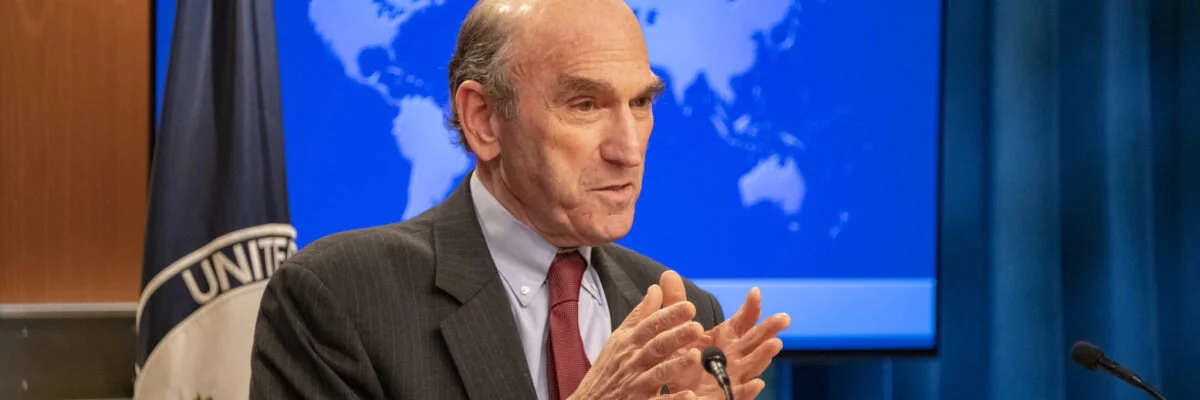
Hook’s replacement, Elliott Abrams, will simultaneously continue as the administration’s envoy for Venezuela, making him responsible for two defining Trump foreign-policy initiatives—neither of which has yielded the kind of high-profile victory the White House once hoped for.
The big question now is who wins this November’s U.S. presidential election. Iran has been rocked by mysterious explosions for weeks and may privately suspect U.S. involvement, but it is wary about rocking the boat before seeing if Trump wins reelection. But there’s also little chance for any last-minute outreach to Iran to secure a new and improved deal before the vote.
“The administration is sunk in a deep rut of its own devising, with no pathway to negotiations,” said Barbara Leaf, a former U.S. ambassador to the United Arab Emirates during the Obama and Trump administrations. “And needless to say, Tehran will not pick up the phone if Washington rings before November 3rd.”
Abrams, the longtime foreign-policy hawk taking over from Hook, would also bring potential baggage to the new role. He is perhaps best known for pleading guilty for lying to Congress over the Iran-Contra scandal during the Ronald Reagan administration. Some former officials think Abrams might use the remaining months before the election to tighten the screws on Iran, whether through an increase in the mysterious attacks inside the coronavirus-racked country or by further deepening U.S. relations with Israel.
“I think Abrams is much smarter than Hook. He may be more effective,” one former U.S. official said. “They don’t have time to get things done, but they do have time to make trouble.”
Iran’s challenge will be to lie low until it knows whom it will be dealing with next year.
“I think the Iranians are concerned about Trump because of how unpredictable he’s been, and I think they see the U.S. as implicated in the explosions,” said Ariane Tabatabai, a Middle East fellow at the German Marshall Fund of the United States who specializes in Iran. “But they’re careful not to talk too much about it because of the fact that then they’d have to do something and they don’t want to rock the boat.”
If Trump does win, some administration officials expect that Iran might finally come to the table to discuss a new nuclear accord, due to the unsustainable pressure from loads of U.S. economic sanctions that have pushed Iran’s economy to the brink.
“When it comes to Iran, the election is a big part of their calculation,” one U.S. official said. “If Trump ends up winning the election, I think you’re going to end up seeing some movement on these things.”
“We still believe the only way the current Iranian government has ever come to the table is pressure,” the official added.
Hook shepherded the so-called “maximum pressure” campaign on Iran for two years, overseeing a substantial expansion of U.S. sanctions that put the administration squarely at odds with European allies who have tried to keep afloat the Iran nuclear deal, formally called the Joint Comprehensive Plan of Action (JCPOA).
Hook, considered a moderate Republican, became an influential behind-the-scenes fixture first under former Secretary of State Rex Tillerson and later as point man on Iran. He long argued, including in a Q&A with Foreign Policy, that the onus was on Tehran to come to the table for new talks after the Trump administration pulled out of the deal in 2018.
Instead of agreeing to talk, Iran shook off the deal’s constraints on uranium enrichment and nuclear development, potentially shortening its breakout time to acquire nuclear capability. Former administration officials pointed to Iran’s stepped-up activity, a series of attacks on oil tankers in the Persian Gulf, and the downing of an American drone as evidence that Hook was increasingly the spokesperson for a failed strategy.
“I don’t think the [White House] will admit the strategy was a failure,” a former senior Trump administration official told Foreign Policy. “But Iran is breaking the JCPOA limits on enrichment and storage, so it will be super difficult to say it is working.”
News of Hook’s departure comes as the Trump administration faces likely defeat on his major diplomatic initiative at the U.N. Security Council next week: a U.N. resolution to extend a conventional arms embargo on Tehran. China and Russia, veto-wielding members of the Security Council, are unlikely to back the resolution, several diplomatic sources said. Hook will stay in his role to see through the U.N. fight, a State Department official told Foreign Policy.
Some former officials see Trump’s Iran policy as a way to try to fence in Joe Biden should he win. The former vice president has expressed a willingness for the United States to return to compliance with the 2015 Iran nuclear deal. By extending the arms embargo and triggering snapback sanctions, the United States could potentially shatter the legal framework underpinning the deal, experts suggested.
“At this stage, the Trump administration’s Iran policy is all about preparing for Trump’s loss and trying to pin down a future President Biden in his options with Iran,” said Jarrett Blanc, the former State Department coordinator for Iran nuclear implementation during the Obama administration and now a senior fellow at the Carnegie Endowment for International Peace. “I think they’re likely to fail at that effort.”
Photo: Wikicommons

US Pointman on Iran Hard Line Quits
The envoy leading President Donald Trump's hardline push on Iran quit on Thursday, months before an election that could reorient US policy.
Bu Shaun Tandon
The envoy leading President Donald Trump's hardline push on Iran quit on Thursday, months before an election that could reorient US policy.
Brian Hook, a stalwart Republican considered one of the most powerful figures at the State Department, decided to return to the private sector, Secretary of State Mike Pompeo said.
Hook "has achieved historic results countering the Iranian regime," Pompeo said in a statement.
Hook will be replaced by Elliott Abrams, an intellectual architect of the 2003 invasion of Iraq who has been leading Trump's unsuccessful campaign to oust Venezuela's leftist president, Nicolas Maduro.
Abrams, known in the 1980s for his staunch defense of right-wing strongmen in Latin America, will handle both Iran and Venezuela, Pompeo said.
Hook has been at the forefront of Trump's campaign against Iran's clerical state which has included pulling out of a nuclear accord and imposing punishing unilateral sanctions.
Hook's decision to head to the private sector comes three months before US elections in which Trump is trailing Democrat Joe Biden in the polls.
Biden was a strong backer of the nuclear deal negotiated under former president Barack Obama and has promised to salvage a diplomatic solution.
Hook exits just as the Trump administration readies a key effort on Iran—seeking to extend an arms embargo on Tehran through the UN Security Council.
If the effort fails, Pompeo and Hook have threatened to employ a disputed legal procedure aimed at forcing UN sanctions against Iran.
'Crisis of Legitimacy'
A dour, bespectacled lawyer whose formal manner seems more out of Britain than his Midwestern home state of Iowa, Hook was put in charge of strategic planning at the State Department following Trump's election.
After becoming secretary of state in 2018, Pompeo made 12 sweeping demands of Iran that included giving up its activities across the Middle East and soon put Hook in charge of the effort.
Tensions soared to a new high in January this year when Trump ordered a drone strike that killed a top Iranian general, Qasem Soleimani, at Baghdad's airport.
Critics say that the effort led by Hook badly backfired with Iran only expanding its regional operations and taking steps out of the nuclear deal with which it had been in compliance.
"Few human beings have done more to advance the Iranian nuclear program than Brian Hook," said Ben Rhodes, one of Obama's closest foreign policy aides.
"It was rolled back when he took his job, now it's moving forward," he wrote on Twitter.
Taken to task on his record at an event Wednesday, Hook said that Iran was facing its worst economic crisis since the 1979 Islamic revolution and that mass protests in Iraq and Lebanon showed opposition to Tehran.
"They're facing a crisis of legitimacy and credibility with their own people. The regime today clings to power on the basis of brute force," Hook told the Aspen Security Forum.
"And these are not things that we were talking about three and a half years ago when we came into office."
Hook played the lead role in the release of two US citizens imprisoned in Iran, Princeton scholar Xiyue Wang and military veteran Michael White.
He was also faulted by the State Department's internal watchdog over the ousting of a department employee of Iranian descent.
The inspector general did not find that Hook shared bias but said he did not distance himself from a smear campaign.
Hook rejected the findings of the report and Trump later sacked the inspector general, Steve Linick, who had also been conducting an unrelated probe into Pompeo.
Photo: IRNA

Iran Warns US Against Disrupting Oil Shipments to Venezuela
Iran's foreign minister on Sunday warned the US against deploying its navy in the Caribbean to disrupt Iranian fuel shipments to Venezuela.
Iran's foreign minister on Sunday warned the US against deploying its navy in the Caribbean to disrupt Iranian fuel shipments to Venezuela.
In a letter to United Nations chief Antonio Guterres, Mohammad Javad Zarif warned against "America's movements in deploying its navy to the Caribbean in order to intervene and create disruption in (the) transfer of Iran's fuel to Venezuela."
He said that any such action would be "illegal and a form of piracy," according to a foreign ministry statement.
Zarif added that the US would be responsible for "the consequences of any illegal measure."
Iran's Fars News claimed Saturday that it had received information that four US Navy warships are in the Caribbean for a "possible confrontation with Iran's tankers."
Elliot Abrams, the State Department's Venezuela envoy, has alleged that Caracas is paying Iran in gold to restore its troubled oil sector.
The US has imposed unilateral sanctions aimed at ending oil exports by both Iran and Venezuela, both major crude producers.
Zarif's deputy has summoned the Swiss ambassador, who represents Washington's interests in Tehran, to communicate Iran's "serious warning".
Abbas Araghchi said any potential threat to Iran's tankers would be met with a "quick and decisive response."
Venezuela has the world's largest proven oil reserves but analysts say that the sector operates below capacity.
The country's economy is in a state of collapse, with millions fleeing as they lack basic goods.
Iran has also taken a hit from renewed US sanctions after US President Donald Trump pulled out of a nuclear accord in 2018.
Maduro has withstood more than a year of US-led efforts to remove him and retains the support of the military.
Iran has repeatedly expressed support for Maduro against opposition leader Juan Guaido, who is recognised by some 60 nations as interim president due to reports of irregularities in Maduro's 2018 re-election.
Photo: IRNA