

Democrats Push Back on Sanctions, Citing Coronavirus Fears
Top Democrats in Congress are urging the Trump administration to ease sanctions on Iran, Venezuela, and other countries badly hit by the coronavirus pandemic, citing the need to provide medical supplies and humanitarian support.
By Jack Detsch
Top Democrats in Congress are urging the Trump administration to ease sanctions on Iran, Venezuela, and other countries badly hit by the coronavirus pandemic, citing the need to provide medical supplies and humanitarian support.
In a stream of several letters aimed at Secretary of State Mike Pompeo and other top U.S. officials, Democratic members of Congress including presidential candidate Sen. Bernie Sanders and Rep. Alexandria Ocasio-Cortez are pushing for the administration to grant clearly outlined waivers from American sanctions.
Democratic Sen. Chris Murphy also spearheaded a call by several Democrats to the Trump administration to ease U.S. sanctions against countries, including Iran and Venezuela, hit hard by coronavirus, saying the measures are hampering the free flow of medicines and other humanitarian supplies to the neediest as the pandemic worsens.
“Helping these nations save lives during this crisis is the right thing to do from a moral perspective, but it is also the right thing to do from a national security perspective,” Murphy wrote in the letter sent Thursday to Pompeo and Treasury Secretary Steven Mnuchin. “By allowing our sanctions to contribute to the exceptional pain and suffering brought about by the coronavirus outbreaks in both nations, we play into the anti-Americanism that is at the heart of both regimes’ hold on power.” The letter was co-signed by several Senate Democrats, including Chris Van Hollen, Tim Kaine, and Patrick Leahy.
An early draft of the letter sent by Sanders and Ocasio-Cortez that was seen by Foreign Policy also calls for a temporary suspension of sanctions, including on the banking and oil sectors that have been heavily targeted since President Donald Trump pulled the United States out of the Iran nuclear deal in May 2018. The letter is expected to be sent to Pompeo and Mnuchin early next week.
The Trump administration has said that it would only lift sanctions—which are aimed at pressuring Iran into a fresh nuclear deal without sunset provisions—once Iran stops its activity of supporting terrorist groups and proxies in the Middle East and halts its ballistic missile program. In February, the United States asked Iran to identify medical or other needs for coronavirus relief through Swiss interlocutors. State Department spokesperson Morgan Ortagus told the U.S.-funded Radio Farda on Thursday that the offer came without preconditions.
Murphy is asking the administration to hold off on the enforcement of sanctions for 90 days that could halt “a rapid humanitarian response” to the spread of the coronavirus in Iran. He also wants the Treasury Department to ease penalties against information technology companies that could provide information on treating or preventing the disease.
Over 30,000 cases of the novel coronavirus have spread across Iran, including to elite military and clerical leaders. Earlier this month, Iranian state radio said that Mohammad Mirmohammadi, a member of the advisory body to Supreme Leader Ali Khamenei, had died of COVID-19. Amid the crisis, Iran has asked the International Monetary Fund for $5 billion in critical funds and for supplies of masks, respirators, and other medical equipment.
The debate over whether to modify U.S. sanctions on Iran spilled out onto the editorial pages of major American papers this week, with the New York Times editorial board calling for the Trump administration to allow an IMF loan to move forward and for technical assistance. The Wall Street Journal’s editorial board ran a rejoinder on Wednesday.
Some experts say even with sanctions relief or waivers for humanitarian and medical supplies, it’s unclear if countries like Iran have enough foreign currency reserves to buy up medical supplies—or if foreign companies and international banks would be willing to broker the transactions in the first place. “Even if they say they’re not targeting Iran’s humanitarian imports, they’re still chilling the markets overall,” Brian O’Toole, a former CIA and Treasury Department official, told Foreign Policy.
Administration officials also believe Iran’s military and its proxies could immediately take advantage of any broader sanctions relief, even if sanctions were only eased temporarily. “If Iran could suddenly repatriate a bunch of money, or Iran’s [Islamic Revolutionary Guard Corps] funds were unfrozen, it could start to move those into places where it’s hidden, people couldn’t find them as easily, and then you’re stuck back in a place … where you’ve aided U.S. adversaries,” O’Toole said.
The call for the suspension of sanctions coincides with a Democratic effort led by Rep. Eliot Engel, the chairman of the House Foreign Affairs Committee, and Rep. Adam Smith, head of the armed services panel, to keep the U.S. Agency for International Development from halting aid to areas controlled by the Iran-backed Houthi rebels in Yemen, a suspension that’s set to go into effect on Friday.
“USAID is totally stonewalling efforts to push this suspension back, or to create meaningful carve outs for lifesaving programs,” a former U.S. official familiar with the matter told Foreign Policy.
USAID’s assistant administrator for its Bureau for Latin America and the Caribbean, John Barsa, who is set to take over the agency’s top spot in an acting role next month, strongly supports the suspension of U.S. assistance to Houthi-controlled areas, the former official said, though the Trump administration has been warned that the freeze could lack sufficient carve-outs for bystanders living under the Iran-backed group.
But it’s not clear the legislative effort to urge a course change will have an impact on the Trump administration’s efforts to exact what it calls “maximum pressure” on Iran to force it to rein in proxy groups and efforts at ballistic missile and nuclear programs.
Photo: Wikicommons

US Congress Passes Final Resolution to Restrain Trump on Iran
◢ The US Congress on Wednesday gave its final approval to a resolution to restrain President Donald Trump from attacking Iran after months of soaring tensions. The House of Representatives voted 227-186 to join the Senate in support of the resolution, which bars any military action against Iran without an explicit vote from Congress.
The US Congress on Wednesday gave its final approval to a resolution to restrain President Donald Trump from attacking Iran after months of soaring tensions.
The House of Representatives voted 227-186 to join the Senate in support of the resolution, which bars any military action against Iran without an explicit vote from Congress.
But the resolution is virtually certain to be vetoed by Trump, and the coalition of most Democrats and a handful of war-skeptic Republicans lacks the votes to override him.
The House voted moments after a rocket fired on a military base north of Baghdad killed an American soldier, a British soldier and a US contractor, in the deadliest attack on foreign forces in Iraq in several years.
A previous attack in December that killed a US contractor set off a chain of escalation after the United States blamed Iranian-aligned Iraqi Shiite militias.
On January 3, Trump ordered a drone strike that killed Iran's most powerful general, Qassem Soleimani, at the Baghdad airport.
Supporters of the resolution said they wanted to ensure that Congress has the unique power to declare war, as outlined in the US Constitution.
"There are a lot of countries in the world where one person makes the decision. They're called dictators," said Representative Steny Hoyer, the second highest-ranking Democrat in the House.
"Our Founding Fathers did not want dictators running America," he said.
The Soleimani strike angered Iraqi leaders, who called for the departure of US forces, with some questioning whether Shiite militias carried out the attack in a country that still has virulently anti-Western Islamic State fighters.
Photo: Wikicommons
House Votes to Curb Trump Power to Strike Iran Without Congress
◢ The U.S. House of Representatives voted Thursday to limit President Donald Trump’s authority to strike Iran, a mostly symbolic move Democrats say defends Congress’s constitutional powers but Republicans say endangers national security. The resolution was adopted on a 224-194 vote, as tensions in the Middle East remain high.
By Daniel Flatley
The U.S. House of Representatives voted Thursday to limit President Donald Trump’s authority to strike Iran, a mostly symbolic move Democrats say defends Congress’s constitutional powers but Republicans say endangers national security.
The resolution was adopted on a 224-194 vote, as tensions in the Middle East remain high after a U.S. drone strike killed Iranian general Qassem Soleimani. Iran retaliated with missiles striking an Iraqi base used by U.S. troops late Tuesday, without casualties, leaving uncertainty about future hostilities.
With Thursday’s resolution, the House is saying that Congress should be consulted before the conflict with Iran escalates. The Senate now can either consider the House-passed measure or move forward with a different version introduced by Senator Tim Kaine, a Democrat from Virginia.
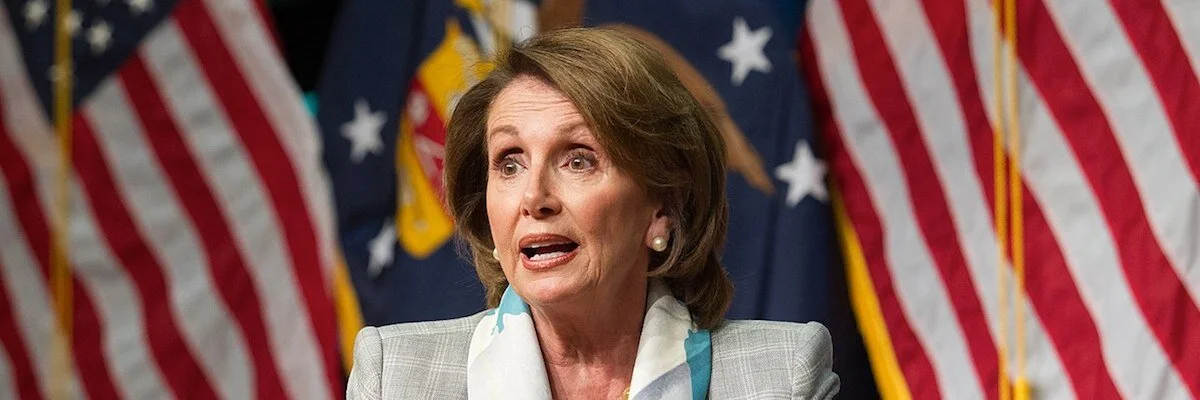
The effort to constrain Trump’s power was backed by three Republicans but faces tough odds in the GOP-led Senate. Still, House Speaker Nancy Pelosi said the measure has “real teeth,” citing the 1973 War Powers Act to limit a president’s military options without consulting Congress.
Republicans Matt Gaetz of Florida, Thomas Massie of Kentucky and Francis Rooney of Florida and independent Justin Amash of Michigan joined 220 Democrats in supporting the measure. Eight Democrats voted with 186 Republicans against it.
Democrats criticized the Trump administration for failing to provide clear justification that Soleimani posed an imminent threat. Two Republican senators -- Mike Lee of Utah and Rand Paul of Kentucky -- sharply criticized Wednesday’s classified briefing led by Secretary of State Michael Pompeo for failing to address their concerns about congressional authorization for the attack.
Lee said the “insulting” briefing tipped his vote in favor of strengthening requirements for the president to consult Congress on military action.
“That briefing is what changed my mind,” Lee said Wednesday. “After today, every time they pull a stunt like this, I’m willing to consider and introduce any and every War Powers Act resolution.”
Constitutional Requirement
The House measure, sponsored by Michigan Democrat and former CIA analyst Elissa Slotkin, would require Trump to cease military actions against Iran unless authorized by Congress or in response to an imminent threat.
Republicans and at least one Democrat -- New York Representative Max Rose, an Army veteran -- criticized the House resolution as an empty gesture that plays “politics with questions of war and peace.”
The House version is a concurrent resolution that wouldn’t require Trump’s signature if passed by both chambers. The War Power Act provides for a concurrent resolution to have the force of law, although that would probably be challenged in court.
The Senate version Kaine introduced is a joint resolution, which would require the president to sign it to become law. Trump vetoed a previous resolution last year to end U.S. military involvement in Yemen, and the Senate didn’t have enough votes to override his veto.
If either Kaine’s resolution or the House version meets Senate requirements to get a privileged voting status, it would only need a simple majority to pass. With Lee and Paul saying they back Kaine’s resolution, it would need support from at least two more Republicans to pass.
Kaine said he dropped two paragraphs that referenced Trump directly after getting feedback from some Republicans he hopes to attract to his effort. GOP Senators Susan Collins and Todd Young, who have voted with Democrats for war powers resolutions in the past, said they are considering the Kaine resolution but haven’t committed to it yet.
Military Authorization
Kaine’s resolution also states explicitly that the 2001 and 2002 Authorizations for the Use of Military Force don’t cover military action against Iran. The Trump administration included the 2002 AUMF as part of its justification for the drone strike near the Baghdad, Iraq, airport that killed Soleimani.
The White House on Thursday issued a statement challenging the House resolution, saying it’s unnecessary and would lack the force of law. The statement of administration policy also said the 2002 AUMF covers any military action that would be restricted under the House measure.
The statement said that if the provisions of the resolution were to become law, “they could undermine the president’s ability to defend United States forces and interests in the region against ongoing threats from Iran and its proxies.”
Kaine said earlier that it is precisely the risk of conflict with Iran that makes it so important for Congress to defend its constitutional authority to declare war.
“We’re at the brink of war right now,” Kaine said. “It increases the necessity of the bill.”
PHoto: Wikicommons

Pompeo's Iran Intelligence Briefing Fails to Reassure Democrats
◢ Democrats were still clamoring for answers about U.S. intentions in Iran, even after a closed-door briefing from Trump administration officials about heightened tensions in the region. Secretary of State Michael Pompeo, Acting Defense Secretary Patrick Shanahan and other intelligence officials spoke with House Republicans and Democrats at the Capitol Tuesday.
By Daniel Flatley and Steven T. Dennis
Democrats were still clamoring for answers about U.S. intentions in Iran, even after a closed-door briefing from Trump administration officials about heightened tensions in the region.
Secretary of State Michael Pompeo, Acting Defense Secretary Patrick Shanahan and other intelligence officials spoke with House Republicans and Democrats at the Capitol Tuesday, followed by a separate briefing for senators. Democrats leaving the briefings characterized them as too-little-too-late and contended that any military action in Iran would require explicit congressional approval.
"The Iranians are nowhere near being ready to talk. They are not showing any signs of backing down from their provocatory behavior,” said Senator Chris Murphy, a Connecticut Democrat. “So, tell me how this strategy is working if Iran won’t talk and they’re not de-escalating militarily?”
The private sessions came at the request of lawmakers seeking more information on recent U.S. movement in the region, including a carrier strike group deployment and the withdrawal of some diplomatic staff from the Baghdad embassy. Shanahan characterized the U.S. strategy as defensive and promised to be more responsive to concerns from Congress.
"Our biggest focus at this point is to prevent Iranian miscalculation,” Shanahan told reporters after the briefing. “We do not want the situation to escalate. This is about deterrence, it’s not about war."
Republican Senator Lindsey Graham, who generally supports Trump but had previously complained lawmakers weren’t being briefed adequately on Iran, said that General Joseph Dunford, chairman of the Joint Chiefs of Staff, has “done a very good job communicating directly and indirectly to the Iranians of the price they will pay” if they attack U.S. forces.
Democrats said the White House’s hesitation to share information with Congress, which has the constitutional authority to declare war, casts doubt on U.S. intentions in an unstable region that continues to be one of the world’s most complex geopolitical challenges.
‘Purely Defensive’
Representative Ruben Gallego, an Arizona Democrat and a Marine Corps veteran who fought in Iraq, said he was alarmed that White House officials including National Security Advisor John Bolton appear to be pushing for military action in Iran, even if President Donald Trump would prefer to keep his campaign pledge to avoid costly foreign conflicts. Gallego compared current tensions to the run-up to U.S. military action in Iraq in 2003.
“I truly believe that the intel is being misinterpreted and misrepresented by Secretary Pompeo, by Bolton and other people that do want us to go to war in Iran as a repeat to Iraq,” Gallego said as he left the briefing.
House Foreign Affairs Chairman Eliot Engel said there’s widespread concern among Democrats that the administration is rushing into an armed conflict. He said there was nothing new in the intelligence briefing, and said he was concerned about how long it took for Trump administration officials to explain their actions to lawmakers.
Texas Representative Michael McCaul, the top Republican on Engel’s committee, said it’s “premature” to talk about seeking congressional approval for military action because the U.S. response thus far has been to deter perceived aggression from Iran.
“It’s purely defensive,” McCaul said. “We’re obviously concerned about our military soldiers who are threatened by Iran and a potential attack on them in Iraq.”
Adam Kinzinger, a Republican from Illinois who served in the Air Force and sits on the Foreign Affairs panel, criticized Democrats who questioned the information provided by the Trump administration. He described the briefing as “solid,” and said, “if anybody’s questioning that somehow there’s made-up intelligence, that’s ludicrous.”
Frustration With Pompeo
The fundamental concern from most lawmakers centered on the secrecy that surrounded subtle escalations from both the U.S. and Iran that could be misinterpreted as provocation. House Majority Leader Steny Hoyer said members want to know what changed “so significantly” on the ground in recent months to lead the administration to take the steps it did.
“Most of us do not believe that a war with Iran will end well or be productive endeavor for us," Hoyer said earlier Tuesday. "We have great reticence. We want to hear today, what are the facts? What is leading the administration to believe that things have changed so significantly that they need to be talking and acting in a way that raises the possibility of war?"
Some of the frustration stemmed from Pompeo and the perception that he has been dismissive of lawmaker concerns.
“Secretary Pompeo basically said, ‘Eh, not a big deal,’ and I disagree with him on that,” Adam Smith, the Washington Democrat who leads the House Armed Services Committee, said after the briefing. Smith gave Shanahan higher marks for responding to Congress, saying he “personally reached out to me on a number of occasions and he said, ‘Yes, we need to do better.’”
Veracity of Intelligence
Bob Menendez of New Jersey the top Democrat on the Senate Foreign Relations Committee, also described Pompeo as “combative” and said the Trump administration has undermined its foreign policy credibility by not explaining recent U.S. responses to developments in the Middle East.
Referring to the faulty intelligence that served as the justification for the Iraq invasion in 2003, Menendez said, “We don’t need another weapons of mass destruction moment. Testing the veracity of that intelligence and the actions taken are incredibly important."
Senator Marco Rubio, a Florida Republican, said it was wrong to compare the two situations.
"This is very different," Rubio said. "No one here is proposing sort of a unilateral U.S. offensive against Iran. It’s been very clear from the outset, and that is: If Iran attacks, there’s going to be a response. If they don’t attack, then there will ll be no war."
Both Democrats and Republicans argued that the Trump administration would need approval from Congress to go to war.
"If we’re going to go to war, it ought to be debated and discussed and passed by Congress," said Republican Senator Mike Lee.
Photo: Bloomberg

Congress Demands Iran Briefing From White House as Tensions Rise
◢ Members of Congress are seeking answers from the Trump administration on U.S. plans to respond to escalating tensions with Iran, demanding more information about fast-moving developments in the Middle East. U.S. officials will meet Thursday with congressional leaders from both parties in both chambers, including heads of both intelligence committees, to discuss the Middle East, according to a person familiar with the plans.
By Steven T. Dennis and Billy House
Members of Congress are seeking answers from the Trump administration on U.S. plans to respond to escalating tensions with Iran, demanding more information about fast-moving developments in the Middle East.
U.S. officials will meet Thursday with congressional leaders from both parties in both chambers, including heads of both intelligence committees, to discuss the Middle East, according to a person familiar with the plans. There will be a larger briefing for all U.S. House members next week, which will include Secretary of State Michael Pompeo, according to another person.
Bob Menendez, the top Democrat on the Senate Foreign Relations Committee, rejected this timeline for information and warned that uninformed decisions could lead to conflict like the U.S.’s military involvement in Iraq in the last decade, which was justified with faulty intelligence.
“Things are happening at warp speed here,” Menendez said. “We don’t need another Iraq weapons of mass destruction moment, that we’re led into things on false information, unverifiable, untested. So I am alarmed that we cannot even get the basic briefings in a timely manner.”
Policymakers’ scramble for information comes as the U.S. ordered its non-emergency government staff to leave Iraq, citing an “increased threat stream” in the region. Trump administration officials this week are warning of rising threats to Americans from forces backed by neighboring Iran and are deploying warships and B-52 bombers to the Gulf.
Senate Minority Leader Chuck Schumer said there is an “alarming lack of clarity” about the strategy in Iran.
“Any potential increase in our military presence in the Middle East should require consultation with Congress and anything beyond that would require this body to act,” Schumer said Wednesday on the Senate Floor. “President Trump, what is your strategy? Where are you headed and why aren’t you talking to Congress about it?”
Senators leaving a Wednesday meeting with senior U.S. intelligence officials—previously scheduled to discuss next year’s defense funding—expressed concern about misinformation that could lead to miscalculation. CIA Director Gina Haspel had been expected to be at the briefing but had to go to the White House instead, said GOP Senator Lisa Murkowski of Alaska.
Senator Jack Reed, the top Democrat on the Armed Services Committee, called for a classified briefing for the full Senate on Iran “as soon as possible.”
“We have to know what’s going on and we don’t know the details” about plans in Iran, Reed said.
Senator Chris Murphy, a Connecticut Democrat on the Foreign Relations Committee, said, “The administration is engaged in a series of blind escalations without any endgame.”
Photo: Wikicommons