
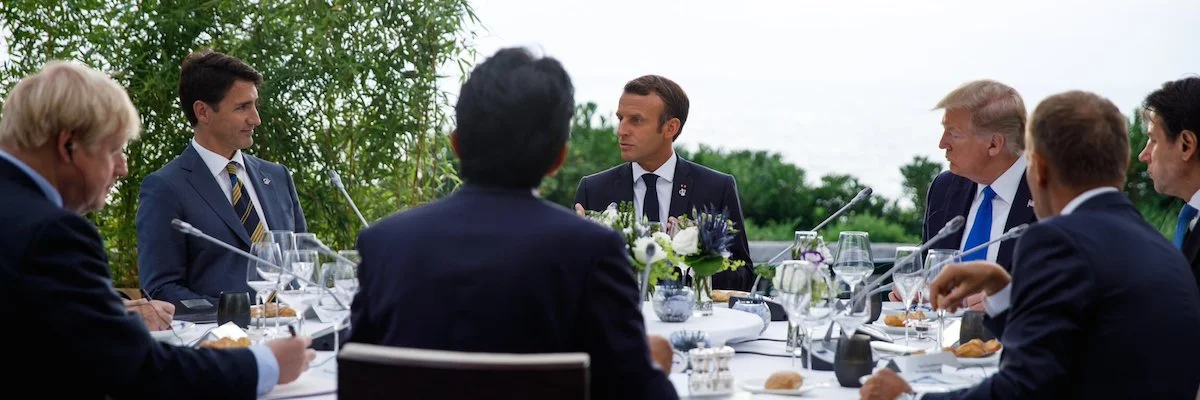
Trump Switches Tone on Iran, Raising Hopes at G7
◢ US President Donald Trump said Monday that he had agreed to the Iranian foreign minister flying in for a G7 summit and insisted he was not seeking regime change in Tehran—a change of tone that could lower tensions. "I knew everything he (Macron) was doing and I approved everything he was doing," Trump said, adding that the French president "asked for my approval,”
By Sebastian Smith, Adam Plowright and Stuart Williams
US President Donald Trump said Monday that he had agreed to the Iranian foreign minister flying in for a G7 summit and insisted he was not seeking regime change in Tehran—a change of tone that could lower tensions.
Mohammad Javad Zarif made a surprise appearance at the summit in Biarritz on Sunday for talks with French President Emmanuel Macron, who is seeking to broker a deal between Iran and the United States.
Zarif also met with French and other European diplomats, but Trump said it was "too soon" for him to meet Zarif.
"I knew everything he (Macron) was doing and I approved everything he was doing," Trump said, adding that the French president "asked for my approval.”
In early August, Trump lambasted Macron for sending "mixed signals" on Iran, and at the end of July the US administration imposed sanctions on Zarif.
Trump has put in place a policy of "maximum pressure" on Tehran over its disputed nuclear programme via crippling sanctions that are seen as raising the risk of conflict in the Middle East.
The US president unilaterally pulled out of a landmark 2015 international deal that placed limits on Tehran's nuclear activities in exchange for trade, investment and sanctions relief.
"I believe that for our country's national interests we must use any tool," Iran's President Hassan Rouhani said of his top diplomat's Biarritz visit in a speech aired live on state television on Monday.
But hardliners criticised the initiative, with the ultra-conservative Kayhan newspaper saying the trip was "improper" and sent "a message of weakness and desperation."
Some analysts also cautioned against optimism about Macron's mediation efforts.
"There is considerable room between what President Trump says and what he thinks one day, and what he says and thinks the next," Robert Malley, head of the International Crisis Group, told AFP.
Photo: Elysée
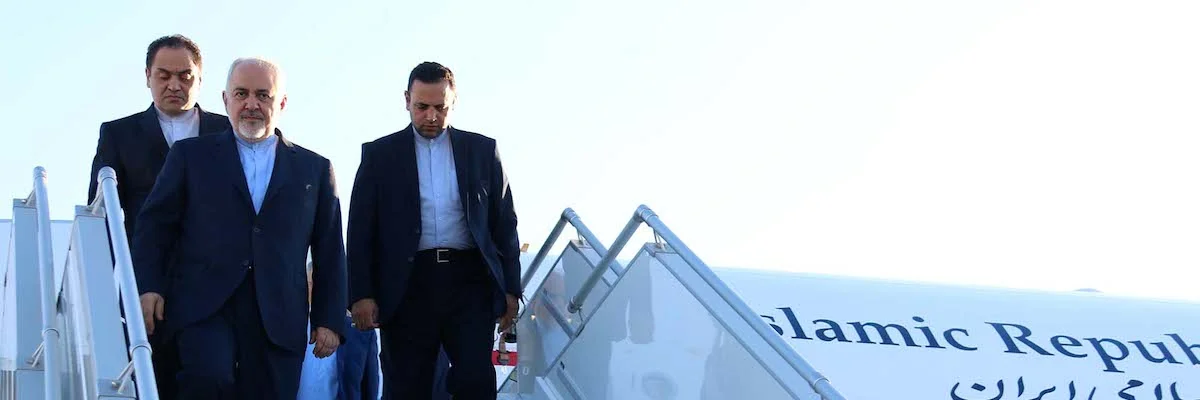
Iran Foreign Minister Makes Surprise Visit to G7 Summit
◢ A top Iranian official paid an unannounced visit Sunday to the G-7 summit and headed straight to the building where leaders of the world's major democracies have been debating how to handle the country's nuclear ambitions. The surprise arrival of Iranian Foreign Minister Mohammad Javad Zarif came just two days after his meeting with France's president, who is the host of the Group of Seven gathering in Biarritz.
By Helene Fouquet and Josh Wingrove
Emmanuel Macron has thrown his G-7 guests a mid-summit curveball—inviting Iran’s foreign minister for a surprise visit in a move that risks infuriating Donald Trump’s administration.
Iranian Foreign Minister Mohammad Javad Zarif flew to Biarritz, the French seaside resort town that’s the site of the summit, on Sunday as leaders met nearby. The French government insisted he wasn’t in the town to join the G-7, but instead to meet nearby with the French foreign minister as part of a bid by Macron to deescalate the crisis.
Still, the arrival came as a stunning development, and several delegations appear to have been caught off-guard—the Americans and Canadians declined to say if they had advance notice, while the Italians found out from French news wire AFP. Iran already has dominated the discussions at the G-7, with Macron and Trump sparring over Macron’s outreach to the Islamic Republic.
Zarif was in Paris only last week, meeting with Macron about the future of the landmark 2015 nuclear deal. Zarif described the talks as “constructive and good”, the semi-official Iranian Students’ News Agency reported.
Zarif is a lightning rod for the Trump administration, which sanctioned him personally just recently and heavily restricted his movements during a recent visit to New York. Macron had wanted to shake up the summit, and he has already angered the American side, which accused him of trying to manipulate the agenda to embarrass Trump.
The French president is trying to show that he’s achieved something on the geopolitical issues he’s raised, and he has led the European effort to salvage the Iran nuclear deal, after Trump pulled out in 2018. Macron told TF1 television Sunday that leaders agreed they need to stop Iran developing nuclear weapons and destabilizing the region -- though that was the state of play before talks began.
Macron also touted an agreement to send a joint message from the G-7 to Iran as one of his victories from a dinner among the leaders. "We’ve enacted a common communication, which in my view has a lot of value,” he said this morning in a French television interview.
But Trump immediately pushed back on the idea that Macron was speaking for the whole G-7, and therefore Trump as well. “We’ll do our own outreach,” he said. “But I can’t stop people from talking.”
One person familiar with the situation says Trump does not agree that Macron can convey a message from the G-7 to Iran since the leaders didn’t all settle on what the message should be.
Trump has pursued a “maximum pressure” campaign against Iran, using sanctions to cut off their sales of oil in a way that’s hurting that nation’s economy. White House officials say the G-7 countries agreed Trump’s pressure campaign on Iran is having an impact, and that it should continue.
Photo: IRNA
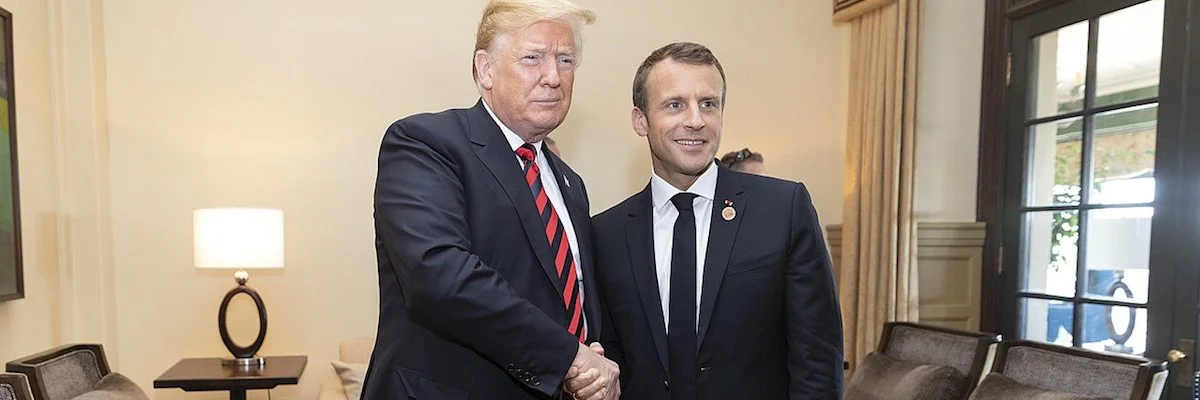
Trump Unlikely to Support Macron’s Plan to Revive Iran Deal
◢ French President Emmanuel Macron pitched U.S. President Donald Trump on a plan to end the standoff over the Iran nuclear deal—by allowing Iran to sell oil for a limited period of time in exchange for returning to talks and to compliance with the agreement. A senior U.S. official termed the plan a non-starter.
By Helene Fouquet and Nick Wadhams
French President Emmanuel Macron pitched U.S. President Donald Trump on a plan to end the standoff over the Iran nuclear deal—by allowing Iran to sell oil for a limited period of time in exchange for returning to talks and to compliance with the agreement.
The proposal was described by a French official after Macron and Trump sat down to an impromptu lunch that stretched for two hours at the Group of Seven Summit in Biarritz, France. A senior U.S. official termed the plan a non-starter.
The U.S. in the past has resisted any compromise that allowed Iran to resume selling oil, which is sharply restricted by U.S. sanctions. That’s why ending the impasse and putting the deal back together is so difficult: Iran’s No. 1 demand to come back to the bargaining table is that it be allowed to sell oil to help its struggling economy.
The French official described a plan that would occur in two phases. Iran would be allowed to sell some volume of its oil in exchange for a series of commitments: return to compliance with the existing agreement, find ways to lower tensions in the Persian Gulf amid a spate of tanker seizures, and return to structured talks on missiles, regional issues and what happens after 2025, when the current agreement is set to expire.
The hope, this official said, is that this could create a de-escalation that allows the two sides to begin talking again, particularly knowing that both Trump and the Iranians have said they don’t want war. Macron met with an Iranian delegation on Friday, including Foreign Minister Javad Zarif, to discuss this proposal.
Trump pulled out of the deal in May 2018, saying it didn’t do enough to prevent Iran from getting a nuclear weapon. Iran remained in compliance with the deal for a time, but recently said it was enriching uranium at higher levels than allowed in the deal—meaning it’s no longer in line with the agreement, known as the Joint Comprehensive Plan of Action, or JCPOA.
Macron has led a European effort to find a compromise that would get Trump back to the table with the Iranians. One struggle has been finding incentives for Iran to renegotiate a deal that took effect so recently, this time surely at worse terms for Iran.
Salvaging the Iran nuclear accord is one of the key topics of the summit at this beach resort town, which sees Trump in his customary role as the outlier to the European nations that still think the deal can be saved. Another potential stumbling block to compromise in Biarritz: Trump brought with him national security adviser John Bolton, the leading Iran hawk in his administration.
Photo: Wikicommons