

Pathways for Regional Environmental Cooperation in the Gulf
This edited volume is a result of a collaboration between the Bourse & Bazaar Foundation and the Middle East Institute at the National University of Singapore. It seeks to identify areas for regional environmental cooperation between the GCC, Iraq, and Iran.
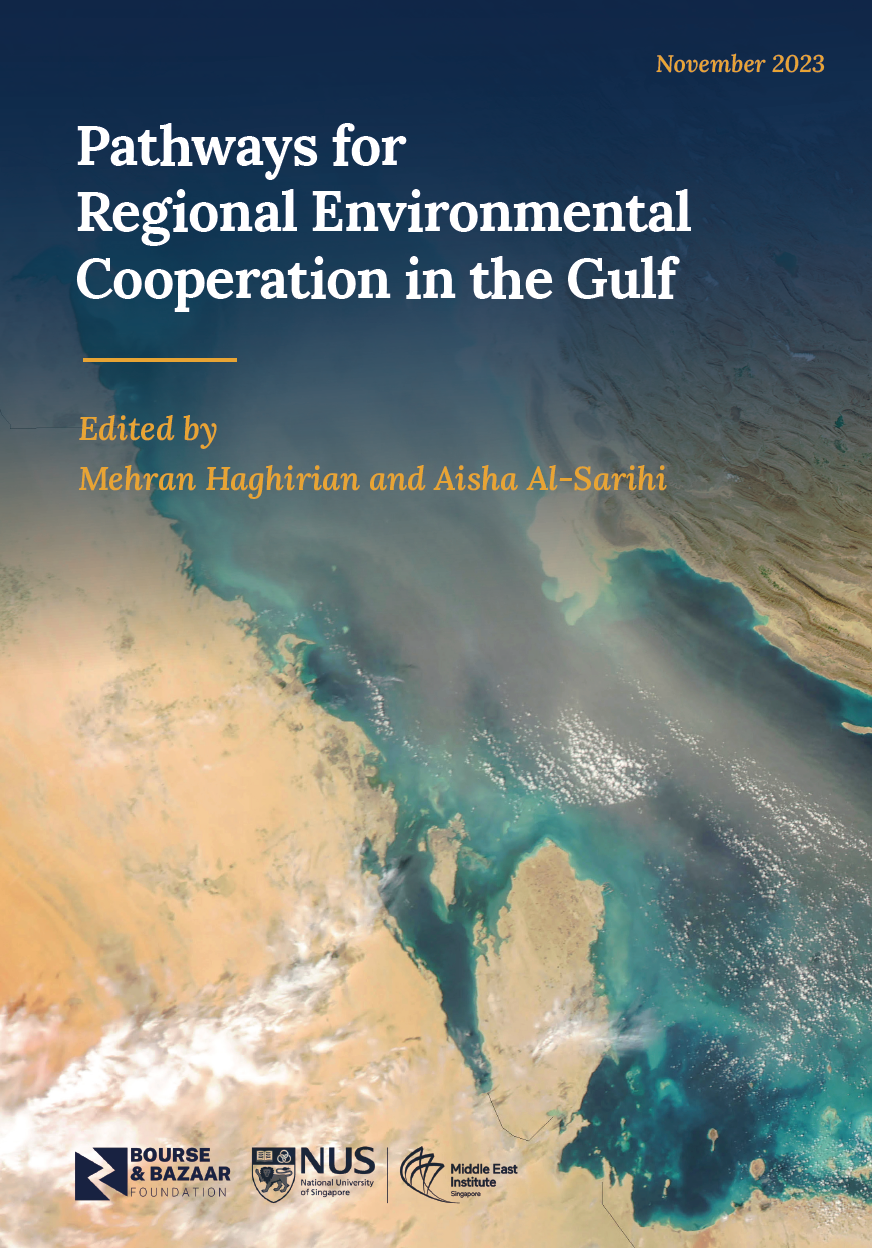
Download the Publication
November 2023 - 129 Pages
Please enter your name and email address below to download the full publication. After entering your details, a download link will appear in the space below.
Executive Summary
The countries surrounding the Gulf – Bahrain, Iran, Iraq, Kuwait, Oman, Qatar, Saudi Arabia, and the United Arab Emirates (UAE) – are facing acute risks from climate change. With its arid and semiarid climatic conditions, the Gulf region is already grappling with grave environmental issues including water scarcity, severe sand and dust storms, exposure to cyclones, heatwaves, and pollution. The regional countries are paying heavy human and financial costs for the mounting consequences of these challenges – shutting down factories, announcing emergency public holidays, cutting water and electricity supplies, and even losing tourists.
This edited volume is a collaboration between the Bourse & Bazaar Foundation and the Middle East Institute at the National University of Singapore. The publication seeks to identify areas for regional environmental cooperation and explore practical approaches to address shared challenges. The chapters examine potential cooperation on protection of marine environments, responses to extreme weather events, mitigation of sand and dust storms, cooperation on food security, and advancement of the energy transition, among other topics. The experts who contributed come from diverse backgrounds, but all agree that the Gulf region is facing devastating climate impacts, which will only intensify in the absence of inclusive mitigation strategies.
This edited volume brings a practical perspective to the growing conversation on shared environmental challenges in the Gulf. The nine chapters go move beyond talking points on the need to fight climate change to present practical recommendations for regional governments and external stakeholders, as well as academic institutions, companies, and individuals involved in climate action. The edited volume is comprised of the following chapters:
Chapter 1: Collective Environmental Action to Preserve the Gulf’s Marine Ecosystem
Mohammad Al-Saidi
Chapter 2: Towards Common and Sustainable Resource Management in the Gulf
Tobias Zumbrägel
Chapter 3: Joint Efforts to Combat Extreme Weather Events in the Gulf
Said Al-Sarmi and Suad Al-Manji
Chapter 4: Tackling Sand and Dust Storms to Build on Regional Détente in the Gulf
Glada Lahn and Adnan Tabatabai
Chapter 5: Cooperation Opportunities for the Gulf in the Energy Transition
Robin Mills
Chapter 6: Boosting Food Security in the Gulf through Regional Cooperation
Malak Altaeb
Chapter 7: Bolstering Iraq’s Climate Response through Regional Environmental Cooperation
Maha Yassin
Chapter 8: Addressing Shared Environmental Challenges in the Gulf with European Support
Mehran Haghirian
Chapter 9: Examining Gulf-Southeast Asia Interregional Environmental Cooperation
Aisha Al-Sarihi and Muhammad Shidiq
Taken together, these nine chapters make clear that missed opportunities for cooperation due to political differences across the Gulf have not only delayed environmental mitigation but have also limited economic integration as well. While trust and political will remain prerequisites for enhanced regional environmental cooperation, this volume highlights the importance of joint climate science and research programs, knowledge sharing, capacity building, finance leveraging, and policy coordination as key areas to improve regional environmental cooperation in the Gulf region. Opportunities abound for the Gulf states to cooperate in tackling shared environmental challenges.
About the Editors
Mehran Haghirian is the Director of Regional Initiatives at the Bourse & Bazaar Foundation. He leads the Integrated Futures Initiative, a project seeking to identify areas for economic diplomacy and regional integration in the Middle East. He is a PhD candidate at Qatar University and holds a master’s degree in international affairs from the American University’s School of International Service in Washington, DC.
Dr. Aisha Al-Sarihi is a Research Fellow on policy and politics of climate and environment at the National University of Singapore’s Middle East Institute, as well as an Associate Fellow at Chatham House, the Middle East Council on Global Affairs and the Arab Gulf States Institute in Washington, DC.

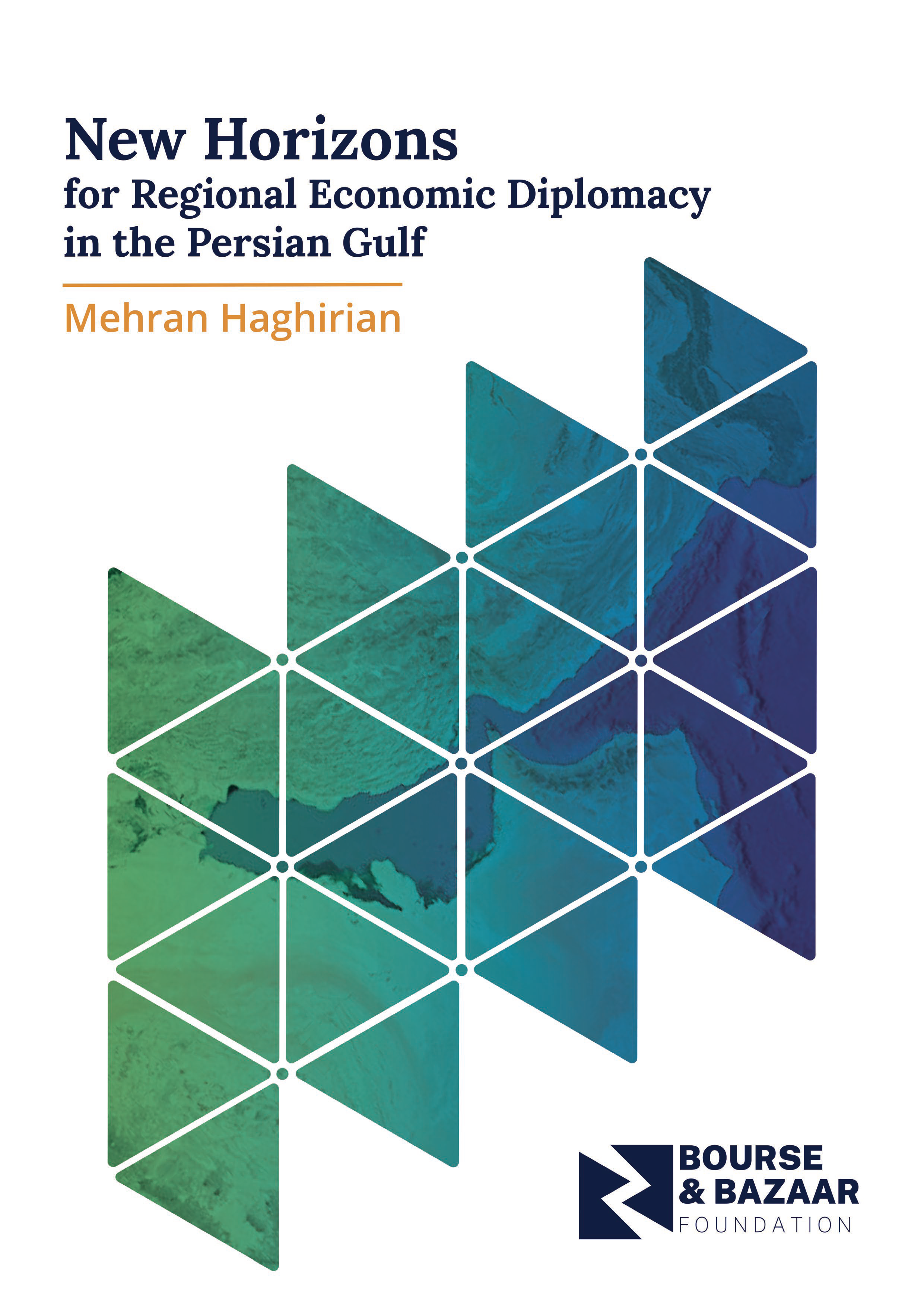
New Horizons for Regional Economic Diplomacy in the Persian Gulf
This special report explores whether regional economic integration can serve as a pillar for more constructive diplomatic relations between the countries of the Persian Gulf region.
Download Report
March 2022 - 18 Pages
Please enter your name and email address below to download the full report. After entering your details, a download link will appear in the space below.
Executive Summary
To date, research and convenings on Iran-Arab relations have been predominantly focused on political issues and security tensions, including sectarianism and proxy wars. The ways that shared economic incentives could chart a path towards more constructive regional ties have been largely overlooked. This report analyses the new geopolitical developments and foreign policy shifts in the region to identify the drivers behind the new horizons for regional diplomacy and the potentials for regional economic integration. The objective of this report is to assess whether regional economic integration can support regional diplomacy and is conducive to better outcomes in the political and security dialogues now underway. This report draws on the perspectives of 24 policymakers, analysts and scholars to assess the feasibility of using regional economic integration to support more constructive bilateral and multilateral relations between Bahrain, Iran, Iraq, Kuwait, Oman, Qatar, Saudi Arabia and the United Arab Emirates. These perspectives were gathered through individual research interviews and a half-day online workshop conducted in November 2021, held under the Chatham House Rule.
About the Author
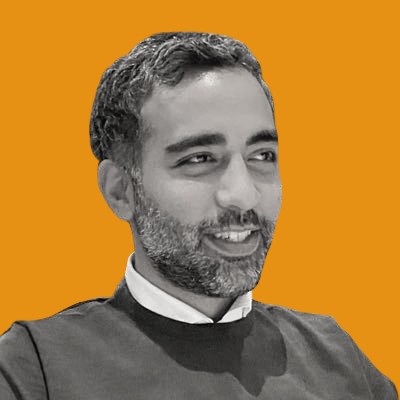
Mehran Haghirian is the Director of Regional Initiatives at the Bourse & Bazaar Foundation. In this role, Mehran draws on his extensive background researching regional political and security frameworks. He is a PhD candidate at Qatar University, where he focuses on the geopolitics of the Persian Gulf region, and holds a master’s degree in international affairs from American University’s School of International Service in Washington DC. Haghirian is also a visiting fellow with the Middle East and North Africa programme at the European Council on Foreign Relations. Prior to joining B&BF, Mehran worked at the Ibn Khaldon Center for Humanities and Social Sciences as a researcher and assistant director and at the Atlantic Council’s Future of Iran Initiative as a project assistant.

Iran in the New Eurasian Context
As Europe and Asia grow closer and the rapid growth in economic exchanges over the last two decades necessitates the creation of a new, tentative political order, it is no longer sufficient to see Iran as a state in the Middle East.
SERIES INTRODUCTION
Iran’s Bilateral Relations in the New Eurasian Context
By Esfandyar Batmanghelidj
In October 2019, the Middle East Institute (MEI) at the National University of Singapore and Bourse & Bazaar commissioned this collection of essays aiming to examine Iran’s relations in their “Eurasian context.” With Europe and Asia growing closer, particularly through economic integration, it is no longer sufficient to see Iran as a Middle Eastern nation. This series of essays will examine Iran’s bilateral relations from a Eurasian perspective, drawing out the understudied and under-appreciated economic and political considerations that increasingly shape the Islamic Republic’s conception of its place in the international system and the power it is able to exercise in that system. Six young and accomplished analysts examine Iran’s bilateral relations with six Eurasian states in this first-of-its kind volume.
Esfandyar Batmanghelidj is the founder of Bourse & Bazaar.
IRAN-CHINA
From Bilateralism to Multilateralism: Iran’s Place in China’s Eurasian Projects
By Jacopo Scita
Thanks to its geographical position and its positive and constructive relationship with China, Iran has a potentially pivotal role within Beijing’s Eurasian projection. However, the US administration’s decision to reimpose secondary sanctions on Iran seems to have slowed down the country’s integration into the emerging Eurasian architecture, causing Tehran to reprioritise bilateral relations with Beijing. This article argues that to mitigate the power imbalance in its relations with China, Iran should keep pushing for integration into China’s Belt and Road Initiative and lobbying for full membership in the Shanghai Cooperation Organistion. Ultimately, Sino–Iranian relations should be the flywheel for Iran’s participation in China-led Eurasian multilateral projects.
Jacopo Scita is a HH Sheikh Nasser al-Mohammad al-Sabah doctoral fellow at the School of Government and International Affairs, Durham University. His doctoral project explores the evolution of China’s role vis-à-vis Iran from the 1979 Revolution to the 2015 JCPOA.
IRAN-RUSSIA
Russia and Iran in Greater Eurasia
By Nicole Grajewski
This paper examines the Eurasian dimension of Russia–Iran relations and, in particular, Iran’s place in Russia’s endeavour to establish its centrality as an order-builder in the macro-regional system of Eurasia. The Russia–Iran relationship in Eurasia illustrates the complex interplay between geo-economic ambitions, security imperatives and wider normative projects.
Nicole Grajewski is a DPhil candidate in international relations at the University of Oxford, where her doctoral dissertation focuses on the place of Iran within Russian discourses on international order, as well as the divergences and convergences in Russia and Iran’s approaches to international relations. She holds an MPhil in Russian and East European studies from the University of Oxford and a BA in international affairs, security policy and Middle East studies from George Washington University’s Elliott School of International Affairs.
IRAN-INDIA
Connectivity and Chabahar: The Eurasian Future of India’s Iran Policy
By Sumitha Kutty
The idea of engaging Iran through the lens of Eurasia is not alien to India’s foreign policy. Even as sanctions debilitate its energy dealings with Iran, India’s connectivity strategy through the Iranian port of Chabahar is designed to further its interests in Eurasia (particularly in Afghanistan and Central Asia). This paper traces India’s shifting priorities vis-à-vis Iran: reduced dealings in energy, limited security interactions and a renewed focus on land and maritime connectivity initiatives. It finds that — intentionally or not — the future of the India–Iran relationship is strongly intertwined with the Eurasian sphere, given its bet on connectivity.
Sumitha Narayanan Kutty is an associate research fellow at the S Rajaratnam School of International Studies (RSIS), Nanyang Technological University, Singapore. She tracks India’s foreign and security policies across the Indo–Pacific with a special interest in the Middle East.
IRAN-GCC
The Rivalry between Iran and the GCC States in the Eurasian Context
By Mehran Haghirian
Iran’s deepening partnerships with Russia and China and renewed ties with the European Union since the signing of the Iran nuclear deal have given the GCC states added reason to expand their own cooperation with these Eurasian players. The GCC states were already looking increasingly towards Eurasia for their security and economic needs, concerned that the US “pivot to Asia” was effectively an American retreat from the Persian Gulf region. The resulting scramble between Iran and the GCC for influence in Eurasia is likely to continue to affect the geopolitics of the Persian Gulf region for decades to come.
Mehran Haghirian is a PhD candidate at Qatar University and a researcher and assistant director at the university’s Ibn Khaldon Center for Humanities and Social Sciences. He is a graduate of American University’s School of International Service in Washington, DC, with a master’s degree in international affairs and a research focus on Iran and the Persian Gulf.
IRAN-ISRAEL
Israel and Iran: Thrust Together By Eurasia
By Daniel Amir
The rivalry between Israel and Iran is a key element of contemporary understandings of the Middle East. This article argues that despite highlighting the explosive hostility between Israel and Iran in certain areas, analysts sometimes neglect to examine the few points where the two do interact. A frequent theatre for this overlap is Eurasia. Here, the relative absence of American dominance sees Tel Aviv and Tehran thrust together, making space for nuanced relationships with and through common partners. The article ends by discussing the risks and challenges that Eurasia presents to the two countries’ political, economic and ideological concerns.
Daniel Amir is a digital journalist at BBC Monitoring. A graduate of the University of Oxford and the London School of Economics, he has written for The Independent, the New Statesman, Haaretz and others. BBC Monitoring tracks, translates and analyses media across the world for governments, corporates and academia. It has particular expertise in places where facts and access to balanced media are hard to come by.
IRAN-EUROPE
Iran’s Centrality in Europe’s Emerging Eurasian Policy
By Axel Hellman
European leaders are placing a greater emphasis on foreign policy. The experience of the Iran nuclear agreement, which European leaders have tried to sustain in spite of the unilateral US withdrawal from it, has laid bare both the ambitions as well as the shortcomings of European diplomacy. As Europe re-evaluates its role in the world, it may find itself operating in a more Eurasian context. Iran has been central both in the transformation of European strategic thinking as well as in preparing European leaders for pursuing their interests in a Eurasian context.
At the time of writing Axel Hellman was a policy fellow at the European Leadership Network (ELN), where his work primarily focused on EU foreign policy, economic statecraft and Russia–West relations. He is a prolific writer and public speaker, and his analyses and commentaries on international affairs have appeared in publications such as Newsweek, The Atlantic, Foreign Policy and The Financial Times. Hellman completed a master’s degree at St Antony’s College, Oxford, and holds a BA in international relations from King’s College London. He has also studied at Georgetown University in Washington, DC.