
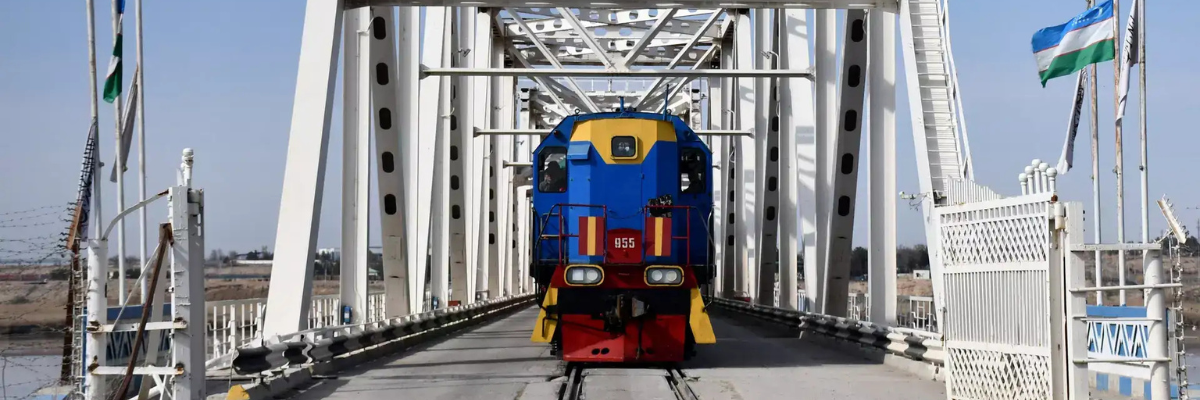
Afghan Authorities Accelerate Push for Road and Rail Projects
As the Taliban government pursues an assertive policy to enhance Afghanistan’s logistical infrastructure, interest in the country’s role as a southern transit hub is gaining momentum across West Asia.
As the Taliban government pursues an assertive policy to enhance Afghanistan’s logistical infrastructure, interest in the country’s role as a southern transit hub is gaining momentum across West Asia, facilitating the joint implementation of a wide range of new road and rail projects. Leading the charge is Uzbekistan, which has revived its ambitions through the Termez–Mazar-i-Sharif–Kabul–Peshawar railway—better known as the Kabul Corridor—positioning itself at the forefront of regional integration.
Meanwhile, Turkmenistan, backed by Kazakhstan, is advancing a parallel railway initiative through western Afghanistan to secure more direct access to Pakistan’s seaports. In a symbolic move, the foundation for the 22-kilometre Torghundi-Sanobar railway line was laid in September 2024, making a significant step towards reshaping regional connectivity.
The growing engagement between the Central Asian republics and Kabul in the development of transport infrastructure reflects a shared ambition to diversify foreign trade routes and establish more efficient supply chains to access the vast South Asian market. Alongside ongoing projects involving Uzbekistan, Turkmenistan, and Kazakhstan, Afghan authorities have announced plans to construct the Mazar-i-Sharif–Herat–Kandahar railway. This line has the potential to become the shortest trade route between India and Russia, enabling New Delhi to build transport links with Afghanistan and Central Asia while bypassing Pakistan.
Even Iran, which remains the primary conduit linking Central Asia to the warm waters of the Indian Ocean, and, by extension, to global trade, is seeking stronger transport links with Afghanistan. Tehran is planning to launch two railway connections to Afghanistan simultaneously: the Khaf–Herat line in the north and the Zahedan–Zaranj line in the south-west. The railway from Khaf to Herat is nearly complete, and the Taliban intend to extend it to Mazar-i-Sharif, a key Afghan trade hub already connected to the Uzbek-built Hairatan–Mazar-i-Sharif railway (launched in 2011) and the planned Kabul Corridor. Integrating these routes could eventually allow Iran to reach the Wakhan Valley in Afghanistan’s Badakhshan province, which is the narrow strip of land separating Afghanistan from China.
Notably, during a Taliban delegation’s two-day visit to Tashkent in February 2025, Uzbek and Afghan authorities agreed to jointly implement the Mazar-i-Sharif-Herat railway route. According to the Afghan Deputy Prime Minister for Economic Affairs, Mullah Abdul Ghani Baradar Akhund, this project would expand Tashkent’s trade with South Asia, Iran, and China, reinforcing the idea that Tehran could utilise the Kabul Corridor to reach the borders of China’s Xinjiang region. Another potential route could see the Zahedan-Zaranj railway extended to Kandahar and Kabul with its subsequent link to the Wakhan Corridor.
In 2020, Iran began constructing the Chabahar–Zahedan railway line, with plans to extend it to Zaranj in Afghanistan’s border province of Nimroz and further onward to Dilaram and Kandahar. Engineering surveys have already been conducted on the Afghan side for the Zaranj–Kandahar railway, which could offer Tehran an alternative access route to Afghanistan beyond the Herat Road—bringing it one step closer to creating a new overland trade route to China.
Nevertheless, the prospect of reviving the Wakhan Corridor— an outcome eagerly anticipated by Tehran—remains uncertain. In 2024, Afghanistan’s Ministry of Rural Rehabilitation and Development announced the completion of gravel laying on a 50-kilometre stretch of the road. However, substantial investments are needed to turn the ancient route into a viable commercial transit point. The Taliban are striving for help from China, although Beijing has so far adopted a cautious, wait-and-see approach and is in no rush to open its arms to Afghanistan.
Despite this limited progress, Tehran appears unlikely to back down, particularly as it pursues other ambitious projects. One of these is the proposed Iran–Afghanistan–Tajikistan–Kyrgyzstan–China railway corridor, also known as the Five Nation Road.
Its initial section will be the Khaf-Herat railway, scheduled to begin full operations later this year. The route would continue through Sheberghan, Mazar-i-Sharif, Khulm, and Kunduz, ultimately reaching the Tajik border at the Sherkhan Bandar crossing. It would then stretch eastwards across Central Asia to Kashgar in western China, spanning an estimated 2,000 kilometres. In this context, the Taliban’s proposed Mazar-i-Sharif–Herat railway becomes a strategic segment of a broader transit route from Iran to China.
The creation of a Five Nation Transit Corridor could also benefit Turkmenistan, which has long pursued a railway link to Tajikistan via Afghanistan through the TAT project. This initiative emerged in 2013 amid rising tensions between Tashkent and Dushanbe over transit routes and the desire to bypass Uzbekistan.
Turkmenistan completed the first stage of the TAT railway in 2016, spanning from Atamurat (Kerki) through Ymamnazar to Akina. The Akina–Andkhoy segment followed in early 2021. However, the Taliban’s return to power in summer 2021 brought work to a halt, as regional actors reassessed the group’s stance on cross-border infrastructure and foreign engagement. Yet contrary to initial concerns, the new Afghan leadership has shown a pragmatic approach to regional connectivity.
In February 2025, Afghanistan and Turkmenistan agreed to carry out survey and design work for the 55-kilometre Andkhoy–Sheberghan railway line, a project first announced by the Taliban in 2024. Meanwhile, in July 2024, Tajikistan’s Ministry of Transport and the Korea International Cooperation Agency signed a protocol to develop a feasibility study for a 51-kilometre Jaloliddini-Balkhi–Panji Poyon railway, linking Tajikistan to the Afghan border. Both developments indicate a resumption of the TAT project, which could raise concerns in Uzbekistan, given its longstanding role as a key transit country for several of its neighbours’ access to global markets.
The development of trans-Afghan logistics infrastructure is also of growing interest to Russia, which sees the new corridors as a means of extending its flagship International North–South Transport Corridor (INSTC) to Pakistan.
A clear indication of this was the visit of a Russian delegation led by Security Council Secretary Sergei Shoigu to Kabul on 25 November 2024, during which the construction of the Trans-Afghan Railway was discussed. Following talks with the Taliban, Russian Deputy Prime Minister Alexei Overchuk stated that the Russian Federation considers this project as an integral component of the INSTC.
The Russian Ministry of Transport later announced that it would collaborate with Uzbekistan to prepare a feasibility study for a railway through Afghanistan, based on two agreed routes: Mazar-i-Sharif–Herat–Dilaram–Kandahar–Chaman and Termez–Naibabad–Logar–Kharlachi. But this announcement was not confirmed by Uzbekistan Railways.
Russian involvement in constructing both the western and eastern Afghan railway routes—starting from the borders with Turkmenistan and Uzbekistan, respectively—would allow Ashgabat and Tashkent to secure a share of cargo flows between Northern Eurasia to South Asia. Increased competition along these routes is likely to drive down the cost of transit transport over time.
The opening of new trade routes through Afghanistan presents significant opportunities for realising Central Asia’s economic and transport-transit potential. Several key factors should be considered when assessing further developments in this area.
One consideration is the potential reorientation of Uzbekistan towards the western Trans-Afghan railway route. The relative cost-effectiveness of the Kandahar Corridor, compared to the railway via Kabul, could serve as a catalyst for such a shift. Although the Mazar-i-Sharif-Herat-Kandahar-Chaman route (1,468 km) is longer than the Kabul Corridor (647 km), it offers advantages in terms of terrain and security. Additionally, the route can branch towards Iran through the border province of Nimroz in south-western Afghanistan, providing a valuable strategic link for future transport corridors.
Another important factor is the growing security risks in Pakistan, coupled with increasing tensions in Afghan-Pakistani relations. These dynamics may prompt Tashkent and its external partners to reconsider their preferences on the trans-Afghan track, favouring the Kandahar Corridor instead. In this context, prioritising a transit route that connects to the southern regions of Pakistan—those closest to the ocean—would be more appropriate.
Given the growing significance of Afghan transit in transregional logistics, Central Asian countries will need to balance the interests of all stakeholders to prevent the emergence of intensified geopolitical rivalries along these evolving trade corridors. Harmonisation of the trans-Afghan routes currently under development appears to be both the most likely and most favourable scenario for the future. In such a case, the key stakeholders, particularly Uzbekistan, Turkmenistan and Kazakhstan, could pool their resources to establish a unified transregional railway corridor through Afghanistan.
This collaborative approach would enhance the prospects for attracting external investment and accelerating project implementation. Moreover, a consolidated approach is vital for strengthening the region's role in shaping the emerging architecture of trans-Afghan connectivity. If done successfully, Afghanistan could gain a genuine opportunity to position itself as a new transit hub at the heart of Eurasia.
Photo: Asian Development Bank