
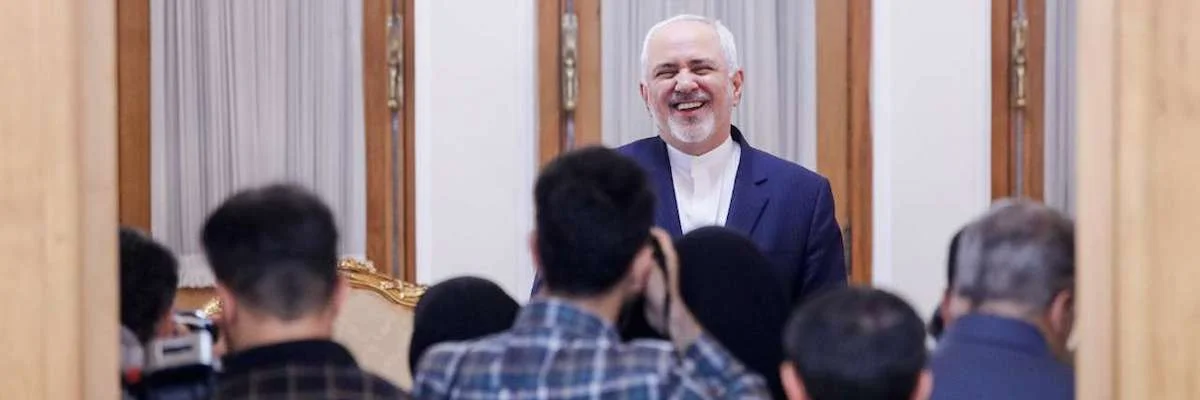
Tehran Says Trump's 'Genocidal Taunts Won't End Iran'
◢ Iranian Foreign Minister Mohammad Javad Zarif said Monday the "genocidal taunts" of US President Donald Trump will not "end Iran", as tensions spike between the two countries. "Iranians have stood tall for millennia while aggressors all gone. Economic terrorism and genocidal taunts won't 'end Iran'," Zarif wrote on Twitter.
By Amir Havasi
Iranian Foreign Minister Mohammad Javad Zarif said Monday the "genocidal taunts" of US President Donald Trump will not "end Iran", as tensions spike between the two countries.
"Iranians have stood tall for millennia while aggressors all gone. Economic terrorism and genocidal taunts won't 'end Iran'," Zarif wrote on Twitter.
"Never threaten an Iranian. Try respect—it works!" he added.
The riposte by Iran's top diplomat follows an ominous warning by Trump, who on Sunday suggested the Islamic republic would be destroyed if it attacked US interests.
"If Iran wants to fight, that will be the official end of Iran. Never threaten the United States again," Trump tweeted.
Relations between Washington and Tehran plummeted a year ago when Trump pulled out of a landmark 2015 nuclear deal with Iran and imposed tough sanctions.
Iranian officials have repeatedly slammed the unilateral US sanctions as "economic terrorism," saying that they have impeded the flow of essential goods.
Tensions have risen further this month with Washington announcing more economic measures against Tehran, before deploying a carrier group and B-52 bombers to the Gulf over unspecified alleged Iranian "threats".
The Trump administration last week ordered non-essential diplomatic staff out of Iraq, citing the danger posted by Iranian-backed Iraqi armed groups.
On Sunday a rocket was fired into the Green Zone of the Iraqi capital Baghdad, which houses government offices and embassies including the US mission. It was not immediately clear who was behind the attack.
While the US claim of Iranian "threats" has been met with widespread skepticism outside the United States, the mounting tensions have sparked growing international concern.
“I would say to the Iranians, do not underestimate the resolve on the US side in the situation," British foreign minister Jeremy Hunt told reporters on Monday in Geneva.
"They don't want a war with Iran, but if American interests are attacked they will retaliate," he added.
Hunt said that Britain wanted "the situation to de-escalate" and urged Iran "to pull back from the destabilizing activities it does throughout the region."
'Goaded' Into War
US media reports say Trump's hawkish national security advisor John Bolton is pushing for war with Iran, but others in the administration are resisting.
Zarif's tweet said Trump is being "goaded by B Team," a term he coined to refer to Bolton as well as Israel's prime minister and the crown princes of Saudi Arabia and United Arab Emirates who are all pushing a hard line on Tehran.
Before Trump's Twitter threat Zarif had downplayed the prospect of a new war in the region, saying Tehran opposed it and nobody was under the "illusion" the Islamic republic could be confronted.
Iran is exercising "maximum restraint" in the face of an "unacceptable" escalation by the United States, Zarif said on Thursday.
Tehran has threatened to gradually withdraw from the 2015 nuclear deal if partners still in the agreement—Britain, China, France, Germany and Russia—do not help it to circumvent US sanctions.
Saudi Arabia on Saturday called for emergency regional talks to discuss the mounting Gulf tensions.
It came days after mysterious sabotage attacks on several tankers in highly sensitive Gulf waters and drone strikes on a Saudi crude pipeline by Yemen rebels who Riyadh claimed were acting on Iranian orders.
Saudi Arabia's minister of state for foreign affairs, Adel al-Jubeir, said Sunday his country does not want to go to war with Iran but would defend itself.
Saudi Arabia "does not want a war, is not looking for it and will do everything to prevent it," he said.
"But at the same time, if the other side chooses war, the kingdom will respond with strength and determination to defend itself and its interests."
Photo: IRNA
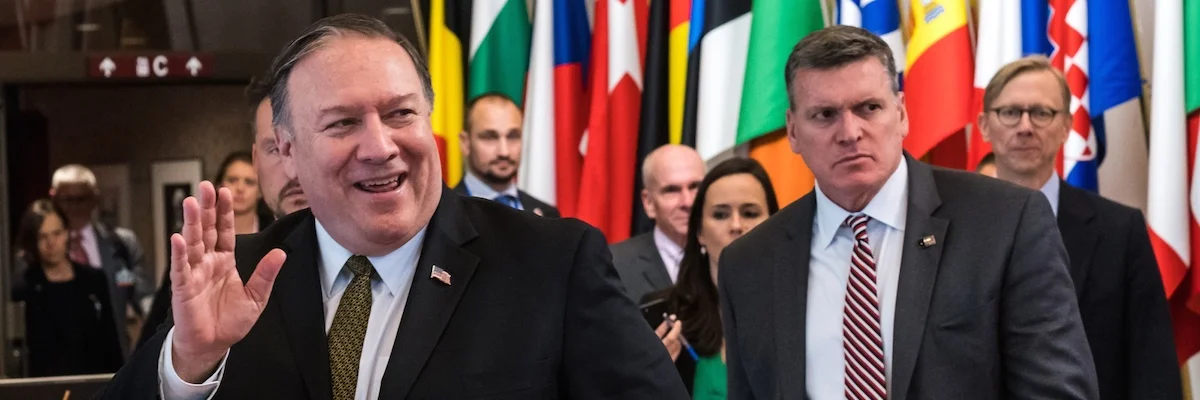
The World Agrees With Trump on One Thing When It Comes to Iran
◢ Blunt, ignorant and confused are some of the criticisms voiced by allies on U.S. policy toward Iran. But none sees the Trump administration preparing for war. Governments worldwide are alarmed at the tension between Washington and Tehran, concerned about the risk of escalation or military miscalculation and frustrated at a lack of communication about U.S. goals.
By Alan Crawford, Ilya Arkhipov and Gregory Viscusi
Blunt, ignorant and confused are some of the criticisms voiced by allies on U.S. policy toward Iran. But none sees the Trump administration preparing for war.
Governments worldwide are alarmed at the tension between Washington and Tehran, concerned about the risk of escalation or military miscalculation and frustrated at a lack of communication about U.S. goals. What keeps the anxiety in check from Berlin to Moscow to Ankara is President Donald Trump’s oft-stated aversion to starting fresh wars.
Many allies share U.S. concerns about Iran’s meddling in places like Iraq, Syria and Yemen, and the prospect of it one day acquiring nuclear weapons. But Washington faces opposition—at times the exasperation has spilled into public view—for ripping up the 2015 nuclear accord with Tehran, for its heavy sanctions on the regime and for a ratcheting up of military activity in the Gulf.
Secretary of State Michael Pompeo’s trip to Brussels last week yielded little support for the U.S. position, with Europe doubling down on its commitment to the deal that Trump abandoned last year.
Pompeo also got nothing new on Iran from President Vladimir Putin during a subsequent visit to the Russian Black Sea resort of Sochi, according to a senior Russian official with knowledge of the discussions. Distrust between Moscow and Washington is so great that no separate deal is possible on Iran, said another person close to the Kremlin.
Still, Russia is counting on Trump to rein in both the hawks in the U.S. administration and regional allies, led by Israel.
“We’ve studied Trump’s approach and tactics pretty well over the past two and a half years; he’s not a military man, he doesn’t like to fight,” said Fyodor Lukyanov, head of the Council on Foreign and Defense Policy, which advises the Kremlin. “He likes to make a show of strength and use economic levers. His idea is that sanctions will force Tehran in the end to negotiate.”
In Berlin, officials view Trump as the main force to halt the spiral toward conflict, primarily due to his well-known resistance to foreign interventions, said a senior lawmaker from Chancellor Angela Merkel’s coalition.
Indeed, a U.S. official said late last week that Trump isn’t seeking conflict—though he’d consider using the military if needed. And the president, when asked about war with Iran, said "I hope not." On Sunday, Trump tweeted that if Iran wanted to fight it would be "the official end of Iran. Never threaten the United States again!"
Trump has spoken frequently of his desire to reduce what the U.S. spends on security support for others, be it NATO or troops in places like South Korea. He’s said for too long other countries have taken advantage of the U.S., without boosting their own military capacity. The U.S. has been a significant presence globally since World War II, and is seen as a buffer against China as a rising global power. A particular red line for Trump appears to be boots on the ground in a fresh conflict.
Still, the overall U.S. strategy on Iran causes concern. One French government official said Trump and senior aides such as National Security Adviser John Bolton are wrong to think that tightening the screws on Iran’s economy would convince its leaders to bend.
Germany, too, has no choice but to maintain a certain level of cooperation with Iran, the lawmaker in Berlin said. Europe is pressing ahead with a trade clearinghouse, known as INSTEX, to circumvent around U.S. sanctions and is eager to settle its first transaction with Iran, another official said.
At the same time, there’s frustration in Germany at the opacity of Washington’s motives.
That’s also a complaint from U.S. allies elsewhere. Each day brings only more confusion, one Asian government official said. An official familiar with Turkey’s thinking said the actions of those within the U.S. administration do however appear coordinated.
“Usually the Americans and Trump are very clear—you could say almost brutal,” said Jacques Maire, a former diplomat who’s a member of parliament for President Emmanuel Macron’s LREM party. “This time, I have to say I’m not always clear what is the end game, what is the goal.”
Iranian Foreign Minister Mohammad Zarif undertook his own Asian tour to seek renewed commitments to deliver the economic benefits that were supposed to derive from the 2015 nuclear deal. He went to New Delhi, Tokyo and Beijing, where he won a pledge from China on Friday to support Iran’s efforts to safeguard its interests.
Japan is worried that Iran, a country with which it has had good ties for decades, will be forced out of the nuclear deal by hawks in the Trump administration. But Tokyo also has no intention of breaking away from the path set by its longtime ally Washington.
“Iran is asking the Japanese to do anything and everything that they can to persuade the United States to be a little more rational, but I don’t know whether Prime Minister Shinzo Abe can really convince Trump,” said Kazuo Takahashi, emeritus professor of international politics at Open University in Japan.
In the Middle East, key U.S. ally Israel is keeping its head down. Prime Minister Benjamin Netanyahu has ordered cabinet ministers to avoid making public statements on the possibility of a U.S.-Iran war, according to three Israeli officials familiar with the matter.
Israel views Trump’s goal as getting an improved nuclear deal that covers Iran’s ballistic-missile development and sponsorship of regional militias such as Hezbollah. That said, if Iran miscalculates and strikes U.S. bases or other interests, triggering retaliation, Israel wouldn’t worry, the officials said. They don’t regard Iran as having the capability to strike Israel.
It’s Iran that is encouraging “false narratives” of war, said Firas Maksad, director of the Arabia Foundation, a Washington think tank that’s close to the Saudi Arabian government.
Saudi Arabia and the U.A.E. have an interest in Washington and Tehran reaching a new understanding, he said. Trump, “while averse to another Middle Eastern war not unlike his predecessor, understands the need for a deal with Iran that goes beyond an arms control agreement to include other aspects of destabilizing behavior,” he said.
“All involved understand that the path to such an understanding will have to go through a difficult period of brinkmanship.”
Minister of State for Foreign Affairs Adel Al-Jubeir told reporters on Sunday that Saudi Arabia does not want war with Iran "in any way, but at the same time we won’t allow Iran to continue its hostile policies toward the kingdom."
A senior European diplomat said that while governments don’t see conflict as likely, that doesn’t mean they aren’t nervous. Leaving the nuclear deal was a mistake that increases risks on multiple fronts, the diplomat said.
It’s a broad concern that’s surfaced elsewhere over the gamut of Trump’s policy beyond Washington, from Venezuela to North Korea, trade tariffs, China’s Huawei and now Iran.
Turkey, for example, “is very much worried over Trump’s roller-coaster global foreign policy,” said Muhittin Ataman, director of foreign policy studies at the Ankara-based SETA think tank. It “injects more uncertainty rather than predictability to challenging problems around the world.”
Photo: Bloomberg
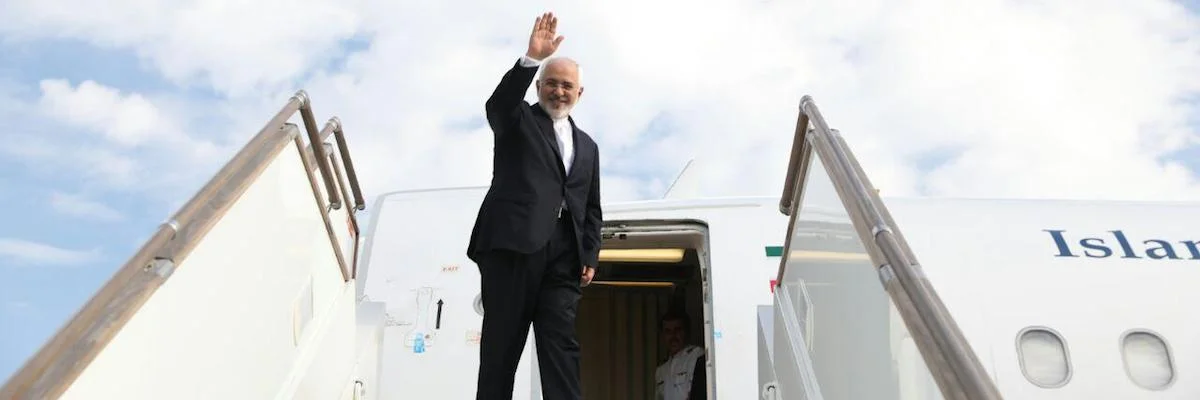
Iran Urges China, Russia 'Concrete Actions' to Save Nuclear Deal
◢ Iranian Foreign Minister Mohammad Javad Zarif on Friday urged China and Russia to take "concrete actions" to safeguard the 2015 nuclear deal as he warned of a "dangerous" situation amid escalating tensions with the US. China was one of the eight global buyers—India, Turkey, Japan, South Korea, Taiwan, Italy and Greece—that was allowed to import Iranian crude oil before the US ended waivers in early May.
By Poornima Weerasekara
Iranian Foreign Minister Mohammad Javad Zarif on Friday urged China and Russia to take "concrete actions" to safeguard the 2015 nuclear deal as he warned of a "dangerous" situation amid escalating tensions with the US.
A stand-off between Tehran and Washington has ratcheted up in recent days, with the US deploying an aircraft carrier group and B-52 bombers to the Gulf last week over alleged threats from Iran.
"Iran and China need to think together and work together about preserving a multilateral global order and avoiding a unilateral global order," Zarif said during a meeting with his Chinese counterpart Wang Yi on Friday evening.
On Wednesday, the US State Department ordered the evacuation of most personnel from the US embassy and consulate in Iraq over an alleged "imminent" threat from Iraqi militias with close links to Tehran.
With tensions rising, the UK warned British-Iranian dual nationals against all travel to Iran on Friday, citing the recent "arbitrary detention and mistreatment" of such citizens.
British insurer Lloyd's of London has also widened its list of areas in and around the Gulf posing "enhanced risk for marine insurers" after a still-mysterious "attack" on tankers anchored off Fujairah, an Emirati port.
Zarif has called on the international community to save the nuclear deal, known as the Joint Comprehensive Plan of Action, or JCPOA.
Iran signed the deal with China, Russia, Germany, Britain, France and the United States. International sanctions were eased in return for curbs on Tehran's nuclear program.
But last year, President Donald Trump walked away from the accord. The US has since imposed sweeping sanctions on Iran.
"So far the international community has mostly released statements rather than taking action," Zarif said.
"If the international community and other JCPOA member countries and our friends in the JCPOA like China and Russia want to keep this achievement, it is required that they make sure the Iranian people enjoy the benefits of the JCPOA with concrete actions," he added.
The White House has sent mixed signals about its intentions in recent days
In a Friday tweet, Trump lambasted the media for what he said was its "fraudulent and highly inaccurate coverage of Iran", amid multiple US reports of infighting in Trump's cabinet over how hard to push Tehran.
'Maximum Pressure'
Zarif said last week that only Russia and China had supported Iran and helped it keep the nuclear deal going, and accused other parties to the agreement of letting Tehran down.
China was one of the eight global buyers—India, Turkey, Japan, South Korea, Taiwan, Italy and Greece—that was allowed to import Iranian crude oil before the US ended waivers in early May.
Zarif's China trip comes after visits to Turkmenistan, India and Japan in the past week.
Despite Washington's campaign of "maximum pressure" against Iran, the Islamic Republic has vowed to keep selling oil to its main customers, especially China, even if it requires using indirect means.
On May 8, Iranian President Hassan Rouhani said Iran would stop observing restrictions on stocks of enriched uranium and heavy water agreed under the nuclear deal in retaliation for the US withdrawal and the reimposition of sanctions.
In his announcement, Rouhani threatened to go further if the European members of the deal failed to start delivering on their promises to help Iran circumvent US sanctions within 60 days.
China in response called on all parties to uphold the nuclear deal in what it called a "shared responsibility.”
European nations have also called on all partners to the deal to help salvage it while expressing frustration at Iran's demands for help in circumventing US sanctions.
One European diplomat called on China to buy Iranian oil as it is less exposed to the United States.
"They are now very exposed to the dollar but it is also a question of political choice," said the source, who spoke on condition of anonymity.
"The reality for the Chinese is that they are in a global trade war with the Americans, they are in the middle of negotiations and they are not quite so sure if they want to load the boat," the diplomat added.
Photo: IRNA
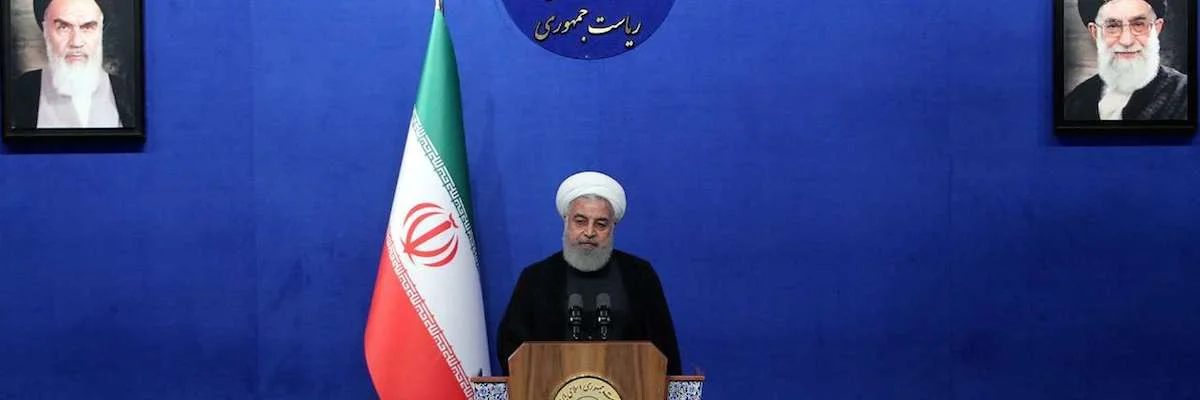
Iran Accuses US of 'Unacceptable' Escalation in Tensions
◢ Iran accused the United States Thursday of an "unacceptable" escalation of tensions and said Tehran was showing "maximum restraint" despite Washington's withdrawal from a nuclear deal with world powers. Tensions were already high after President Donald Trump walked away a year ago from the accord, which eased international sanctions in return for curbs on Iran's nuclear program.
By Kyoko Hasegawa and Paul Handley
Iran accused the United States Thursday of an "unacceptable" escalation of tensions and said Tehran was showing "maximum restraint" despite Washington's withdrawal from a nuclear deal with world powers.
Tensions were already high after President Donald Trump walked away a year ago from the accord, which eased international sanctions in return for curbs on Iran's nuclear program.
But tensions have ratcheted up, with the US deploying an aircraft carrier group and B-52 bombers to the Gulf over alleged threats from Iran.
"The escalation by the United States is unacceptable," Iranian Foreign Minister Mohammad Javad Zarif said in Tokyo, where he is holding talks with Japanese officials.
"We exercise maximum restraint... in spite of the fact that the United States withdrew from JCPOA last May," Zarif said earlier, referring to the agreement on Tehran's nuclear program, which is known as the Joint Comprehensive Plan of Action.
He added that Tehran remains "committed" to the deal, and said continuing assessments showed Iran was in compliance with the multilateral agreement.
Later, Zarif told reporters there was "no possibility" of negotiations with the United States to reduce spiraling tensions, describing US pressure as an "act of suicide.”
Zarif's comments came after the US on Wednesday ordered non-emergency staff evacuated from its Baghdad embassy due to an alleged "imminent" threat from Iranian-linked Iraqi militias.
Two major pro-Iran armed groups in Iraq rejected suggestions the embassy personnel were at risk.
Nasr al-Shomari, a military commander for the Iran-backed Harakat al-Nujaba, told AFP the claim was "a pretext" by Washington to create "an uproar" in Iraq.
But the move added to growing fears that the long-time rivals could be on course for conflict despite both sides stressing they have no desire for war.
Trump, however, predicted Iran would "soon" want to negotiate. "I'm sure that Iran will want to talk soon," the president tweeted.
He also blasted media reports of White House turmoil over Iran, saying "there is no infighting whatsoever. Different opinions are expressed and I make a final and decisive decision."
Zarif late Thursday dismissed Trump's prediction of talks, telling reporters: "I don't know why President Trump is confident."
Opponents of Trump say hardliners led by national security advisor John Bolton, who has long advocated toppling the Iranian government, are pushing the country into war.
According to Iranian state media, Zarif is set to visit China on Friday for discussions on "regional and international issues" including the 2015 nuclear deal with global powers.
'Imminent Threat'
Despite international skepticism, the US government has been pointing to increasing threats from Iran, a long-time enemy and also a rival of US allies Israel and Saudi Arabia.
Senior State Department officials, speaking on condition of anonymity, said the threat came from Iraqi militia "commanded and controlled" by Tehran's Islamic Revolutionary Guard Corps.
"It is directly linked to Iran, multiple threat streams directly linked to Iran," said one official.
"This is an imminent threat to our personnel," said a second official.
Washington says it has received intelligence on possible attacks by Iranian or Iranian-backed forces, possibly targeting US bases in Iraq or Syria.
Iran's supreme leader, Ayatollah Ali Khamenei, on Tuesday insisted the showdown with the United States was a mere test of resolve.
"This face-off is not military because there is not going to be any war. Neither we nor them (the US) seek war," he said.
US Secretary of State Mike Pompeo echoed that sentiment, saying in Sochi, Russia: "We fundamentally do not seek a war with Iran."
World powers have rushed to urge calm and US allies continued to show skepticism over Washington's alarm bells.
But UK Foreign Secretary Jeremy Hunt said he had recently met with Pompeo and shared "the same assessment of the heightened threat posed by Iran".
"As always we work closely with the US," he tweeted.
Britain's defense ministry meanwhile said Wednesday that they have "long been clear about our concerns over Iran's destabilizing behavior in the region"—while still not confirming any new imminent danger.
Some observers speculate Tehran is seeking to retaliate over Washington's decision in April to put Iran's Revolutionary Guards on a terrorism blacklist—a move designed to stymie their activities across the Middle East.
But since the first US warning on May 5, the only incident has been a still-mysterious "attack" Monday on tankers anchored off Fujairah, an Emirati port located at the strategically crucial entrance to the Gulf.
One or more vessels incurred light hull damage, but what caused the damage and who was behind it remains unknown.
Photo: IRNA
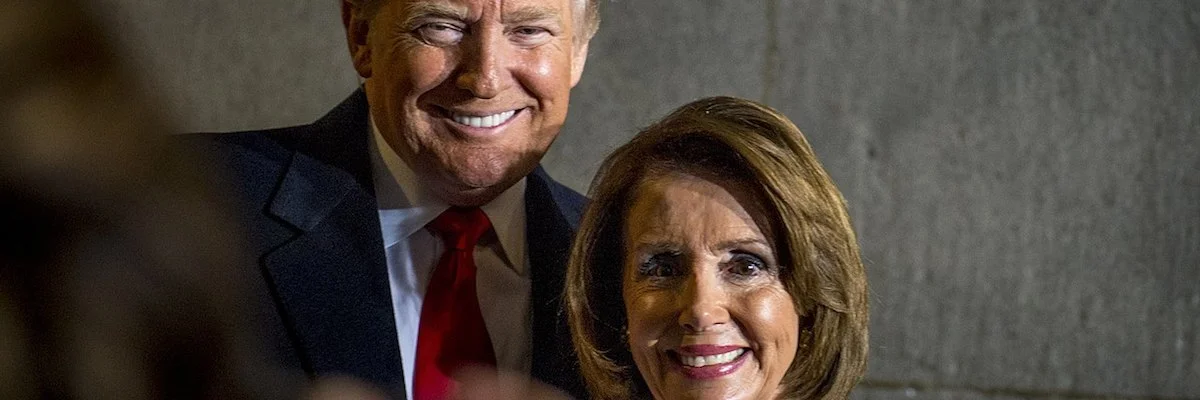
Pelosi Says Trump Needs Congress for Any Military Action on Iran
◢ House Speaker Nancy Pelosi warned the Trump administration against taking military action in Iran without authorization from Congress, as the U.S. weighs how to respond to rising tensions in the Middle East. "The responsibility in the Constitution is for Congress to declare war," Pelosi said Thursday. "So I hope that the president’s advisers recognize that they have no authorization to go forward in any way."
By Daniel Flatley
House Speaker Nancy Pelosi warned the Trump administration against taking military action in Iran without authorization from Congress, as the U.S. weighs how to respond to rising tensions in the Middle East.
"The responsibility in the Constitution is for Congress to declare war," Pelosi said Thursday. "So I hope that the president’s advisers recognize that they have no authorization to go forward in any way."
Pelosi said that the 2001 Authorization for the Use of Military Force—or AUMF—enacted by Congress after the Sept. 11 terrorist attacks would not cover actions taken against Iran. She said that, like President Donald Trump, she opposed the 2003 invasion of Iraq, and she welcomed reports this week that the president had "no appetite" for war, a characterization offered by Republican Senator Mitt Romney.
"I like what I hear from the president that he has ‘no appetite’ for this," she said. "Even though some of his supporters are rattling sabers."
Trump suggested Thursday he wasn’t looking for a military confrontation even as his advisers warn Iran against any provocation. Tensions have been rising with the Islamic Republic over U.S. allegations that Tehran may be preparing an attack on U.S. military forces in the region or on commercial shipping.
“I hope not,” Trump told reporters on Thursday after he was asked about going to war with Iran while greeting Swiss President Ueli Maurer for a meeting at the White House.
Perceived Threats
Senator Rand Paul, a Republican from Kentucky and one of the president’s allies on domestic issues, said he worries that the recent moves by the administration risk dragging the U.S. into a war with Iran.
"There are people who do want a war for regime change and they don’t mind putting all the people so close together that there might be a skirmish that leads to war," Paul said. "I think that would be a terrible tragedy."
Paul is a co-sponsor of legislation introduced by Democratic Senator Tom Udall that would "limit the use of funds for kinetic military operations in or against Iran." He is the only Republican sponsor of that bill.
Other Republicans said they were comfortable giving the White House more leeway to respond to perceived threats.
House Majority Leader Kevin McCarthy said Trump was trying to head off a debate about the use of military force altogether by deterring hostile actions from Iran and Iranian-backed combatants in the Middle East. He said he believes that the administration will act in a “thoughtful” way.
"There’s no action that’s being taken," McCarthy said. "What has transpired today is the administration is trying to make sure there is not. It’s sending a very clear message to Iran."
‘Cause for Concern’
Senator Marco Rubio, a Florida Republican, said U.S. forces have the right to protect themselves if attacked and that questions about congressional authorization would not be relevant in this situation.
"If Iran attacks us, they’re going to get hit hard," Rubio said. "If they don’t attack us, there’ll be no war. It’s up to them."
Representative Mac Thornberry, the top Republican on the House Armed Services Committee, said recent Iranian action in the Persian Gulf is “cause for concern,” according to the top Republican on the House Armed Services Committee.
Thornberry, who has been briefed by Central Command officials and intelligence staff over the last two weeks, said sending a signal to Iranians not to attack Americans “seems like the prudent thing to do.” He said he’s not concerned that the Trump’s administration’s response could be politically motivated.
Senator Richard Durbin, a member of Democratic leadership, said he voted against the Iraq War because he wasn’t convinced of the intelligence, and he fears the U.S. could be heading toward a repeat. He also warned that miscalculation when tensions are high could lead to fatalities, followed by calls for retribution.
The Illinois Democrat said Trump has surrounded himself with advisers “who believe that getting tough on a military basis with Iran is in our best interest. I do not."
Photo: Wikicommons
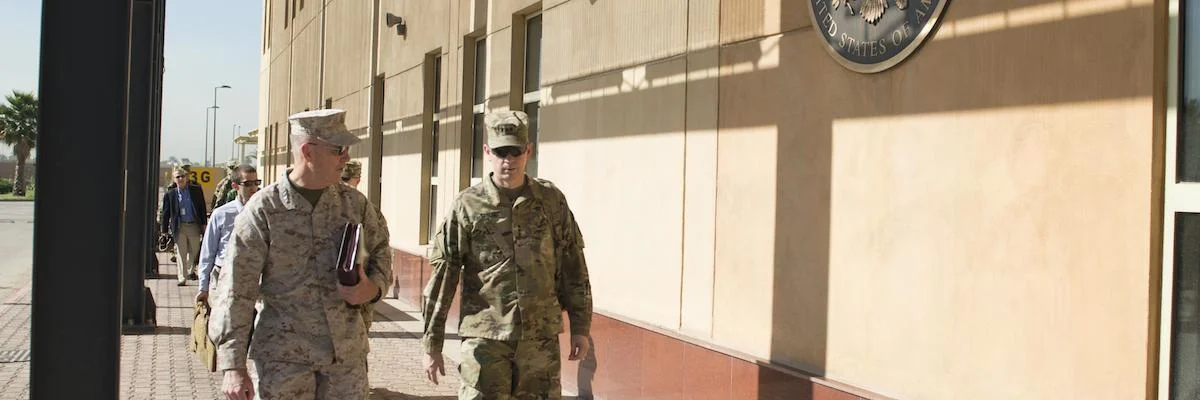
U.S. Pulls Iraq Embassy Staff as Tensions Climb Higher Over Iran
◢ The U.S. ordered its non-emergency government staff to leave Iraq amid increasing Middle East tensions that American officials are blaming on Iran, as fears rise that the region may be heading toward another conflict. Most employees at the U.S. embassy in Baghdad and the consulate in Erbil, in the majority Kurdish region, will leave due to an “increased threat stream,” according to an embassy statement Wednesday.
By Ladane Nasseri and Zainab Fattah
The U.S. ordered its non-emergency government staff to leave Iraq amid increasing Middle East tensions that American officials are blaming on Iran, as fears rise that the region may be heading toward another conflict.
Most employees at the U.S. embassy in Baghdad and the consulate in Erbil, in the majority Kurdish region, will leave due to an “increased threat stream,” according to an embassy statement Wednesday that didn’t give more details. The move comes after the Pentagon accelerated a carrier battle group’s transit to the region and deployed a Patriot anti-missile battery to bolster forces.
U.S. officials on Wednesday reiterated that the Trump administration isn’t seeking a war, but said it will seek to hold Iran “accountable” for its actions and those of its proxies. The officials, who asked not to be identified, said the decision to withdraw embassy staff was based on considerations of safety and not meant as political signaling.
Denying reports of “infighting” in his administration over Iran policy, President Donald Trump said in a tweet Wednesday that “I’m sure that Iran will want to talk soon.”
Yet critics of the Trump administration warned the U.S. isn’t sharing enough clear evidence of Iranian threats and say that without better intelligence, the latest buildup is reminiscent of the lead-in to the Iraq war in late 2002, which was based on faulty intelligence. Iranian officials have said that National Security Advisor John Bolton and other administration hawks are hyping the threat of war.
Separately, Saudi Arabia restarted its main cross-country oil pipeline after a drone attack by Iran-backed rebels based in neighboring Yemen. Saudi Arabia and the United Arab Emirates—both Iranian rivals—reported attacks on Monday on several vessels including Saudi oil tankers.
While it’s not yet clear who was behind the shipping attacks, the combination of events has raised the risk of conflict in a region that exports more than 16 million barrels of oil a day -- enough to supply all of Europe’s demand and more.
The U.A.E.’s minister of state for foreign affairs, Anwar Gargash, said the country is still investigating the attacks on the ships and said he’s “not going to jump the gun” on blaming any nation until the probe is completed. Addressing tensions in the region, Gargash said “we are very committed to deescalation.”
‘Suffer Greatly’
Trump has long said he wants to pull the U.S. out of Middle East conflicts, but this week he also warned that the Islamic Republic would “suffer greatly” if it provokes America.
Trump on Tuesday rejected a report that the Pentagon is updating scenarios for war with Iran, but then warned he’d send “a hell of a lot more” than 120,000 troops to the Middle East in the event of hostilities. Lawmakers on Capitol Hill are demanding briefings on the latest intelligence on Iran, with Secretary of State Michael Pompeo expected to meet with House members next week, according to an official.
Jack Reed, the top Democrat on the Senate Armed Services Committee, said a classified briefing is needed “as soon as possible.”
While the administration didn’t elaborate, it blamed Iran-backed Shiite militias after pulling staff from the consulate in Basra in southern Iraq in September and Pompeo used an unannounced May 7 visit to the country to denounce what he called an “escalating” threat from Tehran.
Yet unlike in other hot spots such as Venezuela and North Korea, where the U.S. managed to forge an international coalition to advance its goals, Trump is diplomatically isolated on Iran after unilaterally quitting the 2015 nuclear deal a year ago, a move that alienated allies including the U.K. and Germany.
Amid the tensions, oil prices rebounded on Wednesday as a government report showed shrinking supplies of U.S. gasoline, suggesting more demand ahead for crude suppliers.
The series of events has increased concerns of a military confrontation, whether deliberate or otherwise.
Pompeo canceled a trip to Germany last week in order to make the unannounced visit to Iraq’s capital, where he spoke with leaders about an “escalating” threat from Iran and possible “big energy deals” to help wean the Iraqi economy away from its neighbor. This week, Pompeo made scant progress in persuading EU counterparts to take a harder line toward Iran in an last-minute trip to Brussels to share what the U.S. says is fresh intelligence on the threat posed by Tehran.
“I made clear once again that we are worried in view of the developments and the tensions in the region,” German Foreign Minister Heiko Maas said after the meetings. “We don’t want a military escalation.” German officials on Wednesday said the country wasn’t aware of a “concrete threat” or change to the security situation in Iraq.
A spokesman for the U.S. Embassy in Baghdad said the departures announced Wednesday did not amount to an evacuation, but to an ordered exit of non-essential personnel. He declined to say how many employees would remain. The last such drawdown took place in 2014, when Islamic State swept through the north of the country toward the capital. It lasted several months.
Shiite Muslim Iran has played a prominent role in Iraq since the U.S.-led invasion of 2003 put Iraq’s majority Shiite community in power. Tehran supports several powerful Shiite militias in Iraq, including some that played a significant role in the successful fight against Islamic State.
Trump says Iran’s missile program and support for militant groups is destabilizing the Mideast region and he has made countering the Islamic Republic a primary focus of his foreign policy, encouraged by Iranian foes led by Saudi Arabia, the U.A.E. and Israel.
In recent weeks, the U.S. ratcheted up the pressure on ruling clerics by scrapping waivers that had allowed some countries to carry on importing Iranian crude, and designating the Islamic Revolutionary Guard Corps, Iran’s elite military unit, as a terrorist organization.
Iranian officials have warned of what they said is a disinformation campaign. Last month, Foreign Minister Javad Zarif said that the targeting of his nation could take a dangerous turn and trigger a wider crisis. He suggested hard-liners in Washington and Saudi Arabia may be “plotting an ‘accident’ anywhere in the region.”
The U.S. assessment of an increased Iranian threat was disowned on Tuesday by the British deputy commander of the international campaign to defeat Islamic State, Major General Christopher Ghika. “There’s been no increased threat from Iranian-backed forces in Iraq and Syria,” he said in a briefing for Pentagon reporters.
In an unusual airing of differences, U.S. Central Command then issued a statement rejecting Ghika’s comments as “running counter to the identified credible threats available to intelligence.”
Gargash, the U.A.E. minister of state, said that the current situation in the region means “we need to emphasize caution and we need to emphasize good judgment. It’s a very brittle, difficult situation.”
Photo: JCS
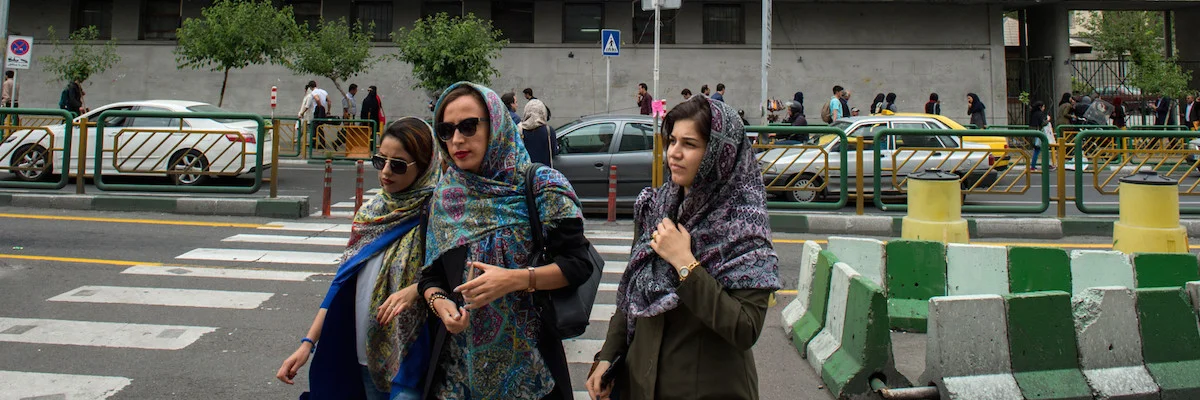
In Tehran, Economic Alarm Outweighs Fear of Conflict With Trump
◢ The sense of a dangerous drift towards conflict is being compounded by volleys of belligerent rhetoric lobbed from both the United States and Iran. An adviser to Iranian President Hassan Rouhani, Hesameddin Ashena, taunted Trump on Twitter with the prospect of war, adding an apparent reference to National Security Adviser John Bolton, regarded as a leading Iran hawk.
By Golnar Motevalli, Glen Carey and Ladane Nasseri
In the Motahari commercial district of central Tehran, Mohammad Mohammadzadeh is more concerned about soaring prices than the threat of war with America.
Folding a pile of documents in his empty printing shop, Mohammadzadeh lists the challenges facing his business, including a 10-fold increase in the cost of ink cartridges, and bemoans the lack of help from Iran’s government. He regards the deteriorating state of relations with the U.S. with wearied resignation.
“The U.S. just talks and talks and their words are meaningless now,” he said, as heavy traffic crawled past the banks, government offices and car showrooms lining the congested boulevard outside. “What can America do that they haven’t done before? They’ve been doing this sort of thing for 40 years.”
President Donald Trump and Iran’s Supreme Leader Ayatollah Ali Khamenei both say that war is not on the horizon. But with no immediate prospect of talks and lacking any obvious back channels of communication, the void is filled by a history of mutual enmity.
The U.S. has chosen “bullying and force” in its approach to Iran rather than engaging with respect, said Diako Hosseini, director of the world studies program at the Center for Strategic Studies in Tehran, which is affiliated with Iran’s presidential office. “This approach won’t yield results and can bring the situation close to a dangerous juncture.”
Perilous Drift
Breaking out of the cycle of antipathy is all the harder because Iran is unsure of Trump’s endgame—Iranian concessions or regime change—and has declined to heed U.S. calls to come to the negotiating table under duress. Tehran will take Trump’s calls for dialogue seriously “when it becomes clear who it is that Iran’s speaking to and to which U.S. policy it needs to respond,” said Hosseini.
The sense of a dangerous drift is being compounded by volleys of belligerent rhetoric lobbed from both sides. An adviser to Iranian President Hassan Rouhani, Hesameddin Ashena, taunted Trump on Twitter with the prospect of war, adding an apparent reference to National Security Adviser John Bolton, regarded as a leading Iran hawk.
In Washington the same day, Trump said that he’d send “a hell of a lot more” than 120,000 troops to the Middle East in the event of hostilities, in the same breath rejecting as “fake news” a report that his administration was planning for war.
Amid the saber-rattling, there are confused signs on the ground, whether real or intended to raise pressure. The State Department told all “non-emergency U.S. government employees” to leave Iran’s neighbor Iraq on Wednesday. The order came after the White House expedited the planned deployment of the USS Abraham Lincoln Carrier Strike Group to the Middle East in response to what it called “troubling and escalatory indications and warnings” from Iran.
‘Rush to War’
That version of events was contradicted by the U.K. deputy commander of the anti-Islamic State coalition, Major General Chris Ghika, who told reporters at the Pentagon there was “no increased threat from Iranian-backed forces in Iraq and Syria.” U.S. Central Command responded with a statement disputing the allied commander’s remarks.
In the Black Sea resort of Sochi, Secretary of State Michael Pompeo said after meeting with Russian Foreign Minister Sergei Lavrov that the U.S. “fundamentally doesn’t want war with Iran.” Democratic presidential candidate Bernie Sanders posted a Twitter message anyway warning against “this disastrous rush to war.”
Trump triggered the impasse last year when he withdrew from the 2015 nuclear accord with Iran despite personal lobbying by German Chancellor Angela Merkel and French President Emmanuel Macron. The U.S. reintroduced sanctions on Iran, sending the economy and rial currency into a tail spin and prices of basic goods surging beyond the reach of many.
It also warned Europe against trying to preserve the accord, imposing secondary sanctions to punish companies doing business with Tehran. That has left European signatories Germany, France and the U.K. frustrated with Washington, squeezed by Iran and with little room to act as intermediaries to ratchet back tensions.
‘Call Me’
German Deputy Foreign Minister Niels Annen used a speech in Berlin on Wednesday to blast the U.S. position as “short-term and inconsiderate of interests of some of its closest partners.”
Trump has said he’s willing to talk to Iranian leaders, including telling them last week to “call me,” but Iran insists negotiations are only possible after the U.S. has returned to the nuclear deal.
The accord “complies with the expectations that the American president recently mentioned—that Iran doesn’t attempt to seek nuclear weapons,” Iran’s Vice President Masoumeh Ebtekar said in an interview in Tehran. “If they go back to the original position that they had at the beginning of their government then yes, it can be considered.”
Oil Assets
Two attacks on Saudi oil infrastructure in three days have only heightened the sense of confusion. On Tuesday, a rebel group in Yemen that’s backed by Iran claimed responsibility for drone attacks that targeted two pumping stations in Saudi Arabia. That came two days after the United Arab Emirates said four ships were damaged in an unexplained incident near the Strait of Hormuz, the world’s most important choke point for oil shipments.
One undeniable reality is the impact of U.S. sanctions, including on Iranian oil. The Trump administration sought to keep up the pressure by announcing fresh measures this month targeting Iran’s copper, iron, steel and aluminum sectors. The International Energy Agency forecast that crude production in Iran, the fifth-largest OPEC member, could fall in May to the lowest since the Iran-Iraq war of the 1980s.
That’s a reminder to Tehran of the Reagan administration’s backing for Saddam Hussein in his eight-year war against Iran. More than 1 million died on both sides in the conflict, some as a result of exposure to chemical weapons used by Saddam against Iranian urban centers and troops.
CIA-Backed Coup
For Iran, it’s one example of the long-term hostility the U.S. has shown the Islamic Republic, going back as far as the CIA-supported 1953 coup that toppled democratically elected Prime Minister Mohammed Mossadegh and installed Shah Mohammed Reza Pahlavi. The Shah was ousted in the 1979 revolution in a multi-party political revolt that ultimately created the current Islamic regime in Tehran.
For the U.S. administration, including Trump and his advisers, there is a deep suspicion of Iranian behavior, grounded in the 1979 hostage crisis when Iranian students took 52 American diplomats captive and held them for 444 days in Tehran.
The Carter administration formally cut ties with Iran and put it under economic embargo in April 1980. Weeks later, a U.S. military effort to free the hostages failed after a helicopter used in the operation collided with a transport plane, killing eight American servicemen and an Iranian civilian. Two other helicopters suffered mechanical defects. Official relations have never been restored.
‘Horrible’ Deal
Trump’s predecessor, President Barack Obama, sought to constrain Iran’s nuclear program by persuading the country to change its policies through strengthening its links with the outside world, culminating in the nuclear accord. Trump abandoned it as a “horrible” deal.
“The Iranians have for decades believed that the United States wanted regime change,” said James M. Dorsey, senior fellow at Singapore’s S. Rajaratnam School of International Studies and its Middle East Institute. “The nuclear agreement appeared to suggest that an accommodation may be possible. Trump is a return to square one.”
In Tehran, Maryam, who didn’t want to give her surname because of the sensitivities of speaking with foreign media, sat behind a desk working on the accounts of a small marketing firm. She said her “real fear” is that the economic situation deteriorates to the extent that Iran shares Venezuela’s fate. She isn’t worried about war, citing European and Russian efforts to prevent it, and is instead holding out for talks.
“They might be convinced that they need to sit down and talk, not over the nuclear deal but just over these current tensions,” she said. “In terms of how bad things are now between the two countries, they need to talk.”
Photo: Bloomberg

Congress Demands Iran Briefing From White House as Tensions Rise
◢ Members of Congress are seeking answers from the Trump administration on U.S. plans to respond to escalating tensions with Iran, demanding more information about fast-moving developments in the Middle East. U.S. officials will meet Thursday with congressional leaders from both parties in both chambers, including heads of both intelligence committees, to discuss the Middle East, according to a person familiar with the plans.
By Steven T. Dennis and Billy House
Members of Congress are seeking answers from the Trump administration on U.S. plans to respond to escalating tensions with Iran, demanding more information about fast-moving developments in the Middle East.
U.S. officials will meet Thursday with congressional leaders from both parties in both chambers, including heads of both intelligence committees, to discuss the Middle East, according to a person familiar with the plans. There will be a larger briefing for all U.S. House members next week, which will include Secretary of State Michael Pompeo, according to another person.
Bob Menendez, the top Democrat on the Senate Foreign Relations Committee, rejected this timeline for information and warned that uninformed decisions could lead to conflict like the U.S.’s military involvement in Iraq in the last decade, which was justified with faulty intelligence.
“Things are happening at warp speed here,” Menendez said. “We don’t need another Iraq weapons of mass destruction moment, that we’re led into things on false information, unverifiable, untested. So I am alarmed that we cannot even get the basic briefings in a timely manner.”
Policymakers’ scramble for information comes as the U.S. ordered its non-emergency government staff to leave Iraq, citing an “increased threat stream” in the region. Trump administration officials this week are warning of rising threats to Americans from forces backed by neighboring Iran and are deploying warships and B-52 bombers to the Gulf.
Senate Minority Leader Chuck Schumer said there is an “alarming lack of clarity” about the strategy in Iran.
“Any potential increase in our military presence in the Middle East should require consultation with Congress and anything beyond that would require this body to act,” Schumer said Wednesday on the Senate Floor. “President Trump, what is your strategy? Where are you headed and why aren’t you talking to Congress about it?”
Senators leaving a Wednesday meeting with senior U.S. intelligence officials—previously scheduled to discuss next year’s defense funding—expressed concern about misinformation that could lead to miscalculation. CIA Director Gina Haspel had been expected to be at the briefing but had to go to the White House instead, said GOP Senator Lisa Murkowski of Alaska.
Senator Jack Reed, the top Democrat on the Armed Services Committee, called for a classified briefing for the full Senate on Iran “as soon as possible.”
“We have to know what’s going on and we don’t know the details” about plans in Iran, Reed said.
Senator Chris Murphy, a Connecticut Democrat on the Foreign Relations Committee, said, “The administration is engaged in a series of blind escalations without any endgame.”
Photo: Wikicommons
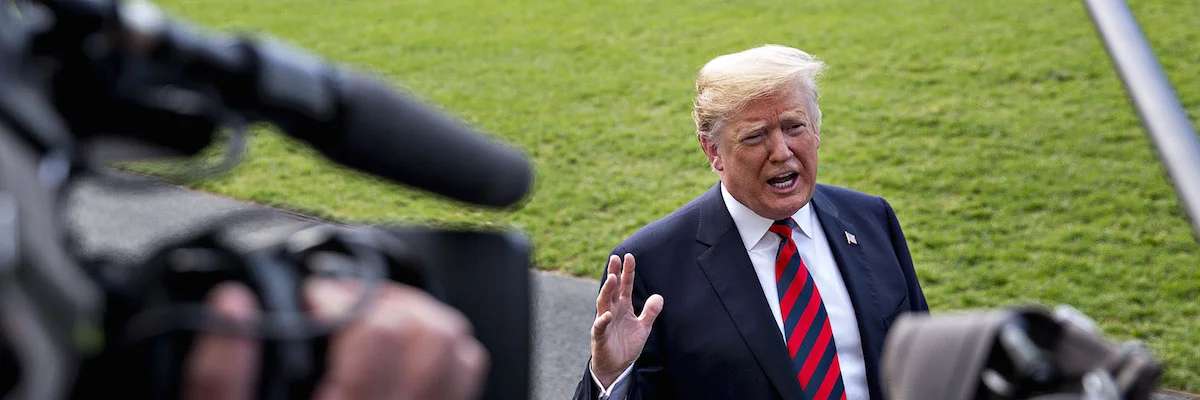
Trump Denies Iran Threat, Then Revives It in Muddled Response
◢ President Donald Trump rejected a report that his administration is planning for war with Iran, but then warned he’d send “a hell of a lot more” than 120,000 troops to the Middle East in the event of hostilities. “I think it’s fake news, OK?” Trump told reporters outside the White House on Tuesday after he was asked about a New York Times report that plans envision sending 120,000 U.S.. troops to fight the Islamic Republic.
By Justin Sink and Margaret Talev
President Donald Trump rejected a report that his administration is planning for war with Iran, but then warned he’d send “a hell of a lot more” than 120,000 troops to the Middle East in the event of hostilities.
“I think it’s fake news, OK?” Trump told reporters outside the White House on Tuesday after he was asked about a New York Times report that plans envision sending 120,000 U.S.. troops to fight the Islamic Republic.
“Now would I do that? Absolutely,” Trump then added. “But I have not planned for that. If we did that, we’d send a hell of a lot more troops than that.”
Tensions are rising with Iran after the Trump administration revoked waivers this month that allowed Iran to continue selling oil to some customers despite U.S. sanctions. Saudi Arabia and the United Arab Emirates reported on Monday mysterious attacks on several vessels including oil tankers in the Persian Gulf, and the Iran-backed Houthi rebels in Yemen claimed on Tuesday they had damaged Saudi oil pumping stations on Tuesday using drones.
Trump warned Iran against provocations yesterday. “If they do anything, it will be a very bad mistake,” he told reporters in the Oval Office.
Iran’s Supreme Leader Ayatollah Ali Khamenei said on Tuesday that neither his country or the U.S. want war, according to the semi-official Tasnim News. The U.S. knows that war won’t benefit it and the only option for the Iranian people is resistance, Khamenei said at a meeting with senior officials, Tasnim reported.
The Times reported that the president’s top national security aides met on Thursday to discuss updated war plans with Iran. The plans envision sending as many as 120,000 troops to the Middle East should Iran attack American forces or accelerate work on nuclear weapons, the Times said.
The Times said the plans do not call for a land invasion of Iran, which would require many more troops.
A spokesman for the White House National Security Council, Garrett Marquis, declined to comment on the accuracy of the Times story. He said in a statement that Trump has been open to talks with the Iranian leadership and made clear that “the United States does not seek military conflicts with Iran.”
But he added: “Iran’s default option for 40 years has been violence and we are ready to defend U.S. personnel and interests in the region.”
Photo: Bloomberg
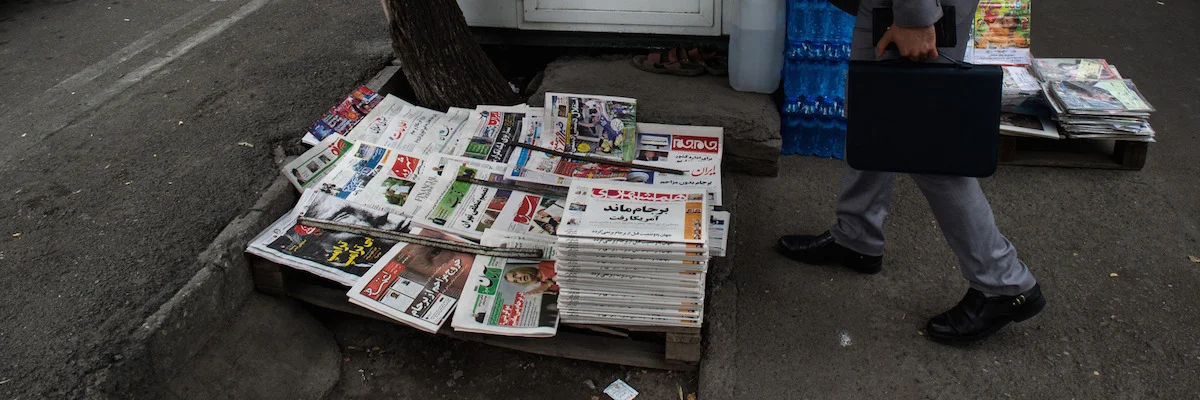
U.S. Sanctions Leave Iran's Papers Short of Ink
◢ The economic hardship triggered by a year of U.S. sanctions has extended to the Islamic Republic’s newspapers, which are struggling to combat fast-rising prices—and shortages—of both paper and printing ink. At a time when Iran’s on front pages around the world, two government-owned dailies have cut coverage while journalists fret about possible layoffs.
By Golnar Motevall
A lack of headlines is making headlines in Iran.
The economic hardship triggered by a year of U.S. sanctions has extended to the Islamic Republic’s newspapers, which are struggling to combat fast-rising prices—and shortages—of both paper and printing ink.
At a time when Iran’s on front pages around the world, two government-owned dailies have cut coverage while journalists fret about possible layoffs.
Javad Daliri, the editor of “Iran,” which broadly supports President Hassan Rouhani, tweeted that the newsprint crisis and more expensive zinc oxide used in ink meant his paper would be eight pages lighter. The most widely-circulated daily, Tehran municipality-owned “Hamshahri,” told readers it would be running at 16 pages, down from 24.
Slashing oil exports has been the primary focus of President Donald Trump’s economic offensive, which seeks to curtail Tehran’s Middle East influence and foment popular discontent with its ruling clerics. But penalties imposed since the U.S. withdrew from the 2015 nuclear accord also led to an exodus of foreign companies from Iran and a 70% slump in the value of the local currency, the rial.
Newspapers “depend on imported paper and fluctuations in the exchange rate in the past year have caused paper prices to multiply by several times,” Mehdi Shafaei, the director of the “Iran” daily’s media and cultural foundation, told the semi-official Iranian Students’ News Agency.
Emily Amraee, a journalist who’s on the editorial board of a leading arts and culture magazine, said its bill for paper had risen by 400 percent. “It’s really damaging to our culture and national interest because it means we cannot then pursue the stories that hold the government accountable,” she said.
Owners typically fire three to four people per page lost during a downturn, Amraee added. Iran’s already financially shaky print media is closely monitored by authorities and vulnerable to state censorship.
The government offered some importers a favorable, fixed-exchange rate to help maintain supplies of essential goods, including paper, as the rial sank. But the policy often backfired, with importers accused of hoarding imports to drive up prices.
ISNA reported on April 30 that only 23,000 tons out of 262,000 tons of newsprint imported through this channel this year had been distributed to suppliers, according to data from the Ministry of Culture and Islamic Guidance. The rest is missing.
Photo: Bloomberg
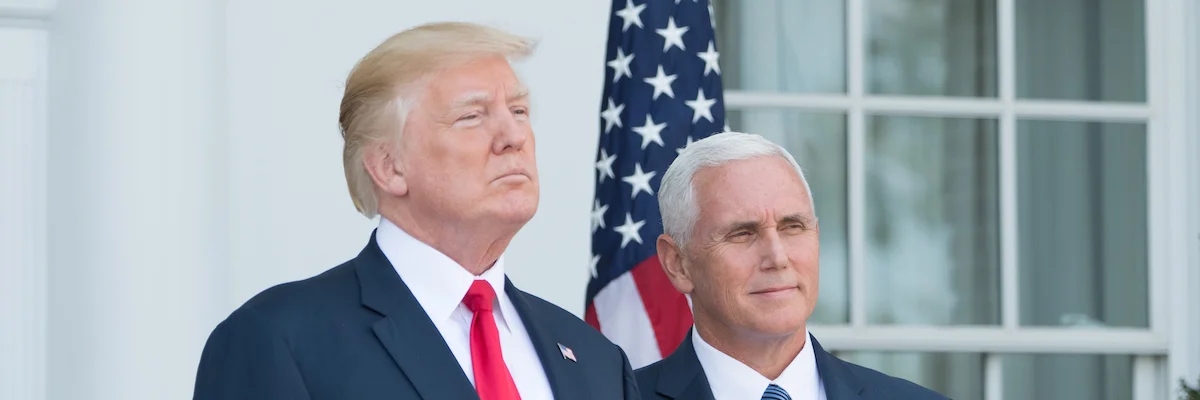
Trump Says Iran Will `Suffer Greatly' If U.S. Is Provoked
◢ President Donald Trump warned Iran against a military provocation and said the country “will suffer greatly” if hostilities break out with the U.S. “We’ll see what happens with Iran. If they do anything it’ll be a very bad mistake, if they do anything,” Trump told reporters on Monday during a meeting with Hungarian Prime Minister Viktor Orban at the White House.
By Margaret Talev in Washington D.C.
President Donald Trump warned Iran against a military provocation and said the country “will suffer greatly” if hostilities break out with the U.S.
“We’ll see what happens with Iran. If they do anything it’ll be a very bad mistake, if they do anything,” Trump told reporters on Monday during a meeting with Hungarian Prime Minister Viktor Orban at the White House.
“I’m hearing little stories about Iran,” Trump added. “If they do anything they will suffer greatly.”
Saudi Arabia claimed that two of its oil tankers were attacked on Sunday while sailing toward the Persian Gulf. The U.A.E. foreign ministry on Sunday reported that four commercial ships were attacked by an unknown adversary.
The precise nature of the incident remained unclear. Saudi Arabia’s state run Saudi Press Agency described it as “a sabotage attack.”
Iran’s Foreign Ministry Spokesman Abbas Mousavi described the maritime incident as “concerning and regrettable” and called for efforts to shed light on what exactly happened, the semi-official Tasnim News reported. He warned against “foreign seditious plots to upset the region’s security and stability.”
Tensions are rising between the U.S. and Iran after the Trump administration earlier this month ended exceptions to U.S. sanctions on Iranian oil sales. The Islamic Republic has threatened to block oil shipments through the Strait of Hormuz and has said it may increase uranium enrichment beyond limits allowed under the 2015 nuclear deal that Trump abandoned.
U.S. National Security Adviser John Bolton said last week that an aircraft carrier and bombers would be deployed to the region to counter unspecific Iranian threats.
Asked what Iran should be worried the U.S. might do, the president said: “You can figure it out yourself. They know what I mean.”
Photo: White House
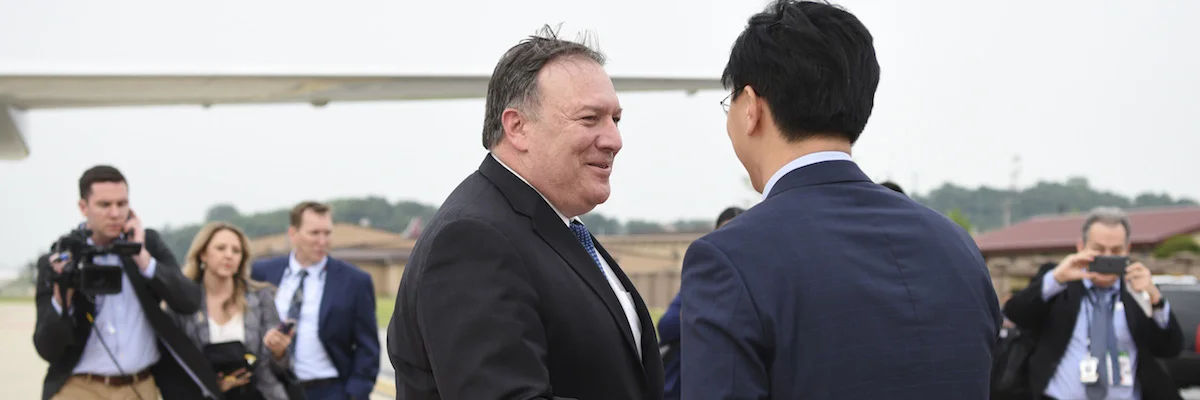
Exasperated Europeans Face Surprise Pompeo Visit on Iran
◢ As European Union governments scramble to save the Iran nuclear accord from U.S. efforts to scuttle it, the mood in diplomatic circles has blackened. Then suddenly, U.S. Secretary of State Michael Pompeo lands in Brussels with little warning. After a cool initial reception to the unscheduled drop-in, Pompeo began meetings with European counterparts to address Iran’s “threatening actions and statements.”
By Patrick Donahue, Gregory Viscusi and Tim Ross
As European Union governments scramble to save the Iran nuclear accord from U.S. efforts to scuttle it, the mood in diplomatic circles has blackened. Then suddenly, U.S. Secretary of State Michael Pompeo lands in Brussels with little warning.
The top U.S. diplomat parachuted in as 28 European Union foreign ministers gathered to discuss Iran. After a cool initial reception to the unscheduled drop-in, Pompeo began meetings with European counterparts to address Iran’s “threatening actions and statements.”
“I made clear once again that we are worried in view of the developments and the tensions in the region,” German Foreign Minister Heiko Maas told reporters. “We don’t want a military escalation.”
The hard-line approach adopted by President Donald Trump has left European allies irritated at the lack of strategy and powerless to sway a U.S. administration that’s failed to provide answers on where it all leads, according to diplomats in Berlin, Paris and London.
On their minds is the risk of a return to a nuclear threat in the Middle East, they said on condition of anonymity as talks proceed behind closed doors. The Europeans are in a bind, with limited options to protect the deal. Their attempt to circumvent U.S. sanctions has fallen flat as companies do not want to run foul of the U.S. and risk trade with such a key partner.
Exasperation
Ministers from the U.K., France and Germany, the three EU signatories to the Iran accord, were expected to sit down with Pompeo, but plans were ad-hoc given the last-minute nature of the visit. Early reaction was lukewarm at best.
“He’s always welcome obviously, but there are no precise plans for the moment,” European Union foreign-policy chief Federica Mogherini said earlier in the day. Later she said she’d convene with him after the EU meeting was finished.
Behind the shuttle diplomacy lies a sense that more than 15 years of heavy lifting that culminated in the nuclear deal is slipping away, according to senior European diplomats. And even if few expect an open conflict in the near term, the fear is that Trump’s unpredictable approach could have unintended consequences.
What Next?
A tit-for-tat could easily ensue from an altercation, such as a hit on U.S. forces by the Islamic Revolutionary Guard Corps, two diplomats speculated. The U.S. squeezed Iran further by designating the IRGC as a terrorist organization last month.
Saudi Arabia said Monday two of its oil tankers were attacked while sailing toward the Persian Gulf. While it did not directly accuse Iran, the incident adds to a febrile atmosphere in the world’s most important chokepoint for oil shipments as Trump dials up the pressure. Crude rose as much as 2%.
It’s the latest turn between the U.S. and erstwhile European allies grappling with Trump’s hectoring on trade, defense spending and Chinese technology. Chancellor Angela Merkel’s government, which has drawn special scrutiny from Trump, has been particularly ruffled by the president’s hardball tactics over a gas pipeline to Russia.
Iran’s warning last week that it had begun to gradually abandon parts of the 2015 nuclear accord capped Trump’s yearlong effort to derail the treaty. The so-called EU-3 responded with a pledge to keep the Iran deal on life support, primarily with an investment vehicle aimed at circumventing U.S. sanctions that are crippling the Iranian economy.
The U.S., meanwhile, has dispatched an aircraft carrier strike group and bomber force to the region, cementing its confrontational stance—and leaving Europeans with few options. And even as they reject a 60-day ultimatum presented by Iran, European leaders are laying blame with the White House.
“First of all, Iran hasn’t left the deal,” French President Emmanuel Macron told reporters Thursday at an EU summit in Sibiu, Romania. “Second of all, if they do, it’ll be the responsibility of the U.S.”
The brinkmanship has left Europeans baffled.
One diplomat said Trump’s legacy may be raising the nuclear threat from Iran as well as North Korea, rather than stopping it. Another quipped that short of Iranian President Hassan Rouhani boarding a flight to Washington and signing Pompeo’s 12 conditions, tantamount to total capitulation, nothing was on the table.
Trump himself has said he’s open to talks with Iran, suggesting the 12 demands from Pompeo are an opening negotiating salvo.
Pompeo has demanded that Iran abandon nuclear ambitions, scrap its missile program and end support for allied groups in places like Syria and Yemen. And while Europeans have made similar demands, they’re convinced open confrontation won’t yield any such results.
The treaty’s other signatories, Russia and China, may not offer Europe much help. While China’s purchase of Iranian oil could go a long way in preserving the deal, the government in Beijing won’t risk baiting Trump while they’re in deadlocked trade talks, according to two European diplomats.
Photo: DOD
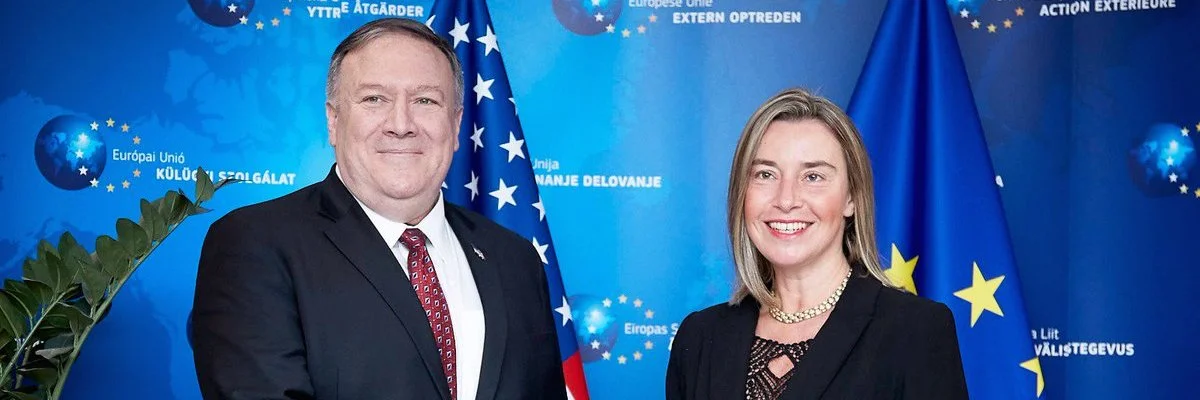
Pompeo to Visit Brussels as Europe Meets on Iran
◢ US Secretary of State Mike Pompeo will visit Brussels on Monday to discuss "pressing matters" including the Iran nuclear deal, as the European signatories to the accord meet for talks on how to prevent its collapse. The EU reiterated its determination to save the 2015 agreement to curb Tehran's nuclear ambitions in return for sanctions relief, as tensions between the US and Iran rack up.
By Damon Wake in Brussels
US Secretary of State Mike Pompeo will visit Brussels on Monday to discuss "pressing matters" including the Iran nuclear deal, as the European signatories to the accord meet for talks on how to prevent its collapse.
The EU reiterated its determination to save the 2015 agreement to curb Tehran's nuclear ambitions in return for sanctions relief, as tensions between the US and Iran rack up.
Iran last week announced it was suspending some of its commitments under the agreement, a year after US President Donald Trump withdrew from the accord and imposed swingeing sanctions on the Islamic republic—putting the deal in grave peril.
Adding a military dimension to the diplomatic tensions, Washington is sending an amphibious assault ship and a Patriot missile battery to the Gulf, having already deployed an aircraft carrier and B-52 bombers.
The European Union's diplomatic chief Federica Mogherini stressed the need for dialogue as "the only and the best way to address differences and avoid escalation" in the region, as she arrived for a scheduled meeting of the bloc's foreign ministers.
"We continue to fully support the nuclear deal with Iran, its full implementation," Mogherini said.
"It has been and continues to be for us a key element of the non-proliferation architecture both globally and in the region."
Alongside the meeting of all 28 foreign ministers, the representatives of Britain, France and Germany—the three European signatories—will meet Mogherini to discuss how to keep the deal going.
"We in Europe agree that this agreement is necessary for our security. No-one wants Iran to come into possession of a nuclear bomb," German Foreign Minister Heiko Maas said as he arrived.
"That is why we will continue to support the implementation of this agreement."
Few details of Pompeo's agenda in Brussels have been announced, beyond the State Department saying talks would be held with officials from France, the UK and Germany.
Mogherini gave a chilly response to news of Pompeo's visit, which she said was only communicated to Brussels at the last minute.
"We'll be here all day with a busy agenda so we'll see during the day how and if we manage to arrange a meeting," she told reporters.
President Hassan Rouhani issued an ultimatum to the Europeans last week, threatening that Iran would go further if they fail to deliver sanctions relief to counterbalance Trump's renewed assault on the Iranian economy within 60 days.
The European powers rejected that ultimatum.
The US has continued to build pressure on Iran, with Pompeo accusing Tehran of planning "imminent" attacks and bolstering the military presence in the Gulf.
Pompeo's visit to Brussels means he is scrapping a stop expected on Monday in Moscow.
But he will still head to the Russian Black Sea resort of Sochi on Tuesday to meet President Vladimir Putin and Foreign Minister Sergei Lavrov, a State Department official added just before Pompeo left Washington.
In recent days, Pompeo has already cancelled trips to Berlin and to Greenland to focus on the Iran issue.
Photo: EEAS
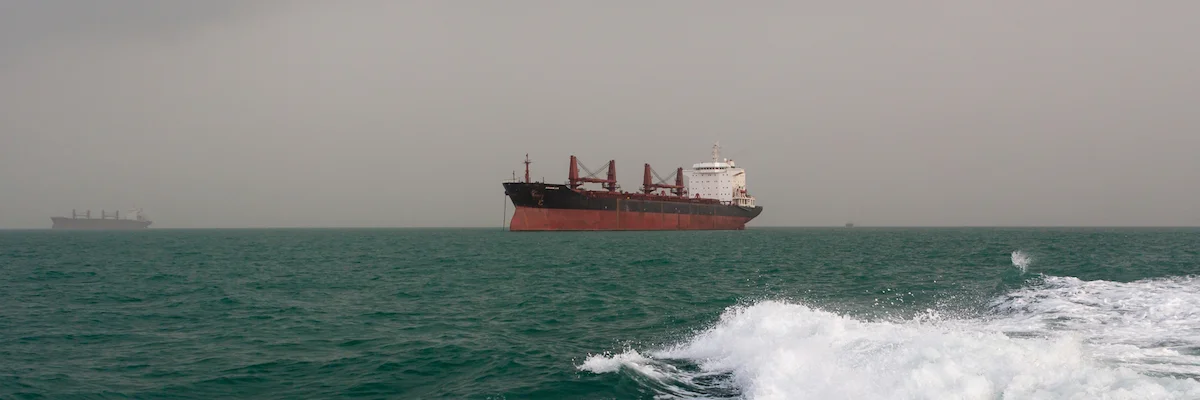
Iran Calls Ship Attacks off UAE 'Alarming', Urges Probe
◢ Iran on Monday called attacks on ships in the Gulf "alarming", after the UAE and Saudi Arabia said several vessels including oil tankers were damaged in acts of sabotage off the Emirati coast. "The incidents in the Sea of Oman are alarming and regrettable," Iranian foreign ministry spokesman Abbas Mousavi said in an English-language statement on the ministry's website.
Iran on Monday called attacks on ships in the Gulf "alarming", after the UAE and Saudi Arabia said several vessels including oil tankers were damaged in acts of sabotage off the Emirati coast.
"The incidents in the Sea of Oman are alarming and regrettable," Iranian foreign ministry spokesman Abbas Mousavi said in an English-language statement on the ministry's website, calling for a probe into the attacks and warning of "adventurism" by foreign players to disrupt maritime security.
On Sunday, the United Arab Emirates said that four commercial vessels of various nationalities had been targeted by acts of sabotage off the UAE port of Fujairah.
Saudi Arabia early Monday said two of its oil tankers were damaged.
Fujairah port is the only terminal in the UAE located on the Arabian Sea coast, bypassing the Strait of Hormuz, a global shipping route through which most Gulf oil exports pass, and which Iran has repeatedly threatened to close in case of a military confrontation with the United States.
The incident comes amid rising tensions between Iran and the United States which has strengthened its military presence in the region, including deploying a number of strategic B-52 bombers in response to alleged threats from Tehran.
It also comes as US Secretary of State Mike Pompeo scrapped a stop Monday in Moscow to visit Brussels instead for talks with European officials on Iran.
Mousavi "called for clarifications" concerning the "exact dimensions" of Sunday's attacks on ships in the Gulf, the foreign ministry's statement said.
He said such incidents would have a "negative impact... on shipping safety and maritime security" in the Gulf.
He also "warned against plots by ill-wishers to disrupt regional security" and "called for the vigilance of regional states in the face of any adventurism by foreign elements", the statement added.
Photo: Depositphoto
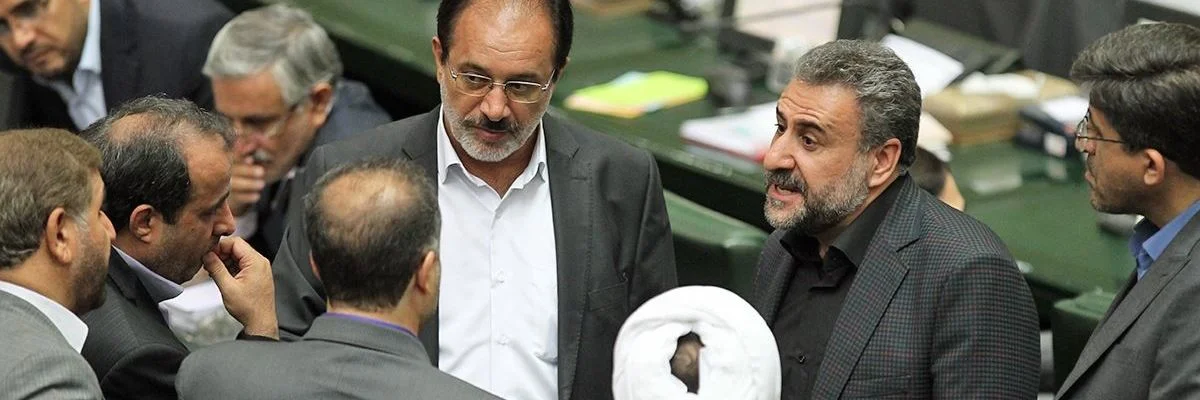
Iran Tells Trump: Don't Wait for Us to Pick Up the Phone
◢ Iranian officials rebuffed President Donald Trump’s suggestion that they call him to try to defuse frictions as the U.S. ratcheted up its actions against Tehran. Several top Iranian aides and lawmakers predicted Sunday that the current tensions wouldn’t lead to war, calling the U.S. deployment of an aircraft carrier, warship, bomber jets and missile defenses to the Middle East a propaganda stunt.
By Golnar Motevalli in Tehran
Iranian officials rebuffed President Donald Trump’s suggestion that they call him to try to defuse frictions as the U.S. ratcheted up its actions against Tehran.
Several top Iranian aides and lawmakers predicted Sunday that the current tensions wouldn’t lead to war, calling the U.S. deployment of an aircraft carrier, warship, bomber jets and missile defenses to the Middle East a propaganda stunt. Antagonism between the countries, already high, has worsened this month since Trump eliminated exceptions to U.S. sanctions on Iranian oil. The Islamic Republic responded by threatening to scale back its obligations under the 2015 nuclear deal.
“Trump has not only shown that he has no respect for the signature of the previous U.S. government but that he’s willing to violate UN Security Council resolutions and other international agreements,” said Kamal Kharazi, the head of a council that advises Supreme Leader Ayatollah Ali Khamenei, according to the Islamic Students’ News Agency.
Hours earlier, U.S. Secretary of State Mike Pompeo repeated Trump’s offer to chat to try to sort out differences. The U.S. has claimed, with no details, that Iran has been mobilizing proxies in Iraq and Syria to attack its forces, and its new deployments have stirred talk of war.
“The Americans know that no other war will bring about their defeat to such an extent and that’s why there won’t be a war, because war is not part of the U.S. strategy,” Heshmatollah Falahatpisheh, the head of Iran’s parliamentary commission for national security and foreign affairs, said in a speech before lawmakers, according to ISNA.
“Nobody is going to call Trump, and eventually the Americans will be forced to raise the issue of negotiations with Iran in a serious way,” he added.
Trump has made confronting Iran the linchpin of his Middle East policy, and his withdrawal from the nuclear deal and reimposition of sanctions meant to choke off Iranian oil exports and access to international banks has pounded the Islamic Republic’s economy. Tehran responded to the U.S. removal of sanctions waivers and the new military deployments by threatening to stop abiding by the nuclear deal’s limitations on uranium enrichment if Europe doesn’t remove obstacles to foreign investment into Iran and ease the flow of Iranian oil within 60 days.
While Iran has always denied its nuclear program had a military component, its uranium enrichment activities had been controversial because Western powers said it could potentially be used in bombmaking, so the threat to abandon limits drew another round of U.S. sanctions, this time on Iranian metals.
Kharazi said Europe could show its willingness to keep the nuclear accord alive by making a trade channel for Iran operational. But the economic sanctions Trump imposed last year have made it tough, if not impossible, for European companies and banks to risk defying the U.S. and getting caught in its sanctions net.
Photo: IRNA
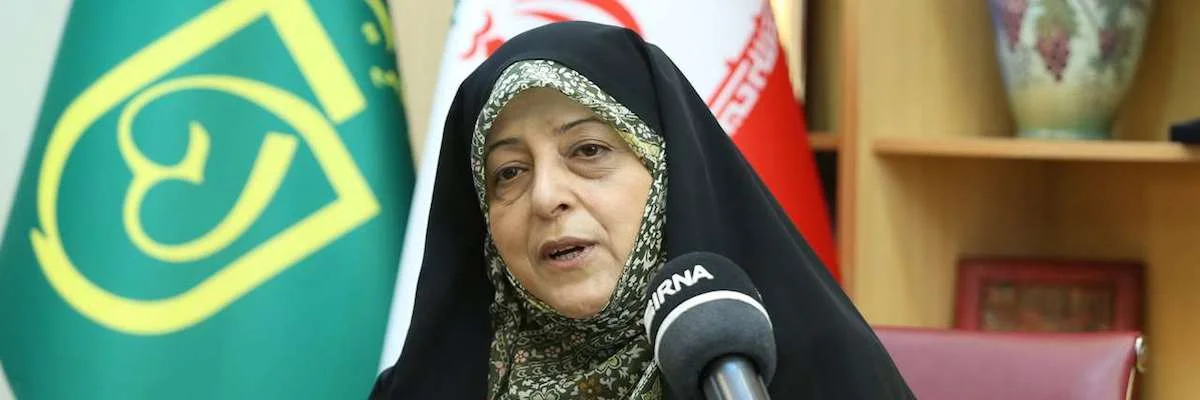
Iran Parliament Upholds Women's Rights in Citizenship Debate
◢ Iran’s parliament struck a blow for women’s rights by overwhelmingly voting to confer citizenship on children born to an Iranian mother and foreign father. Such a law would represent a significant development for women’s rights in Iran, with possible implications for the wider region, where many countries don’t give women the right to pass on citizenship to their children if the father is a foreign national.
Iran’s parliament struck a blow for women’s rights by overwhelmingly voting to confer citizenship on children born to an Iranian mother and foreign father.
Currently, children of “mixed marriages” are only eligible for citizenship if their Iranian parent is a man. If the decision is approved by the Guardian Council, a powerful body of senior clerics and judges, then the offspring of mixed marriages would be eligible for citizenship, regardless of whether their mother or father is the Iranian national.
The parliamentary vote was reported Sunday by state-run Islamic Republic News Agency.
Such a law would represent a significant development for women’s rights in Iran, with possible implications for the wider region, where many countries don’t give women the right to pass on citizenship to their children if the father is a foreign national.
It would also give tens of thousands of children access to social and health care services.
Iran’s vice president for women’s and family affairs said the current legislation, dating back to 1934, was written at a time “when women were considered chattel.”
“Today, when women have gained dignity, respect and a high level of education and status in the country, on the basis of what logic are we depriving a woman the right to transfer the citizenship that’s in her blood on to her child?” Masoumeh Ebtekar said, according to IRNA.
Photo: IRNA
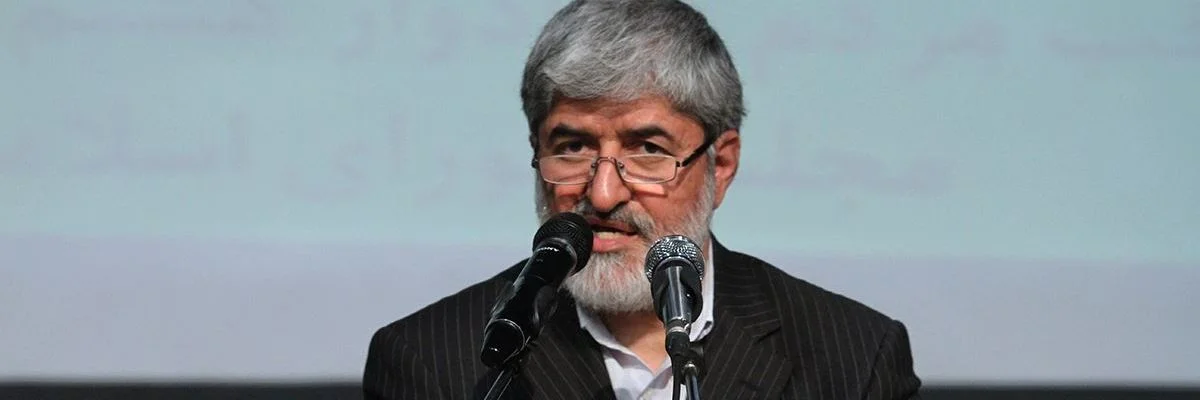
Tehran Lawmaker Says Move on Nuclear Curbs Shows Iran 'Not Weak'
◢ Iran's move to stop respecting some of the agreed limits on its nuclear activities showed it is "not in a position of weakness", a deputy speaker of the Islamic republic's parliament said Sunday. “The timely decision of the Islamic republic regarding its commitments in the (nuclear deal) showed that Iran is not in a position of weakness," said Ali Mottahari, according to the official IRNA news agency.
Iran's move to stop respecting some of the agreed limits on its nuclear activities showed it is "not in a position of weakness", a deputy speaker of the Islamic republic's parliament said Sunday.
“The timely decision of the Islamic republic regarding its commitments in the (nuclear deal) showed that Iran is not in a position of weakness," said Ali Mottahari, according to the official IRNA news agency.
Tehran announced Wednesday that it would stop respecting some of the curbs on its nuclear activities imposed under the landmark 2015 deal with world powers.
The announcement came exactly a year after the US withdrew from the deal, known as the Joint Comprehensive Plan of Action (JCPOA), with further measures threatened if the agreement's other signatories fail to mitigate the impact of renewed American sanctions within 60 days.
The sweeping sanctions have dealt a severe blow to the Iranian economy.
Mottahari's comments came a day after President Hassan Rouhani called for unity among Iranian political factions during a time of heightened tensions with the United States.
Rouhani said Iran was facing "an all-out war unprecedented in the history
of the Islamic republic.”
Iran's situation could be worse than during the 1980-1988 Iran-Iraq war, he said according to the government's official website.
"In the war we didn't have any banking, sales of oil and import-export problems and the only sanctions against us were arms embargoes," he said, during what was billed as an informal meeting with members of different political groups and parties.
The administration of US President Donald Trump has ratcheted up pressure on Iran in recent days over alleged threats from Tehran.
Washington said on Saturday it was deploying an amphibious assault ship and a Patriot missile battery to bolster an aircraft carrier and B-52 bombers already sent to the Gulf.
Photo: IRNA
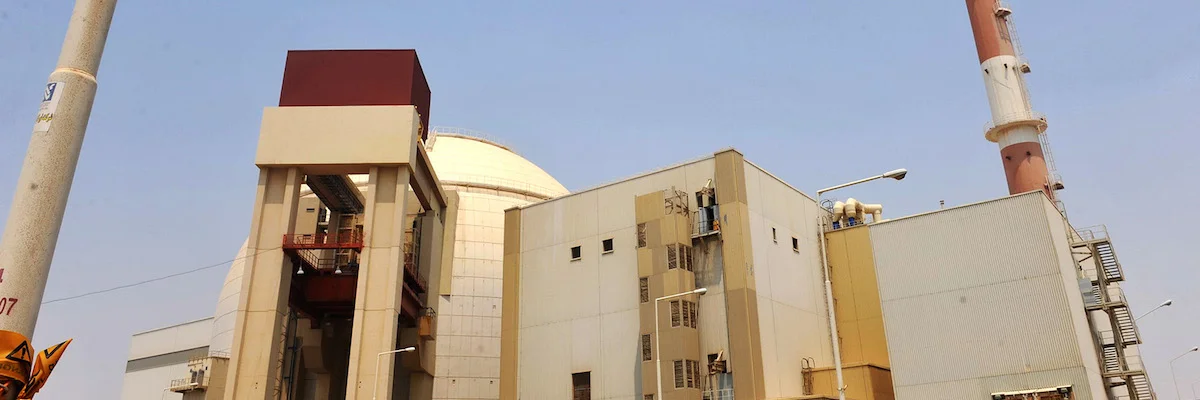
Iran Snap Nuclear Inspections Jump as Tensions With U.S. Rise
◢ Snap inspections at Iranian nuclear facilities jumped last year, underscoring the wide-reaching ability of international monitors to access potential sites that could feed clandestine research. The finding was included in the International Atomic Energy Agency’s latest Safeguards Implementation Report, which is circulating among nuclear-security officials as the specter of another Middle Eastern conflict rises.
Snap inspections at Iranian nuclear facilities jumped last year, underscoring the wide-reaching ability of international monitors to access potential sites that could feed clandestine research.
The finding was included in the International Atomic Energy Agency’s latest Safeguards Implementation Report, which is circulating among nuclear-security officials as the specter of another Middle Eastern conflict rises. Europe in particular has found itself squeezed between hostile governments in Washington and Tehran after the U.S. left the nuclear deal and slapped sanctions on Iran.
According to a copy of the restricted report published this week and obtained by Bloomberg News, inspectors deployed in Iran conducted a record number of so-called complementary accesses for a third year running in 2018. Almost 400 inspectors spent some 1,867 person-days combing Iranian sites and triggered more than three surprise visits a month.
“These snap inspections are a reflection of the concern, particularly among Europeans, that Iran would ramp up nuclear work in a clandestine fashion after the U.S. left the nuclear deal,” said Ellie Geranmayeh, a senior fellow at the European Council on Foreign Relations.
Iran on Wednesday warned that it would abandon some elements of the 2015 accord if European nations failed to come up with ways to protect banking and oil business within 60 days. A day later the U.S., which left the agreement a year ago and is sending a carrier strike force to the Persian Gulf, piled on more penalties.
The escalation is disconcerting to non-proliferation officials who see the so-called Joint Comprehensive Plan of Action between Iran and world powers as a model agreement, one that bestowed unprecedented powers and access to international monitors.
The agreement “amounts to the most robust verification system in existence anywhere in the world,” IAEA Director General Yukiya Amano said last month in Washington after meeting with U.S. officials.
Since the deal came into force in January 2016, IAEA inspectors have issued 14-straight reports showing that Iran has remained within the parameters of the deal.
That could change during the third quarter, after the U.S. revoked two waivers that permitted Iran to ship out enriched uranium and heavy water. Delivering his response to a year of U.S. pressure, Iranian President Hassan Rouhani said Wednesday that recent enriched-uranium stockpiles would exceed limits if the country isn’t allowed to send its inventories of the heavy metal overseas.
Four years of IAEA verification, amounting to more than 8,000 inspection days and more than 100 snap inspections, have cost about 85.5 million euros ($96 million), or about three-fifths the cost of a single F-35 fighter jet made by Lockheed Martin Corp.
“We’re seeing the cost of keeping peace through this diplomatic accord far cheaper than the cost of a potential military confrontation,” according to Geranmayeh, who advises EU governments. “That’s something to consider for a cost conscious U.S. president that complains about ‘forever wars’. The cost of the deal is a drop in the ocean.”
Photo: Bloomberg

Trump Says 'Open to Talk' to Iran
◢ US President Donald Trump said Thursday that he is open to talks with the Iranian leadership, amid mounting tensions between Washington and Tehran. "What I would like to see with Iran, I would like to see them call me," Trump told reporters at the White House.
US President Donald Trump said Thursday that he is open to talks with the Iranian leadership, amid mounting tensions between Washington and Tehran.
"What I would like to see with Iran, I would like to see them call me," Trump told reporters at the White House.
"We don't want them to have nuclear weapons—not much to ask," he said.
The US president also launched an extraordinary attack on John Kerry, claiming that the former US secretary of state was in touch with Iranian leaders and had told them "not to call."
“John Kerry, he speaks to them a lot," Trump said. "He tells them not to call.
Trump claimed this was a violation of the Logan Act, which prohibits private US citizens from negotiating with foreign governments.
"Frankly, he should be prosecuted on that," he said.
"But they should call," Trump said. "If they do, we are open to talk to them.
The United States has deployed an aircraft carrier to the Gulf amid the rising tensions, but Trump said Washington was not looking for a conflict with Tehran.
"I want them to be strong and great, to have a great economy," Trump said, adding that "we can make a fair deal."
Prosecutions of US citizens under the Logan Act, which was enacted in 1799, are extremely rare.
Kerry, as secretary of state under president Barack Obama, was involved in negotiating the agreement aimed at curtailing Tehran's nuclear program.
The 2015 JCPOA, or Joint Comprehensive Plan of Action, between Iran and world powers including the EU offered sanctions relief to the Islamic republic for scaling back its nuclear program.
Trump pulled the United States out of the agreement in May of last year and reinstated unilateral economic sanctions.
On Wednesday, President Hassan Rouhani said Iran would no longer implement parts of the deal and threatened to go further if the remaining members of the pact failed to deliver sanctions relief to counterbalance Trump's renewed assault on the Iranian economy within 60 days.
A spokesman for Kerry condemned Trump's remarks as "theater."
"Everything President Trump said today is simply wrong, end of story," the spokesman said in a statement.
"He's wrong about the facts, wrong about the law, and sadly he's been wrong about how to use diplomacy to keep America safe.
"Secretary Kerry helped negotiate a nuclear agreement that worked to solve an intractable problem," the statement said. "The world supported it then and supports it still.
"We'd hope the President would focus on solving foreign policy problems for America instead of attacking his predecessors for theater."
Photo: Wikicommons
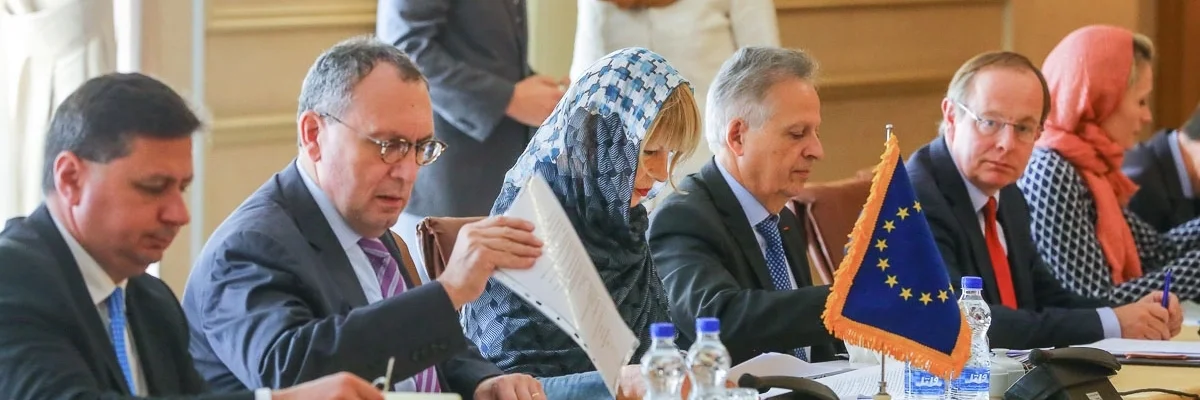
Stuck Between U.S. and Iran, EU Is Running Out of Options
◢ No one spelled out Europe’s predicament over the escalating stand-off between the U.S. and Iran quite as bluntly as Russia. It’s up to “the Europeans, who committed to find a solution to the problem created by the Americans, to fulfill their promise,’’ said Foreign Minister Sergei Lavrov, during a joint news conference in Moscow with his Iranian opposite, Mohammad Zarif.
No one spelled out Europe’s predicament over the escalating stand-off between the U.S. and Iran quite as bluntly as Russia.
It’s up to “the Europeans, who committed to find a solution to the problem created by the Americans, to fulfill their promise,’’ said Foreign Minister Sergei Lavrov, during a joint news conference in Moscow with his Iranian opposite, Mohammad Zarif.
That won’t be easy, because after a year of casting around for ways to enable companies to safely circumvent U.S. sanctions to trade with and invest in Iran, Europe has come up empty. That is unlikely to change in the next 60 days, in which case the 2015 nuclear deal with Iran could be headed for a slow death.
Europe again found itself squeezed between hostile governments in Washington and Tehran on Wednesday, when President Hassan Rouhani threatened to abandon some of the limits to its controversial nuclear fuel program that Iran agreed to in 2015, in exchange for the lifting of international sanctions.
‘Hasn’t Delivered’
Iran’s beef is with the U.S., which withdrew from the agreement last year. And it’s likely to continue getting support from Russia and China, which in the past have continued to do business in Iran and buy its oil, despite U.S. sanctions.
But it was to Europe that Rouhani delivered his ultimatum on Wednesday, demanding that it start countering the effects of mounting U.S. sanctions within 60 days, or see Iran start walking away from the deal, too.
“They’re giving the Europeans a last chance,’’ said Sir Richard Dalton, who served as Britain’s ambassador in Tehran from 2003 to 2006. “So far, Europe hasn’t delivered in a single one of the areas – transport, trade, investment, banking – where it promised Iran cooperation in 2018, when the U.S. pulled out.’’
Dalton described Rouhani’s announcement as carefully calibrated, so as not to immediately collapse the 2015 Joint Comprehensive Plan of Action, while at the same time persuading a domestic audience that the government was pushing back against U.S. economic pressure.
Iran’s economy contracted by 3.9 percent in 2018, and is forecast to shrink by a further 6 percent this year, according to the International Monetary Fund. The recent U.S. decision to end all waivers of sanctions against countries that buy Iranian oil exports is likely to exacerbate the country’s economic woes further.
‘Without Caveats’
France, Germany and Britain on Wednesday all recommitted to the 2015 deal, calling again for the U.S. to return to the agreement, while signaling that any Iranian backtracking would meet a response.
“We and our partners stand by this treaty, without any caveats — and we expect Iran to implement the treat in full as well, without caveats,’’ said Germany’s Foreign Minister Heiko Maas. The U.K.’s junior foreign minister, Mark Field, told Parliament the U.K. also stood by the deal, but said there would be “consequences” if Iran stopped meeting its nuclear commitments.
Europe’s thankless position isn’t new. It has been caught between hawkish policies in the U.S. and Iran ever since international inspectors first confirmed the existence of Iran’s secret nuclear fuel program, in 2003.
Uncomfortable Deja Vu
Still bruised from the U.S. decision to invade Iraq just months earlier, France, Germany and Britain took on the task of negotiating a solution with Tehran that the U.S. could accept. Their aim was to avoid a repeat of the Iraq war, and of the deep rifts that it caused within Europe as governments were forced to choose whether to back or oppose U.S. policy. Unlike the U.S., European nations also had significant economic interests to lose.
Iran’s ultimatum, together with the recent U.S. deployment of an aircraft carrier group and B-52 bombers to the Gulf, suggest those risks are back.
U.S. Secretary of State Michael Pompeo canceled a meeting with German Chancellor Angela Merkel to visit Baghdad on Tuesday where he told Iraqi leaders the threat from Iran is growing. He told the Daily Telegraph that he’d received intelligence “that suggested it was a good time for me to go."
Europe’s governments are probably in a weaker position to push back against U.S. foreign policy choices than they were in the lead-up to the Iraq war, when France, Germany and a number of others joined with Russia to forcefully oppose the Iraq invasion.
Secondary Sanctions
That’s in part because Washington has since developed the use of secondary sanctions against non-U.S. companies into a powerful deterrent. The U.S. fined France’s BNP Paribas SA USD 8.9 billion in 2015, for busting its sanctions on Iran, Cuba and Sudan. Last month, the German unit of UniCredit SpA agreed to pay USD 1.3 billion for busting U.S. sanctions on Iran. Companies, and governments, have become cautious.
The EU is setting up a special purpose vehicle to help European companies safely finance the export of goods to Iran. Even this limited vehicle, however, known as the Instrument in Support of Trade Exchanges, has yet to start work. It would in any case do little or nothing to aid investment or trade in the wider Iranian economy.
Europe’s troubles aren’t only with the U.S. In what could be seen as a veiled threat, Rouhani also talked Wednesday about the role Iran plays in reducing the flow of drugs and refugees to Europe. Iran hosts about 1 million registered refugees from Afghanistan, and as many as 1.5 million more who are unregistered.
At the same time, the non-financial stakes for Europe in defying the U.S. on Iran may also have risen in recent years. President Donald Trump has made it clear his government sees both support for Europe’s defense in the North Atlantic Treaty Organization, and trans-Atlantic trade as negotiable in ways that no U.S. president has before.
“The underlying issue,’’ said Dalton, the former U.K. ambassador, “is whether Europe remains a sovereign force.’’
Photo: Bloomberg