
Syria and Iran Sign 'Strategic' Economic Agreement
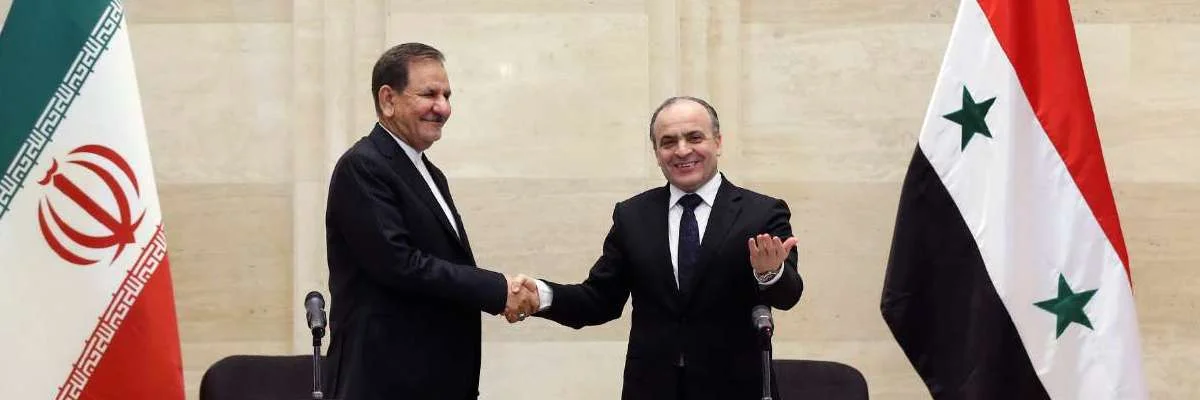
◢ Syria and Iran signed 11 agreements and memoranda of understanding late Monday, including a "long-term strategic economic cooperation" deal aimed at strengthening cooperation between Damascus and one of its key allies in the civil war that has torn the country apart. The agreements covered a range of fields including economy, culture, education, infrastructure, investment and housing, the official Sana news agency reported.
Syria and Iran signed 11 agreements and memoranda of understanding late Monday, including a "long-term strategic economic cooperation" deal aimed at strengthening cooperation between Damascus and one of its key allies in the civil war that has torn the country apart.
The agreements covered a range of fields including economy, culture, education, infrastructure, investment and housing, the official Sana news agency reported.
They were signed during a visit to Damascus by Iran's First Vice President Eshaq Jahangiri.
Syrian Prime Minister Imad Khamis said it was "a message to the world on the reality of Syrian-Iranian cooperation", citing "legal and administrative facilities" to benefit Iranian companies wishing to invest in Syria and contribute "effectively to reconstruction".
The agreements included two memos of understanding between the railway authorities of the two countries as well as between their respective investment promotion authorities.
In relation to infrastructure, there was also rehabilitation of the ports of Tartus and Latakia as well as construction of a 540 megawatt energy plant, according to Khamis.
In addition there were "dozens of projects in the oil sector and agriculture", he added.
The civil war has taken an enormous toll on the Syrian economy and infrastructure, with the cost of war-related destruction estimated by the UN at about USD 400 billion.
Iran will stand "alongside Syria during the next phase that will be marked by reconstruction", Jahangiri promised.
Iran and Syria had already signed a military cooperation agreement in August while Tehran has supported Damascus economically during the conflict through oil deliveries and several lines of credit.
The new agreements come against the backdrop of fresh US sanctions against Iran, while Syrian President Bashar al-Assad's regime and several Syrian businesspeople and companies are already on US and European blacklists.
They also come as Israel has repeatedly pledged to keep arch-foe Iran from entrenching itself militarily in Syria, where the war has already claimed more than 360,000 lives and displaced several million people.
Photo Credit: IRNA
Eyeing Reconstruction, Russia, Iran Take Centre Stage at Syria Expo
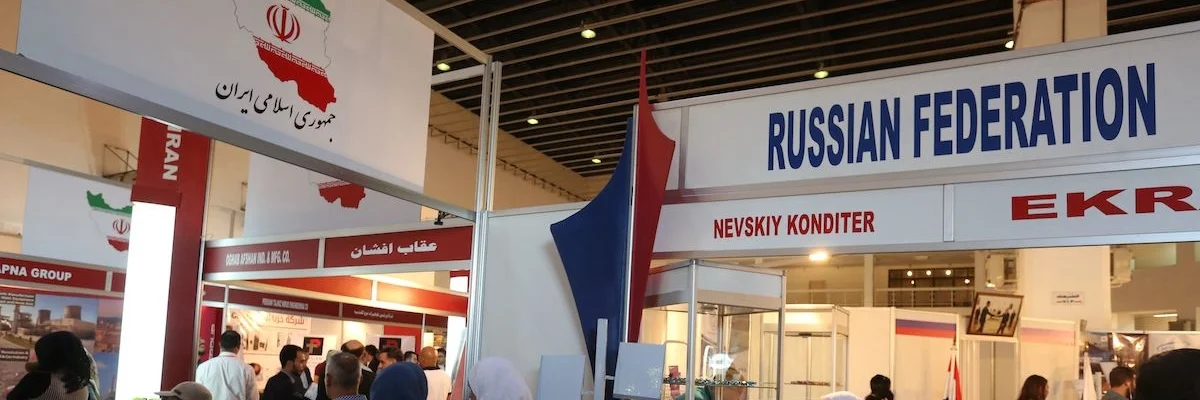
◢ Companies from dozens of countries are showing their wares at the Damascus International Fair this week, but those from two in particular are getting special treatment—Russia and Iran. Firms from the top two wartime allies of Syria's government are set up in an entirely separate building, hinting at the preferred status they hope to enjoy as the country tries to transition into reconstruction.
Companies from dozens of countries are showing their wares at the Damascus International Fair this week, but those from two in particular are getting special treatment—Russia and Iran.
Firms from the top two wartime allies of Syria's government are set up in an entirely separate building, hinting at the preferred status they hope to enjoy as the country tries to transition into reconstruction.
Packed pavilions feature Iranian cars and carpets, Russian wires and cables—and translators ready to help Syrian businessmen connect with potential foreign partners.
A flatscreen television in the Russian wing plays a sleek advertisement for Libena Agro Build, a metalworking company that produces farming equipment and grain silos.
“Foreign companies are scrambling and competing to invest in Syria, but Russia's got preference," says its regional representative, Lebanese-Russian national Leba Shehadeh.
"We were the ones defending Syria politically and militarily, so we expect the lion's share of the economy and of the reconstruction phase."
He flips through a pamphlet of irrigation products, metal recycling services, moulds, and more.
"Syria needs all this equipment," Shehadeh tells AFP, saying Libena Agro was aiming for large-scale deals with Damascus.
"We're here so that, together, we can draw the plan for rebuilding this country."
Seven years since war first broke out, President Bashar al-Assad has managed to recapture around two-thirds of Syria, with help from both Tehran and Moscow.
Iranian "military advisers" and Tehran-backed militias have supported troops on the ground, and Russian warplanes have battered rebel targets from the sky for the past three years.
’Attractive for Investment'
But fighting has left Syria in ruins, with the United Nations saying
destruction has cost the country close to USD 400 billion.
Assad has pledged to make reconstruction his top priority, saying Syria's "allies" would be the only ones allowed to take part.
Even during war, Russian companies have invested in Syria's oil, gas and mining sectors and won contracts to build flour mills and water-pumping stations.
Syrian state companies have also issued tenders open exclusively to Iranian companies, according to the economic magazine Syria Report.
Just last month, Tehran and Damascus reached a deal for Iran to rehabilitate Syria's defense industry.
And on Friday, at the fair's opening, the Russian and Syrian ministries of industry inked a memorandum of understanding on future cooperation.
The Russian ministry had organized a delegation of investors to attend the fair, including representatives of Romax, a firm that produces storage silos and is involved in transportation and shipping.
“The Syrian market is attractive for investment," says its representative at the fair, Aron Levashov.
"We're finding a window, a gate for Russia towards the Mediterranean sea, and from there to Europe and Africa," he tells AFP, speaking in Russian through an interpreter.
He says Russia's "familiarity with the situation on the ground, the markets, the depth and scope of destruction" gave it a better understanding of Syria's economic needs.
"Russia proved herself with a show of force in the air, and it's continuing its political support. We should take advantage of the space afforded to us to crystalize our economic role," Levashov tells AFP.
'Like Brothers'
Companies from 25 countries, as well as officials from another 23 are taking part in the fair, Syrian state media said.
Around 50 Russian firms are being represented, and Iran has made an equally strong showing.
Mohammad Reza Khanzad, who runs the Iranian pavilion at the expo, says the wing "includes 50 Iranian companies, among them 32 firms specialising in reconstruction"—compared with 31 firms in total last year.
"The rest are in various industries like car production, homeware, programming, reconstruction materials, handmade carpets and agriculture," he says.
At a nearby table, Iranian businessman Mehdi Qawwam, 38, is smoothly pitching his construction firm Maskan Omran to three Syrian entrepreneurs in Farsi through a translator.
"After Syria's war, the market will need companies specialized in construction and will benefit from Iranians to rebuild an even stronger market," he says.
Dressed in a grey suit, Qawwam concludes his sit-down and tucks newly acquired business cards into his suitcase.
"We reached some preliminary agreements to facilitate the entry of Iranian goods exclusive to our company into Syria, and in the coming phases we'll have meetings in Tehran or Damascus to confirm those deals," he says.
Strolling through the expo, he waves to friends and rivals alike.
"Syria is one of the few countries that accepts our products in the wake of the US sanctions" reimposed by Washington last month, he says.
"These sanctions must not affect us, because the relationship between our two countries is like one between brothers."
Photo Credit: EPA