
Iran Says Ready for More US Prisoner Swaps
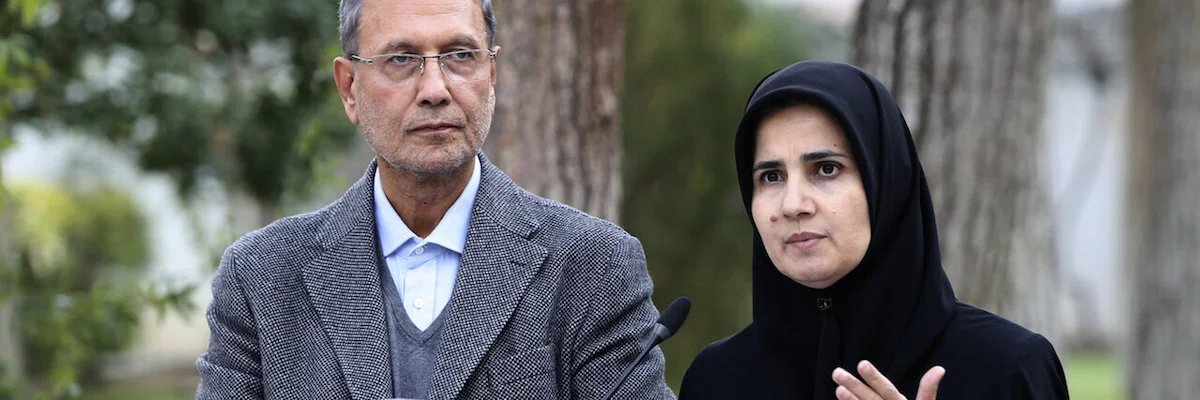
◢ Iran said Monday it was open to more prisoner swaps with the US while stressing an exchange at the weekend was not the result of formal negotiations with the Trump administration. "This was only an exchange and... regarding exchanges we are ready to act but there are no negotiations," spokesman Ali Rabiei said on state television.
Iran said Monday it was open to more prisoner swaps with the US while stressing an exchange at the weekend was not the result of formal negotiations with its arch-foe.
US President Donald Trump thanked Iran for what he called a "very fair negotiation" after an American scholar was released Saturday in exchange for an Iranian scientist held in the United States.
The exchange involved Xiyue Wang, a Chinese-born American held in Iran since 2016, and Massoud Soleimani, an Iranian scientist detained in the United States since 2018.
But Iran's government dismissed the idea that it was the result of any negotiations between the two countries, which have not had diplomatic ties since 1980.
"This was only an exchange and... regarding exchanges we are ready to act but there are no negotiations," spokesman Ali Rabiei said on state television.
"Negotiations or any kind of talks" can only take place "within the framework of the 5+1 and after America has refrained from sanctions and economic terrorism," he said.
The P5+1 is the group of countries that agreed a nuclear deal with Iran in 2015—the five veto-wielding permanent members of the UN Security Council plus Germany.
The nuclear deal has been hanging by a thread since last year, when Trump unilaterally withdrew from the accord and began reimposing sweeping sanctions on the Islamic republic.
Iran's government has long demanded that the US first drops the sanctions for it to return to negotiations under the auspices of the P5+1.
Wang, doctoral candidate at Princeton, was conducting research in Iran when he was imprisoned in August 2016. He had been serving 10 years on espionage charges.
Soleimani, a professor and stem cell researcher at Tehran's Tarbiat Modares University, was arrested at a Chicago airport in October 2018 for allegedly attempting to ship growth hormones.
On Monday, the Iranian spokesman Rabiei said the prisoner swap came despite a US rejection of an offer Tehran made to Washington last year for an exchange of all detainees.
A few months ago, he said, Iran had received a message from "a former US official" saying the Americans were ready to make an exchange.
Rabiei appeared to be referring to former US congressman Jim Slattery who, according to the New Yorker magazine, had approached the Iranians on behalf of the Wang family's lawyer.
In its report, the New Yorker said Soleimani was expected to be deported after pleading guilty under a deal that Slattery had worked on with Soleimani's lawyers.
"In a surprise move, however, the Justice Department instead dropped all charges against Soleimani," before the exchange went ahead, it said, citing an official from the US administration.
Photo: IRNA
Trump Thanks Tehran as American Freed in Prisoner Swap
◢ President Donald Trump thanked Tehran for a "very fair" negotiation Saturday after an American scholar detained in the country was released in exchange for an Iranian scientist held in the United States. Coming at a time of soaring tensions, the prisoner swap took place in neutral Switzerland.
By Elodie Cuzin
President Donald Trump had rare positive words for Iran on Saturday, thanking the US foe for a "very fair" negotiation to successfully pull off a prisoner swap that saw an American released from Iranian detention amid soaring tensions.
The exchange, which took place in neutral Switzerland, involved a Princeton graduate student jailed in Iran for espionage since 2016 and an Iranian national arrested over a year ago in Chicago.
"Thank you to Iran on a very fair negotiation," tweeted Trump, as Xiyue Wang made his way home to his family. The US leader was expected to welcome Wang in person when he arrives in the United States, after a stop in Germany for medical evaluations.
"It was a one-on-one hostage swap," Trump told reporters. "I think it was great to show than we can do something. It might have been a precursor as to what can be done."
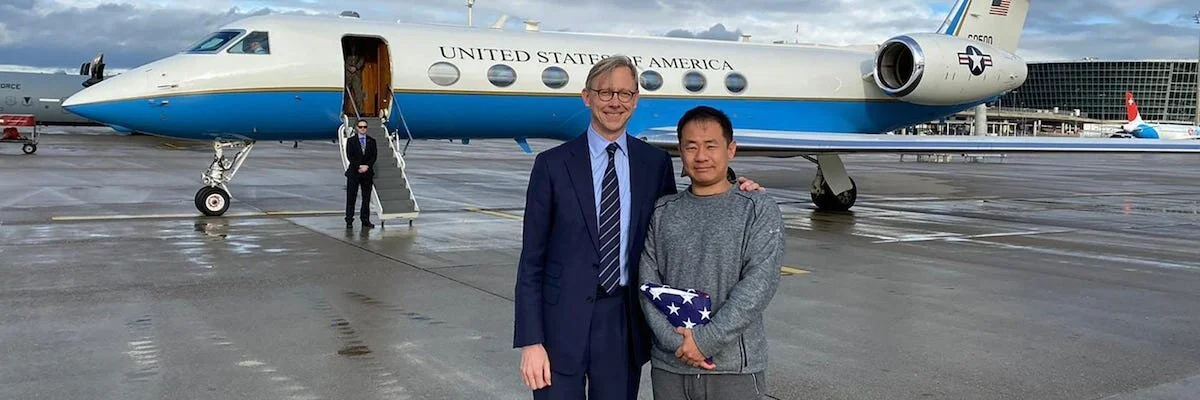
A photo tweeted by the American Embassy in Bern showed Wang on a rainswept tarmac in Zurich with an official blue and white US jet in the background, hugging Ambassador Edward McMullen.
The Chinese-born American was in apparent good health and in "very, very good humor," said a senior US administration official.
Tehran had announced the release of its national, Massoud Soleimani, shortly before Trump revealed that Wang was returning home.
"Glad that Professor Massoud Soleimani and Mr Xiyue Wang will be joining their families shortly," Iran's Foreign Minister Mohammad Javad Zarif tweeted—along with a photograph of himself and the scientist on a plane under the words "Going home."
"Many thanks to all engaged, particularly the Swiss government," which has looked after US interests in Iran in the absence of diplomatic ties, Zarif said.
The Swiss foreign ministry confirmed that the exchange—which it called a "humanitarian gesture"—took place on its territory. Both the US and Iran credited Switzerland with an intensive diplomatic effort to secure the men's release.
"Our country stands ready for further facilitation," the foreign ministry statement said.
‘Hopeful' Sign
The United States and Iran have not had diplomatic ties since 1980, and relations have sharply worsened since Trump withdrew from an international accord giving Iran sanctions relief in return for curbs on its nuclear program.
The arch-enemies came to the brink of military confrontation in June this year when Iran downed a US drone and Trump ordered retaliatory strikes before cancelling them at the last minute.
Secretary of State Mike Pompeo said the United States was "pleased that Tehran has been constructive in this matter."
Briefing reporters on condition of anonymity, the senior US official noted that Trump "remains committed to talks with Iran without preconditions" -- about Tehran's nuclear program, its "malign activities" in the Middle East, and the deadly mass protests that have gripped the country.
While Iran has so far rebuffed US offers of talks, the official said: "We're hopeful that the release of Mr Wang is a sign that the Iranians may be willing to come to the table to discuss all these issues."
The official also voiced hope that Wang's release signals "the Iranians are realizing that the practice of hostage-taking diplomacy really should come to an end."
A doctoral candidate at Princeton, Wang was conducting research for his dissertation on late 19th- and early 20th-century Eurasian history when he was imprisoned in August 2016. He was serving 10 years on espionage charges.
"He was not a spy, he was not involved in espionage and, and was wrongfully detained from the start," the US official said.
A statement on the Iranian judiciary's Mizan Online website said Wang had been "freed on Islamic clemency."
Soleimani, a professor and senior stem cell researcher at Tehran's Tarbiat Modares University, was arrested on arrival at an airport in Chicago in October 2018 for allegedly attempting to ship growth hormones, according to Iranian media.
The US official confirmed the Justice Department has dropped charges against Soleimani, calling the swap a "reciprocal humanitarian gesture" and a "very, very good deal for the United States."
"There's been absolutely no payments of cash or lifting of sanctions or any sort of concessions or ransom," the official said.
Spying Allegations
Rob Malley, president of the International Crisis Group consultancy, called it a "rare bit of good news on US-Iran front."
"But several other Americans remain unjustly detained in Iran and they should be released too," he cautioned. "They should not be used as pawns in the two countries' fraught relationship."
Foreign nationals still held in Iran include former US soldier Michael R. White, British-Iranian mother Nazanin Zaghari-Ratcliffe, French academic Roland Marchal and Australian university lecturer Kylie Moore-Gilbert.
Two other Australians, travel bloggers Jolie King and Mark Firkin, were released in October by Iran, in another apparent swap for Iranian student Reza Dehbashi.
In September, Negar Ghodskani, an Iranian woman sentenced in the United States for violating sanctions against Tehran was released and returned home after giving birth in custody.
An unknown number of Iranians are detained abroad.
Photo: U.S. Department of State